Identifying whether a piece of writing was generated by artificial intelligence (AI) or written by a human can be a complex task, especially as AI models have become increasingly sophisticated. However, there are certain indicators and techniques that can help distinguish between AI-generated and human-written content.
1. Style and Tone Consistency
One of the more subtle ways to identify AI-generated text is by analyzing the consistency of style and tone throughout the writing. While AI models have improved significantly, they may still struggle to maintain a consistent voice, especially in longer pieces. Human writers, on the other hand, tend to have a distinct style or tone that remains fairly consistent throughout a document, reflecting their personal voice, experiences, and emotions. For instance, a human writer might vary their tone based on the subject matter or the intended audience, while AI might apply a more uniform tone regardless of context.
2. Complexity and Nuance
Human writing often reflects a deep understanding of context, cultural references, and subtleties that AI may not fully grasp. Humans are more likely to incorporate metaphor, irony, humor, and nuanced opinions that are influenced by their unique experiences and perspectives. AI-generated content, while coherent and often informative, might lack this depth of insight. The AI might miss the implications of certain phrases or fail to capture the intricate details that a human writer might include, especially when dealing with complex topics.
3. Predictable Patterns
AI models, particularly those trained on vast amounts of text data, might generate content that follows certain predictable patterns. For example, AI-generated text might overuse specific phrases or structures, reflecting the most common patterns found in the training data. Human writers, however, are more likely to introduce variations, experiment with different sentence structures, or employ creative ways to convey their message. Additionally, AI might repeat certain themes or phrases within the same text, which can be a telltale sign of machine generation.
4. Errors and Imperfections
Ironically, the presence of minor errors, such as typos, grammatical mistakes, or awkward phrasing, might indicate human authorship. Human writers, even skilled ones, are prone to occasional mistakes that can slip through even after editing. In contrast, AI-generated text typically exhibits flawless grammar and spelling, though it might occasionally produce unnatural or awkward sentences. These odd phrasings are not errors in the traditional sense but can feel slightly off, which might suggest that the text was machine-generated.
5. Creativity and Originality
Human creativity often involves breaking the rules or combining ideas in unexpected ways. This can lead to original metaphors, unconventional viewpoints, or a narrative style that is uniquely human. AI, on the other hand, generates text based on patterns it has learned from existing data, which means its output can sometimes feel derivative or lacking in true originality. For example, an AI might generate a technically correct piece of writing, but it might lack the spark of creativity that a human writer could bring to the same topic.
6. Contextual Awareness
Human writers are generally aware of the broader context in which they are writing, such as current events, cultural trends, or the specific needs of their audience. This awareness allows them to craft content that is relevant, timely, and resonant with their readers. AI, while able to generate relevant text based on prompts, might not fully understand the current context or fail to address it appropriately. This can result in content that feels out of touch or misaligned with the intended audience.
7. Purpose and Intent
Human-written content often has a clear purpose or intent behind it, whether it’s to persuade, inform, entertain, or provoke thought. This intent is shaped by the writer’s motivations, experiences, and the specific message they wish to convey. AI-generated text, while capable of mimicking various writing styles, may lack the underlying intent that drives human writing. It might produce content that is technically accurate but feels mechanical or lacks the passion that a human writer would infuse into their work.
Conclusion
While AI-generated text can be remarkably convincing, there are still several indicators that can help distinguish it from human-written content. By paying attention to style consistency, complexity, predictability, errors, creativity, contextual awareness, and intent, one can often discern whether a piece of writing was crafted by a human or an AI. As AI continues to evolve, these distinctions may become more nuanced, but the unique qualities of human writing are likely to persist.
The last time I wrote to you, I was about to leave Nottingham for the next stop on my road trip holiday.
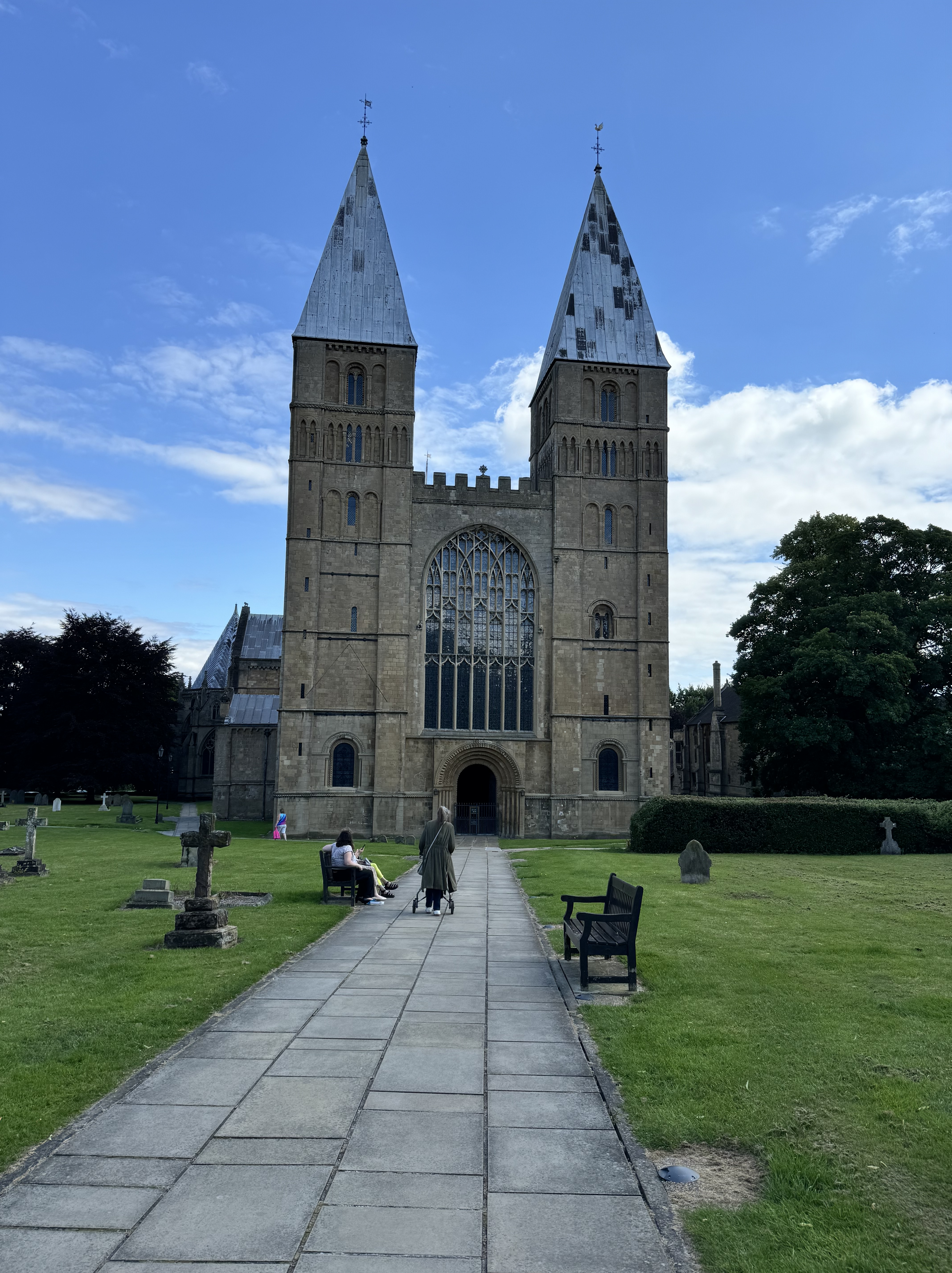
Before going away, I had read about Nottinghamshire in a book I had called I Never Knew That About England. The section on Southwell I found particularly interesting, with it being described as one of England’s least known cathedral towns. It turned out to be a perfectly easy stop on the way between Nottingham and Lincoln, so mum and I decided to go and explore.
The quite remarkable Southwell Minster. I didn’t have the patience to wait for the old lady with the walking frame to get out of the way.
Southwell is a small, pretty, well-looked-after town that is completely dominated by its magnificnet minster. Built in Roman times, it really needs to be seen to be believed.
The town is also famous for (and very proud of) being the birthplace of the Bramley apple. Mary Ann Brailsford, aged 9, planted some apple pips in her garden on the outskirts of Southwell in 1809. The resulting tree produced so much fruit that in 1856 the later owner of the house, Matthew Bramley, was asked if he would consider selling the apples. By 2007, 95% of total culinary apple orchards in England and Wales were Bramley apples. Mary Ann Brailsford probably never knew that the tree she planted had become so famous – when you think about it, we should really be making our apple pies with Brailsfords.
From Southwell, we drove on to Lincoln. This was my first time in Lincoln, but unlikely to be my last. With its castle and cathedral, I felt an immediate affinity with my beloved home city of Norwich. It doesn’t happen often, but Lincoln might actually beat Norwich for history – it still has a Roman archway that traffic passes through.
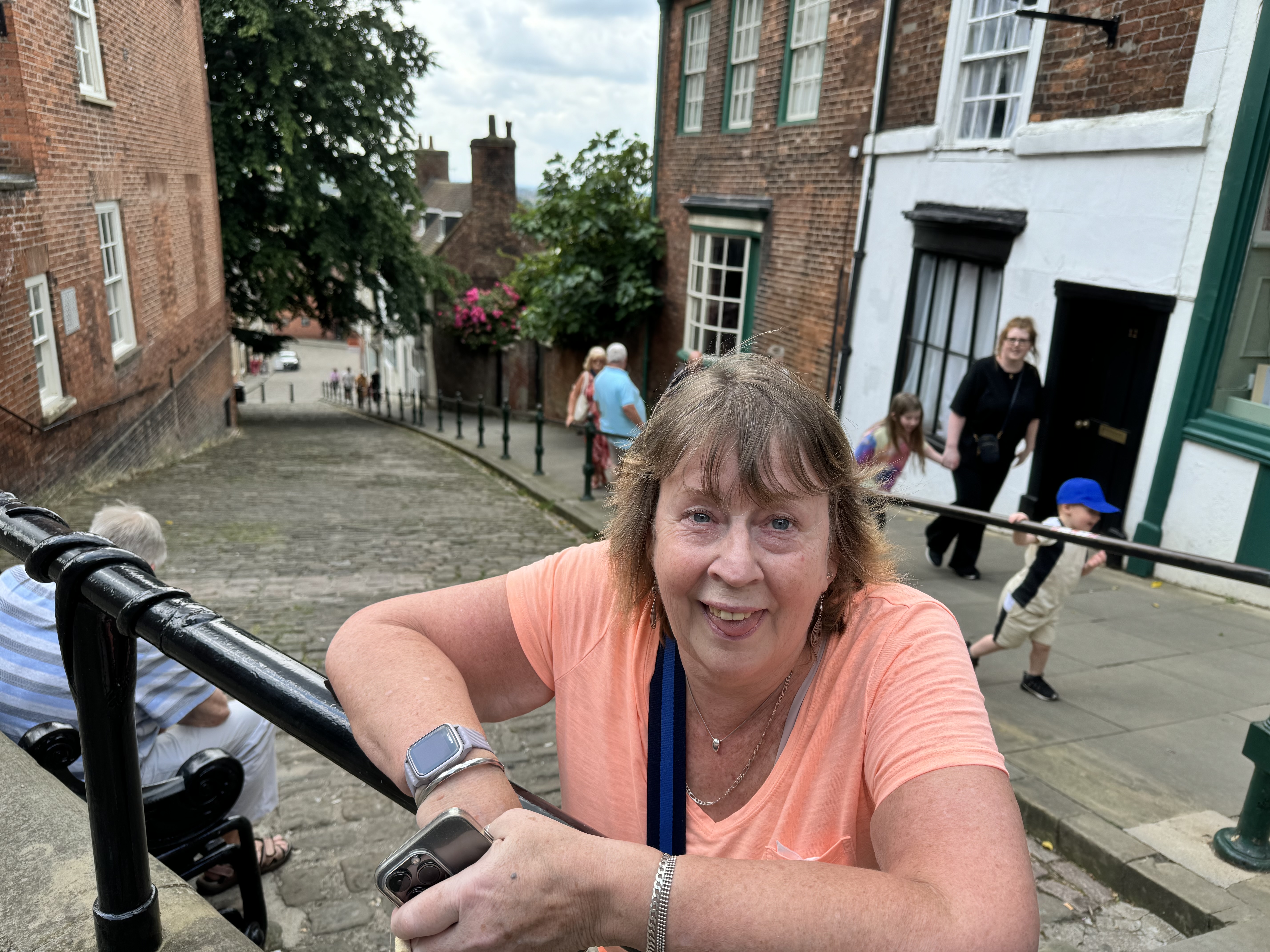
We had been warned about Steep Hill in Lincoln, possibly the most aptly named road in Britain. My dear mum, who is asthmatic, has a hernia and has just turned 60, surprised the both of us by managing to walk up this monster of a hill. Here she is at the top.
Mum at the top of Lincoln’s frankly ludicrous Steep Hill
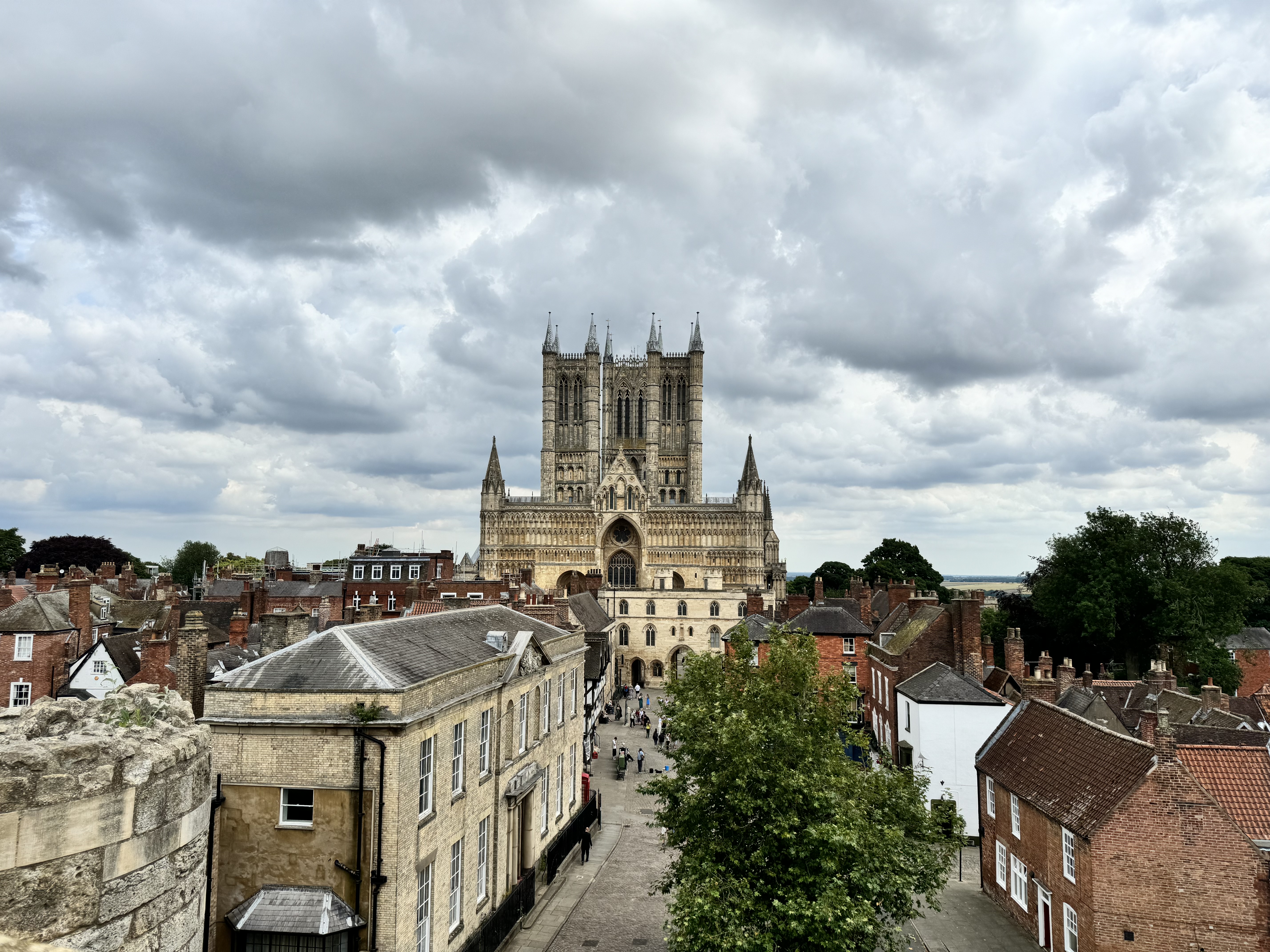
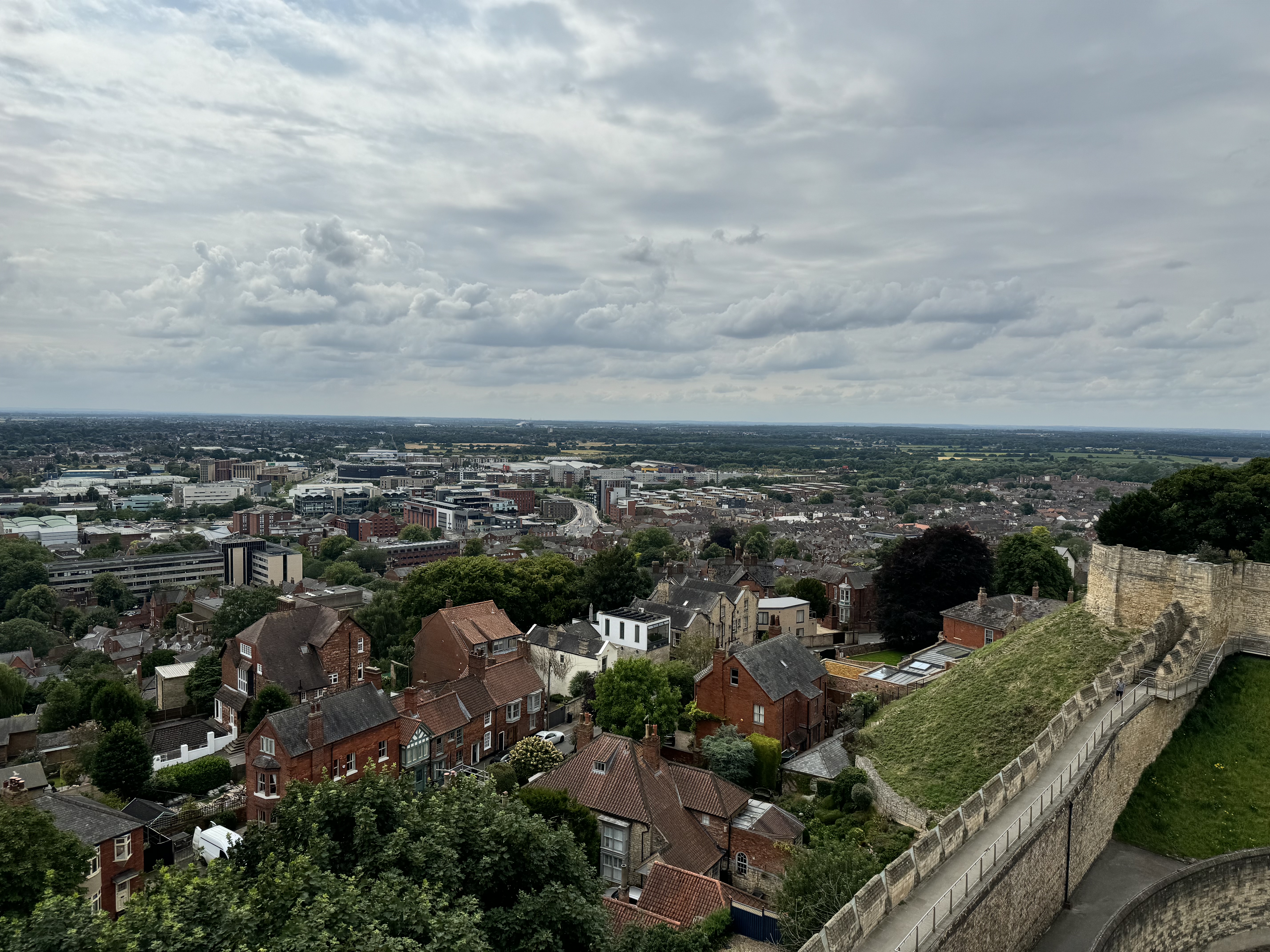
Steep Hill was well worth the climb though, as the Cathedral Quarter at the top is beautiful. We went into the grounds of the castle and paid to do the castle wall walk. You get to walk all the way along the top of the castle walls, a full circle, and it was well worth the £10 fee to do so. The views are simply spectacular, both of the cathedral opposite and the surrounding countryside.
The cathedral as seen from the castle walls.Overlooking Lincoln from the castle walls
We decided to come back on Thursday to do the cathedral. The only other thing we did in Lincoln on Wednesday was have the best waffle I’ve ever tasted at Madame Waffle. Seriously, if you are ever in Lincoln, go and have a waffle at Madame Waffle. I had one covered in Nutella and topped with fresh strawberries and I am wondering if I will ever taste anything like it again.
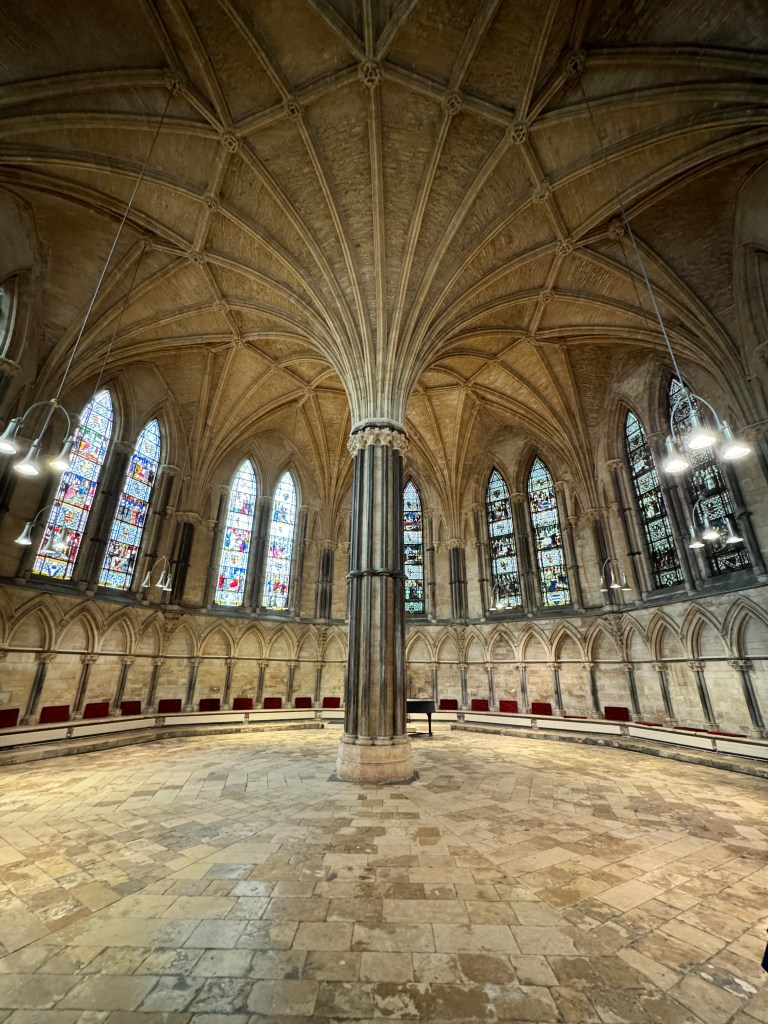
The nave of Lincoln Cathedral was off limits to the public on the day we visited because it was being used for the local university’s graduation ceremonies, but it meant we got in for a reduced rate and got to experiene the atmosphere of a cathedral filled with the sound of organ music. There was still plenty of the magnificent building worth seeing, including the Chapter House.
The Chapter House inside Lincoln Cathedral
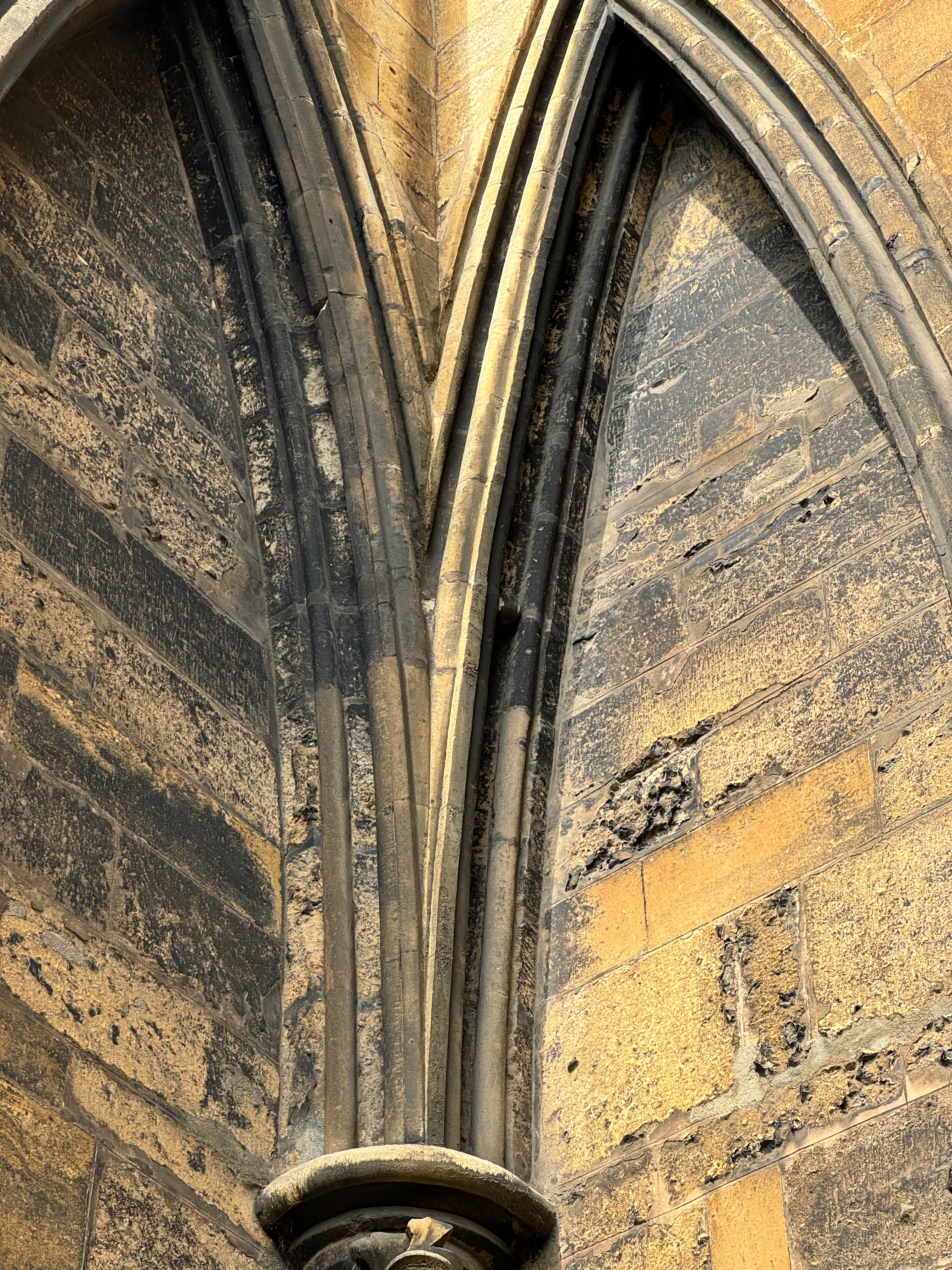
I had also read about a slightly more recent bit of quirky history to do with Lincoln cathedral. The story goes that a boy, Gilbert Bell, was playing with a tennis ball in the shadow of the cathedral, all the way back in 1914, when it unfortunately became stuck in the mouldings of the building. It was too high to even entertain the thought of climbing up to retrieve it. And there Gilbert’s tennis ball has remained! 110 years on, the tennis ball is still lodged in place – and I managed to find it!
Gilbert Bell’s tennis ball, lodged in the mouldings of Lincoln Cathedral since 1914
The final stop on the road trip was to Boston. Boston is famous for being the place a lot of the first pilgrims that travelled to the USA came from – and that is very much what the town shouts about. References to the pilgrims are everywhere – in statues, in street names, in pubs. I don’t want to be too negative about the place, but I can understand why the pilgrims were so keen to leave! Of course, the Boston in Massachusetts, USA takes its name from this Lincolnshire port.
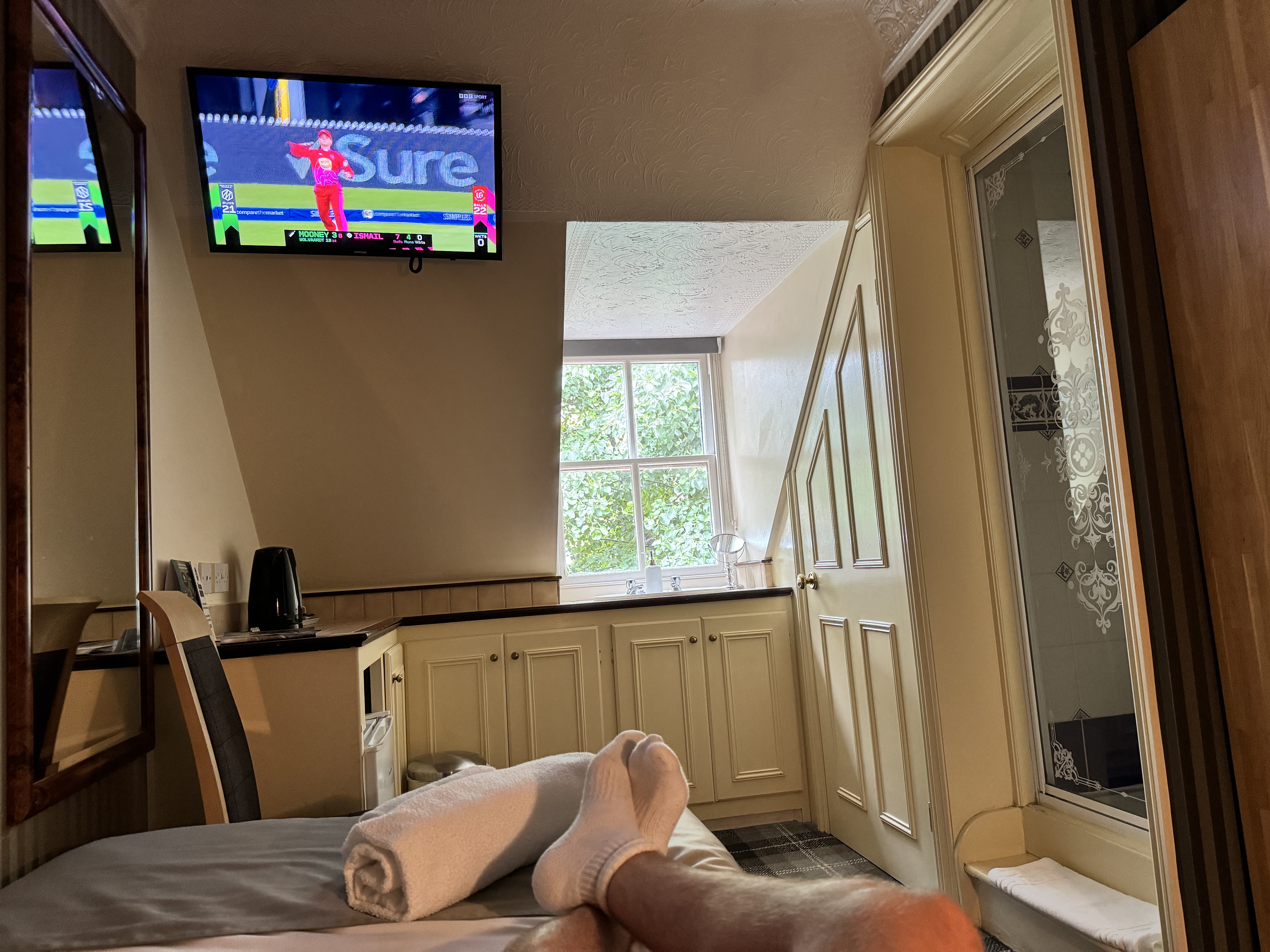
Yes, Boston is a little on the rough side these days. A lot of it needs regenerating, I was wary of the locals and I made sure I wasn’t still out after dark. But our accomodation, the Quayside Hotel, was a gem. Its owners were actually once winners on the Channel 4 show Four in a Bed. The rooms were small but had everything I could wish for.
Relaxing on my bed in the Quayside Hotel, Boston
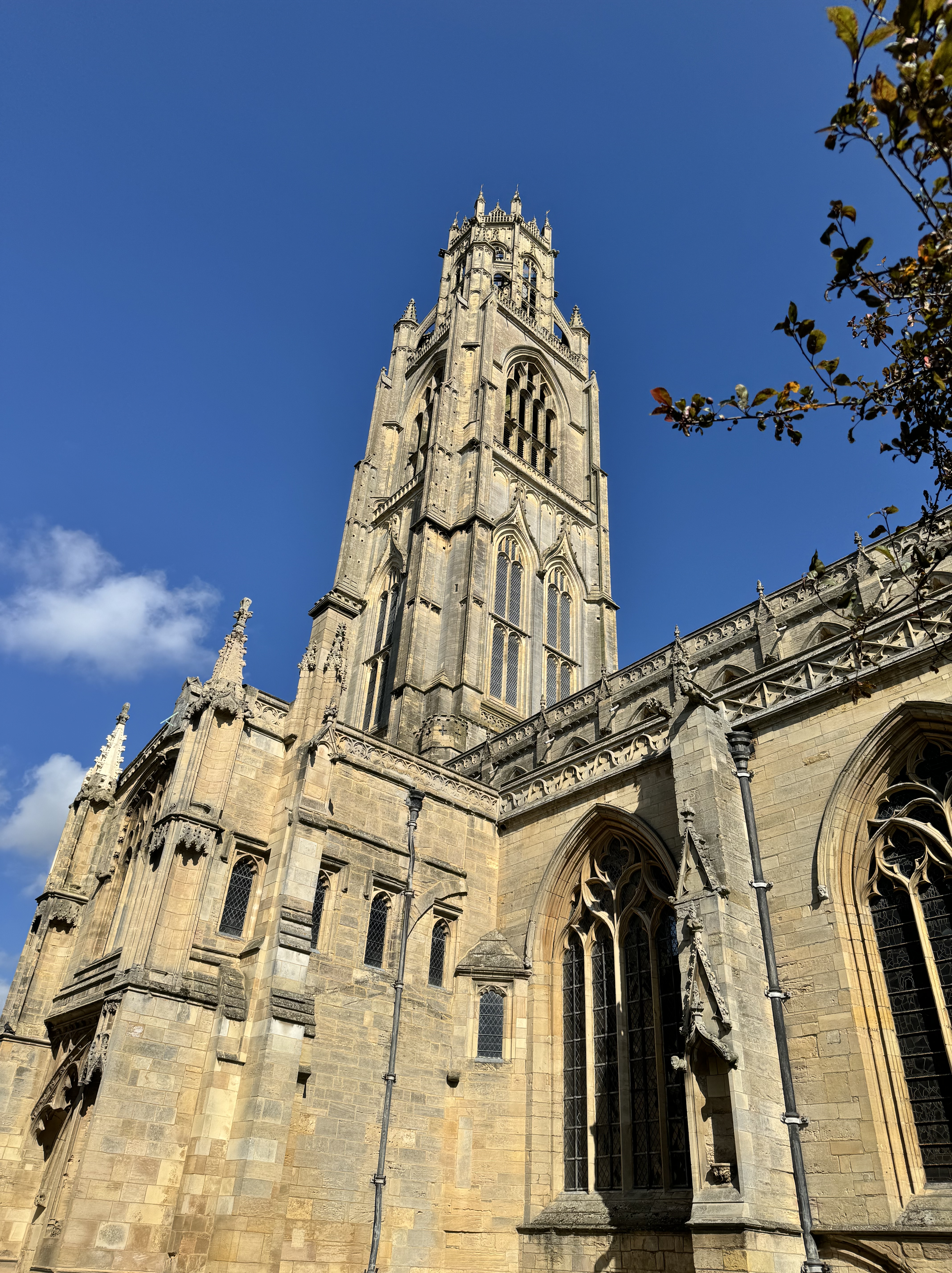
Undoubtedly the jewel in Boston’s weathered crown is St Botolph’s Church, known locally as the Stump. The sheer size of what is simply a parish church would put many cathedrals to shame. We had a great time wandering around, taking in all the details, and watching resident ‘morale assistant’ dog Morse running around with a tennis ball.
St Botolph’s Church, Boston, knows as ‘the Stump’
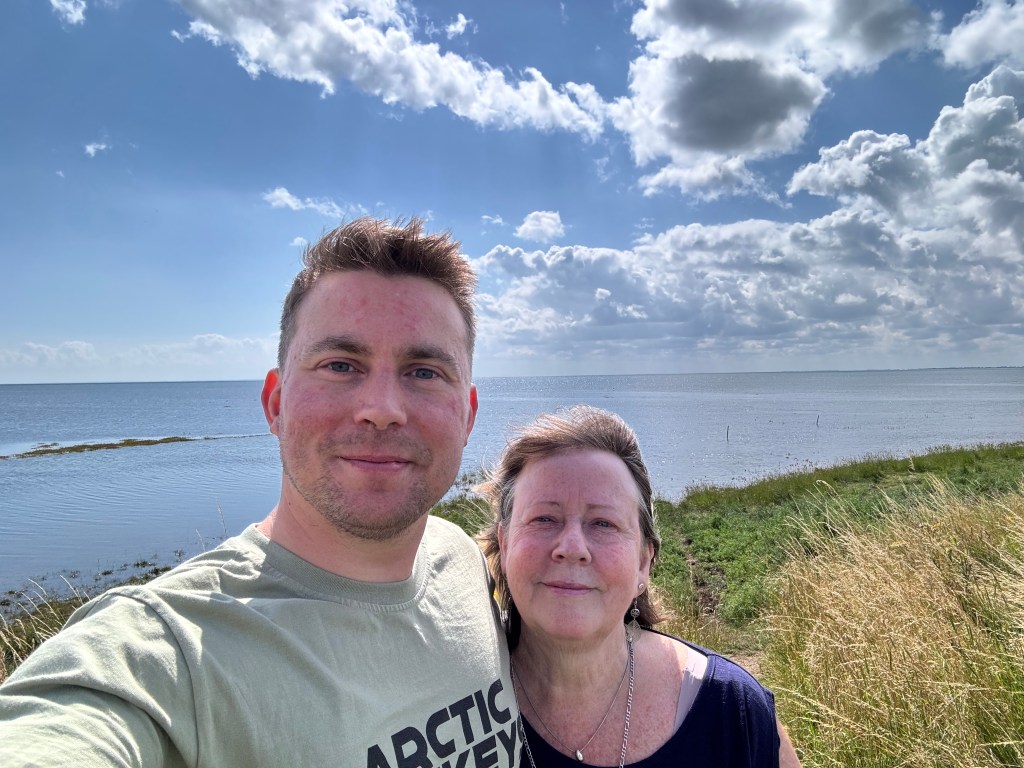
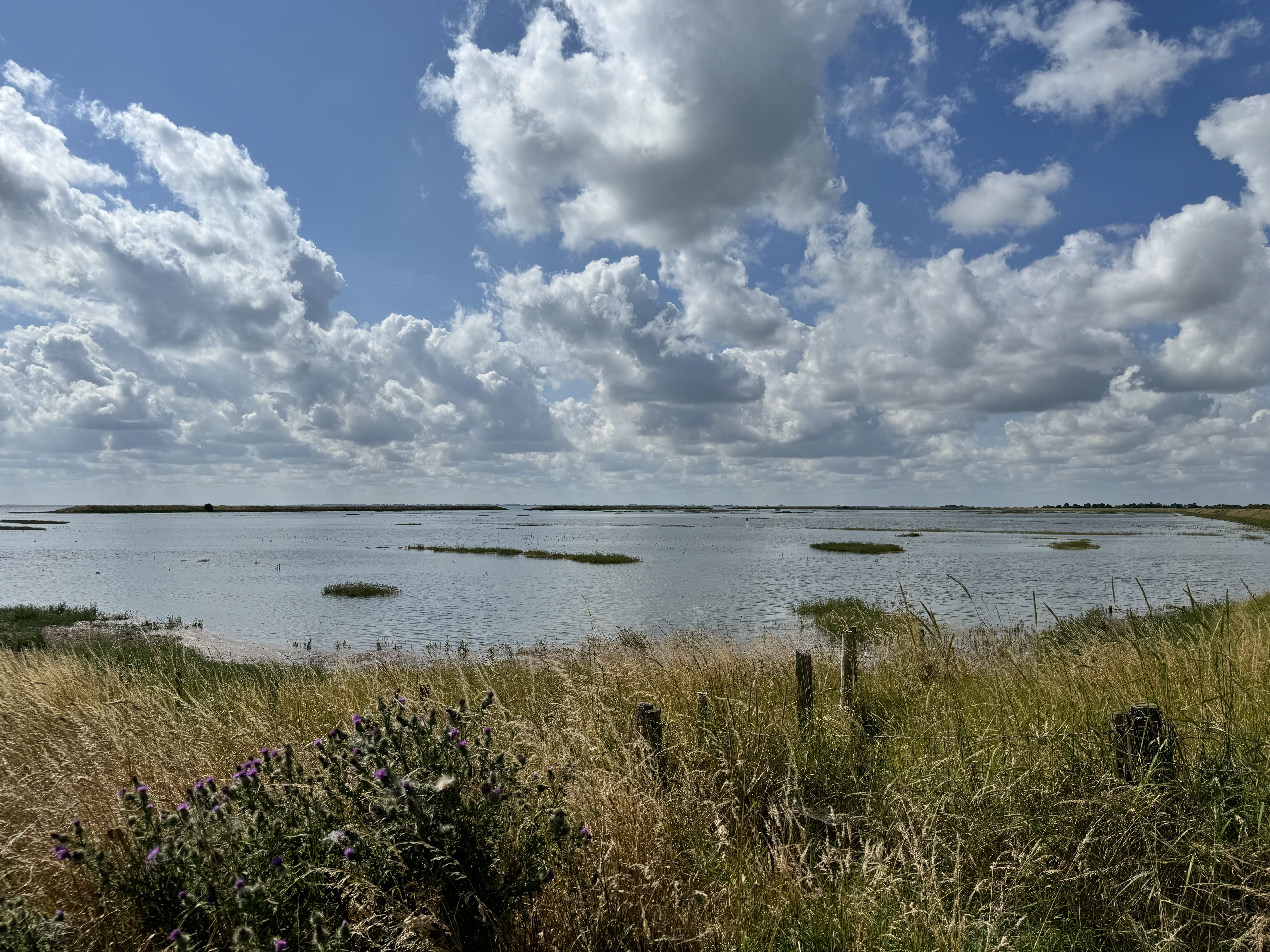
And so to Friday morning. Mum wanted to go to the coast, look back over the Wash to the shoreline of Norfolk, and take in the view that she had so often seen from the other side. We achieved this at a salt marsh about twenty minutes from Boston.
Salt marsh near Boston. In the distance you can just about make out the Norfolk coastline (the Hunstanton/Heacham area)
Then it was time to head home. Another lovely holiday is over, and on Sunday it’s back to the Misery Dome (i.e. work) for me. But I have really enjoyed myself. It’s been lovely to get away, to recharge, to see some new sights. I’ve even walked in the footsteps of royalty. I saw a great day of cricket and discovered Lincoln. I come home happy.
While anxiety still constantly lurks behind me and attacks at random moments, I am dealing with it better than I could before all of this happened. I’ve learned to acknowledge the beginnings of a panic attack but not let it take over. It hasn’t got any more pleasant, but it is a step forward.
I am now in my second week back at work, still doing shorter hours for the time being, and while I have got back into the swing of things quite well and been blown away by the warm welcome from my colleagues, there is a growing feeling that I won’t be truly able to move on from this episode unless I make a fresh start elsewhere.
Gressenhall
I got a museum pass for Christmas, allowing me unlimited entry to ten of Norfolk’s museums for a whole year. I love museums, so this was a great gift for me, but with the first quarter of my year being taken up by The Darkness (the illness, not the Lowestoft rock band from the 2000s) I hadn’t had the chance to use it until last Wednesday.
I went to Gressenhall Farm and Workhouse, only three miles or so from home, for a wander around. The building itself, which looms over you as you drive between Dereham and North Elmham, has always given me the creeps. Knowing the hardship that the people in a workhouse went through – separated from their families, worked to the bone and given hardly enough food to live on – makes me feel uneasy. But it was interesting to learn about how the place operated and its joint purpose as a museum of rural life means it has a few buildings laid out as shops from decades past, as well as a room made up like it was the 1950s.
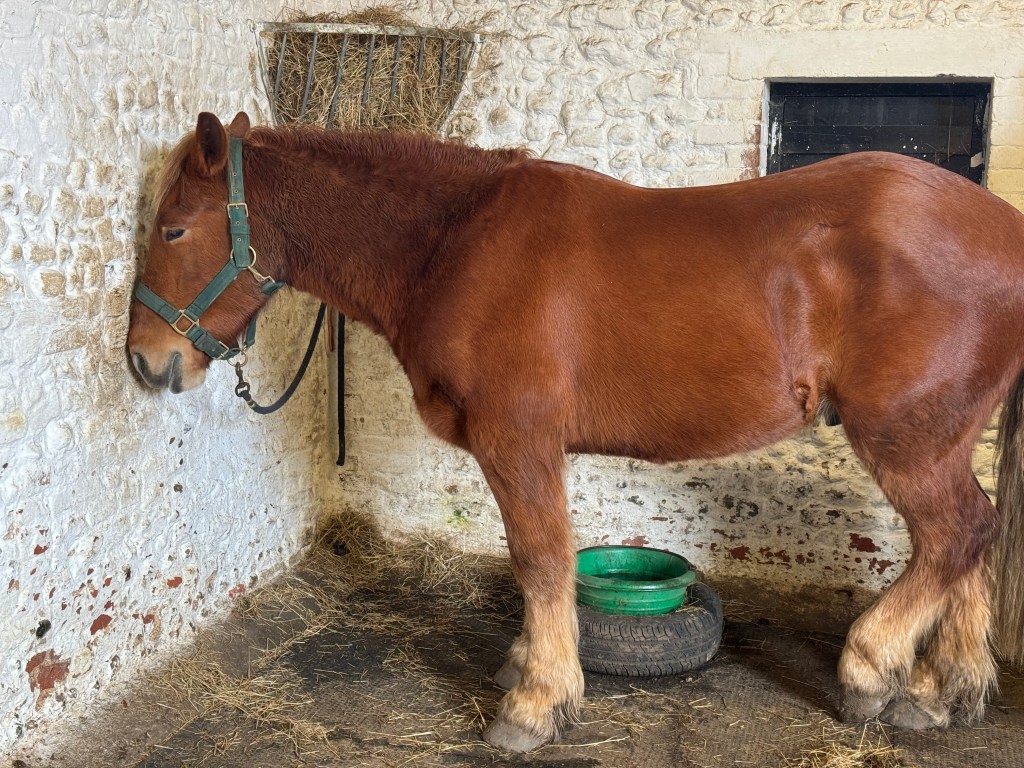
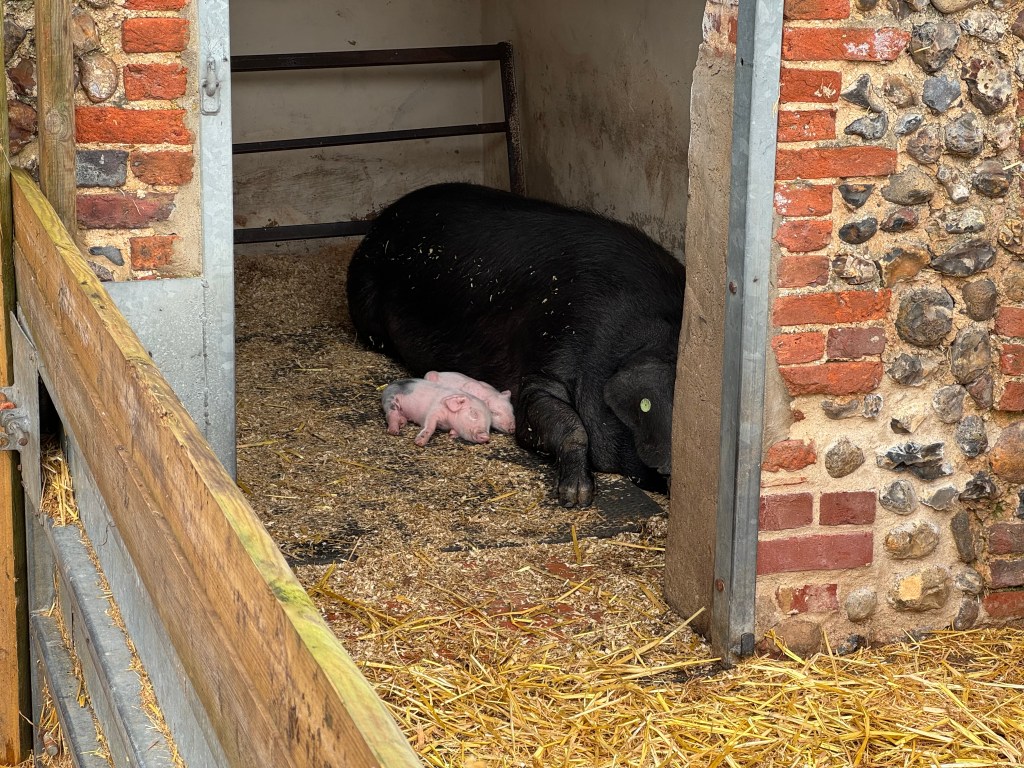
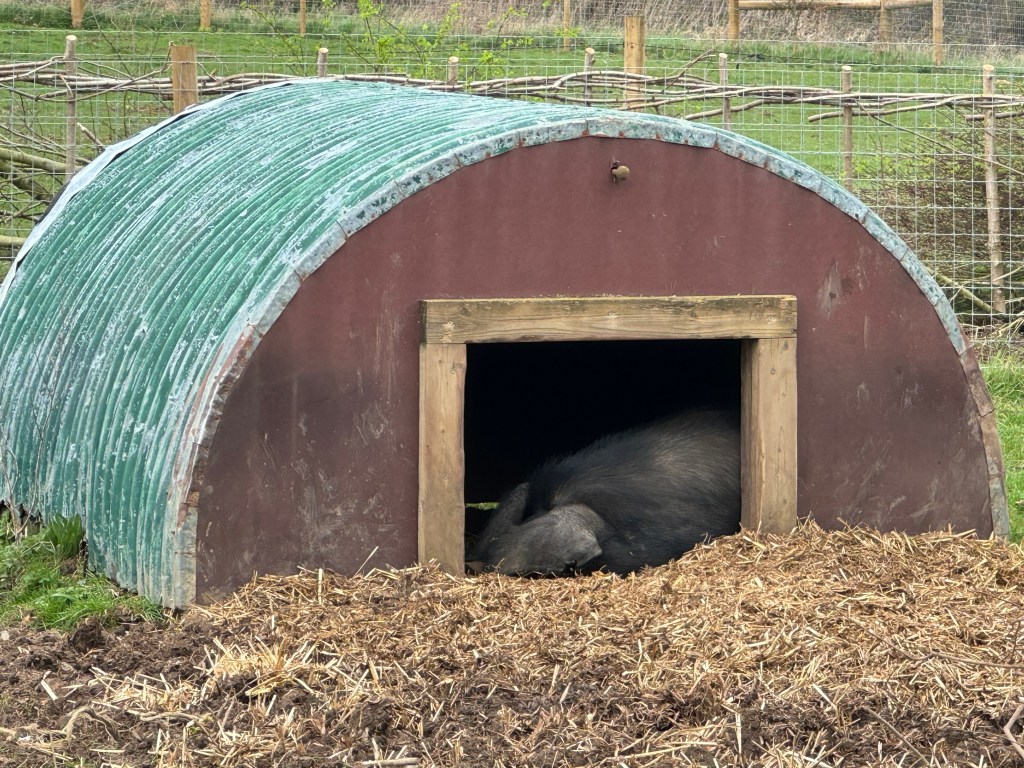
Across the road there is the farm with horses, cows, sheep and pigs. Being spring, there were a couple of lambs and some recently born piglets to see. When I sent my mum the photo of the piglets, she replied ‘aww, little bacon rolls’. Mother! Here is a gallery of some photos I took on the day.
If you fancy a day out, whether you’re alone like lonely old me, or want somewhere to go with the family, I heartily recommend Gressenhall. A museum pass is only £42.30 a year for an adult if you pay by direct debit, which is great value when you consider one visit to Gressenhall would cost you £16.10.
Half Man Half Biscuit
I’ve been listening to Half Man Half Biscuit a lot lately. They are a Merseyside rock band who have been together for 40 years this year and are known for their great riffs and brilliantly funny lyrics. Right up my street. What about this for a line?
There’s a man with a mullet going mad with a mallet in Millets
National Shite Day by Half Man Half Biscuit
Pure poetry. Why not give them a try?
I think that will do for today. It’s good to be back! Thanks for reading if you made it this far.
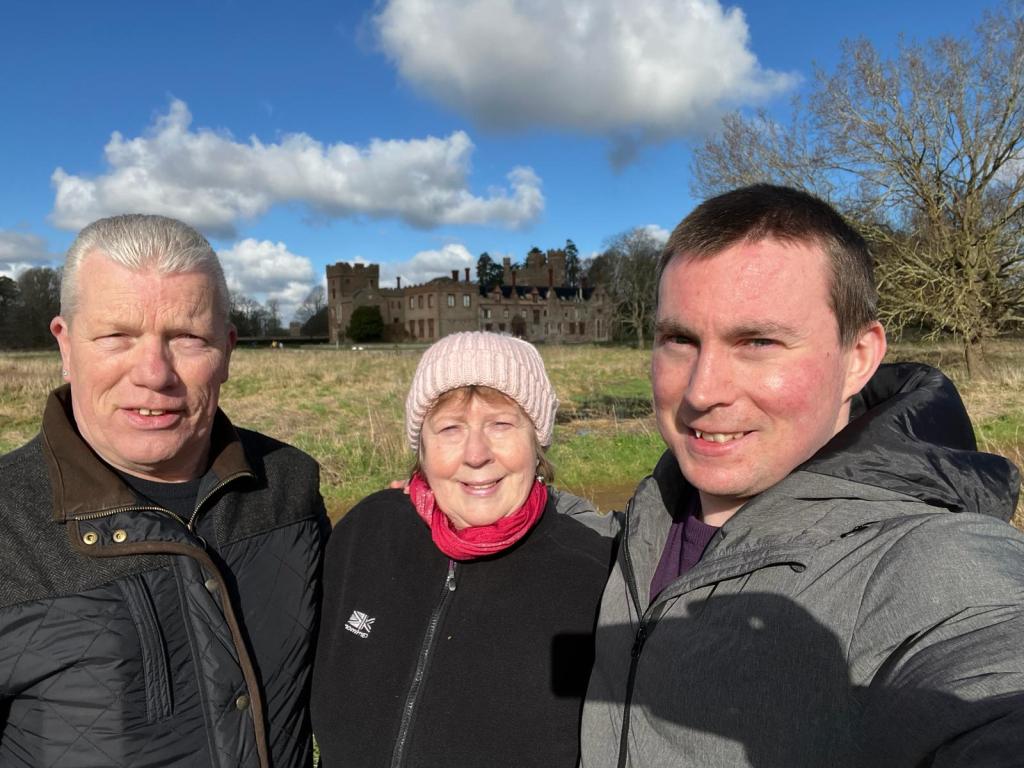
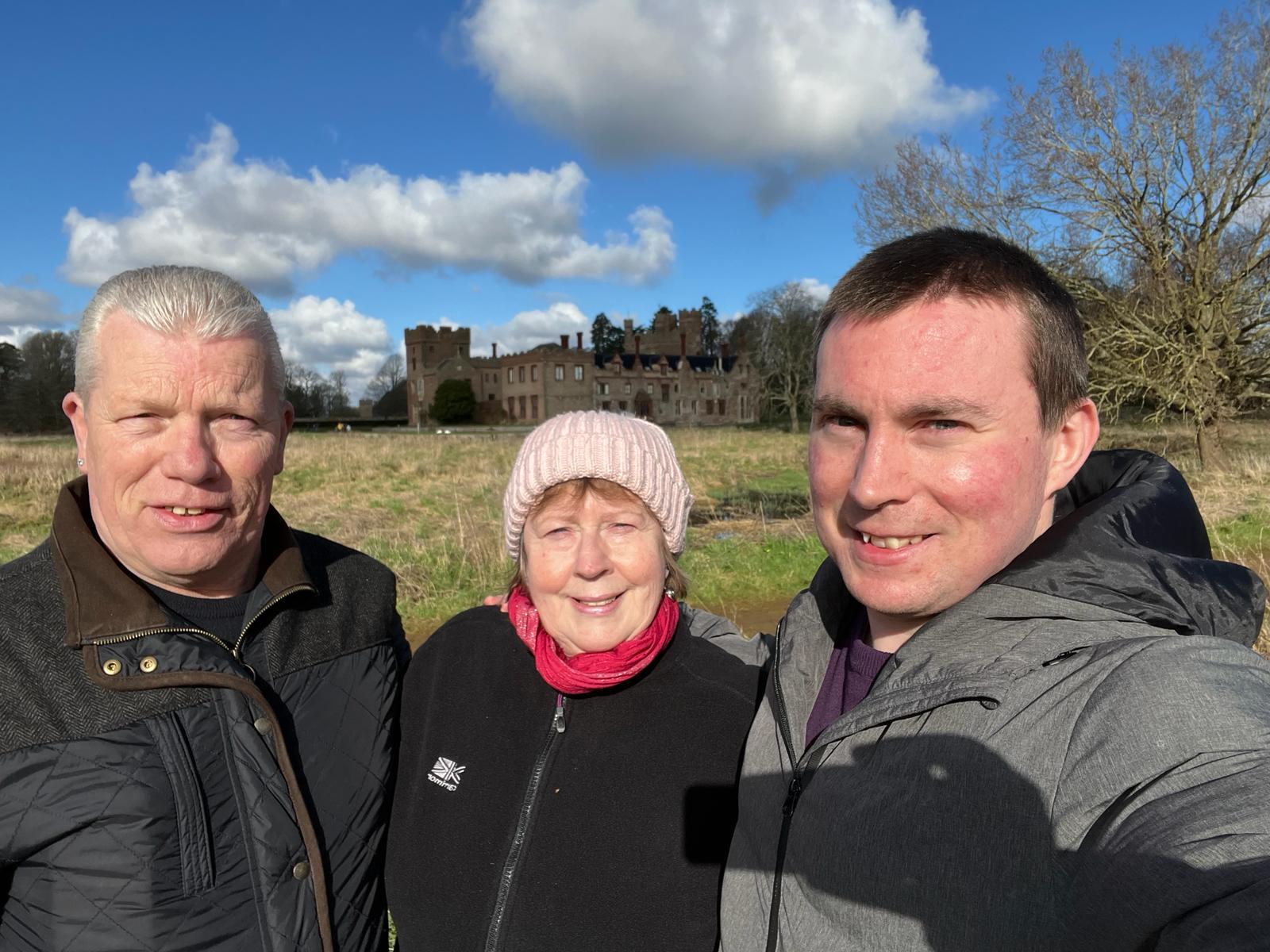
My step-dad, my mum and me. Oxburgh Hall, Saturday 24th February 2024.
Without wishing to sound as pretentious as this might seem, it feels like I am saying hello again to myself as much as to anyone who has chosen to read this. The fact I feel able to sit and type this is a triumph in itself; not so long ago I wouldn’t have been capable of it.
I have always been prone to periods of low mood. To feeling like I am struggling to stay afloat. I don’t know why that is, and I certainly don’t relish it. I don’t want to wallow in self-pity. I wish I could be on a consistently upward trajectory, with a clearly defined goal to aspire to that would mean I had been successful. But is anyone’s life really like that? If I have learned anything over the last two months, it’s that everyone has their peaks and their troughs. Some have learned how to deal with them better than others, but only through experience. No one is immune.
This is the first time I have ever had a prolonged absence from work. I had never before had a sick note signed by a doctor. In thirteen years of work, I have had no more than four consecutive days off with illness – once enforced with Covid and once because of flu (not just a bad cold, the full blown flu). I even carried on when I had shingles at one point.
On a Tuesday morning in early January, I knew I couldn’t continue. I was gone. Going to work, no, leaving the house – no, actually, getting out of bed seemed like an impossible task. I couldn’t identify one particular incident that had led to this moment. I think now that it was like a boiler constantly having its pressure raised until it all got too much and gave in. A culmination of many things. In truth, I had been having panic attacks for over a year already. They nearly always happened at work, and when they appeared I would have to take myself away. I would have to find an excuse to be away from people. I’d deliberately find a task that meant I had to put distance between myself and everyone else.
I couldn’t explain why they were happening. It was the same job I had been doing for all my working life, it was a job I knew how to do, and suddenly I felt incapable, I felt weak, I felt like I was letting people down. The thought of my early shift on a Friday morning would render most of Thursday a waste of time. I couldn’t enjoy my day off because I was full of anxiety about work the next day. It took some persuasion to get me to see a doctor, because I thought I would be wasting their time. But I wasn’t, of course. Doctors have seen this all before. I was put on some medication, pointed towards talking therapies and offered time off work. That was in April.
I didn’t take the sick note then because I didn’t feel like I needed it. It wasn’t that bad. And other than making a few cursory glances at the wellbeing assistance offered by work, I didn’t pursue the therapy route. That seemed like crossing some sort of line. Like I would be admitting defeat. I am wrong about all of this, obviously, and kind of despise myself for ever thinking in this way. But I can’t deny it.
I carried on. I carried on right through the busy Christmas period that is always hell when you work in a supermarket. I dealt with having to work Christmas Eve, Boxing Day, New Year’s Eve and New Year’s Day. I guess I thought when January came it would be easier. People wouldn’t need so much stuff, either because they had enough already or because they were skint. It didn’t get noticeably quieter, though, and on two consecutive Sundays I found myself on the verge of walking out. I was walking through the corridors, hoping to bump into a manager. If I had, I would have told them that I was going home there and then. My ability to cope had been exhausted. I didn’t go home, though, and I talked myself out of running away. I got through the day and would collapse into a chair in the living room, completely done in, falling asleep at 5.30pm. At 31 years of age!
Maybe I should have spotted that things were coming to a head. That Tuesday morning came and I could not continue. I had to withdraw. I officially went off sick, was referred to the Norfolk Wellbeing Service by a mental health nurse and put on different medication. My mum took me to a garden centre, just to get me out of the house, and I was so restless with anxiety while sat in the cafe, a place that should be calm and comfortable, that it felt ridiculous. It was clear that I would not be able to go to work on the Friday, so we asked for a sick note. I was expecting maybe a couple of weeks, so was surprised when the doctor had put a whole month on the certificate.
The first few days, indeed the first few weeks of the note, were unpleasant to say the least. I was consumed by guilt, shame and paranoia. Guilt that I was letting my colleagues down, shame that I’d let myself give in and paranoia that some people wouldn’t believe that I was as bad as I said I was. I developed a habit of waking with a start at 4am, always 4am without fail, usually from a nightmare where I had gone back to work and it had become apparent it was too early. Even minor errands like going to the local shop seemed terrifying. I would put them off until I couldn’t put them off any longer, and then I would hate every second of them. I wanted to run away from the situation. Home was my sanctuary. One night I even slept in the caravan on our driveway because it was thought that a change of scenery, however minor, might help me sleep a bit better.
Going to the football, something I have been doing for fifteen years, felt like the most insurmountable challenge. On the morning of one match I had every intention of going but had got myself into such a state that my mum suggested it might not be a good idea. I stayed at home while mum and my step-dad went. I was immediately relieved at not having to go through the ordeal but angry with myself for not being up to it.
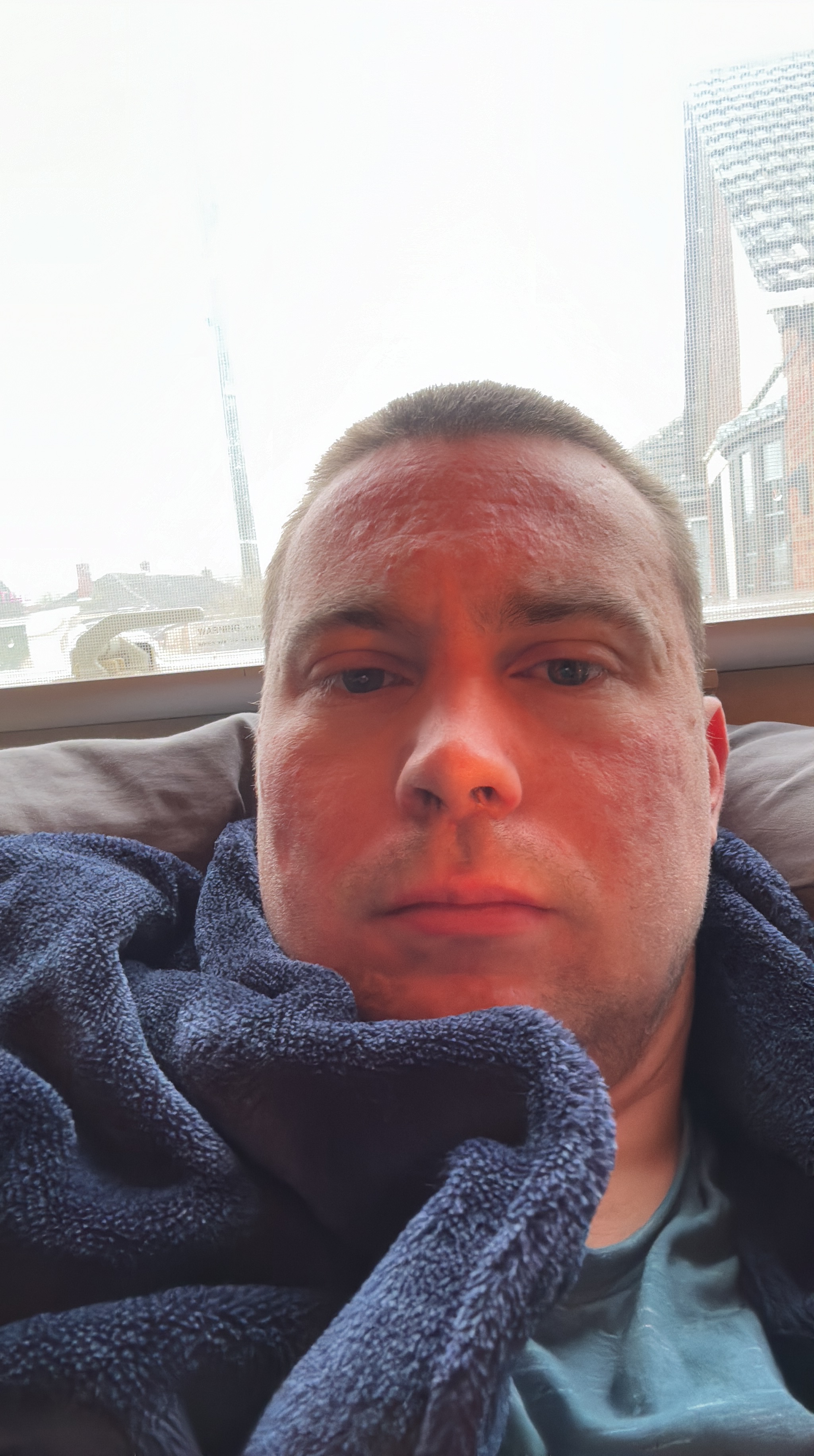
The lowest I felt
For a while, this seemed to be the new me. Outside of society, hidden away, not capable of functioning in the real world. It honestly didn’t feel like it would ever get better. But something else I’ve learned is that things always get easier after a while. The doctor doubled the dose of my medication, I reached the top of the waiting list to start telephone appointments for cognitive behavioural therapy (CBT) and I realised that it had been a while since I’d had an ‘episode’.
Throughout all of this, our little budgie Messy had been a constant companion. He was something for me to care for, to stop thinking about myself for a while, if only to feed him and get him some clean water in the mornings. When my mum and step-dad were at work, just hearing him moving around his cage or chucking bits of seed out of his food dish made me feel like I wasn’t on my own.
Then Messy died.
We thought he had hurt his leg, because he wasn’t moving very well. He had never been able to fly, because the people we bought him from had clipped his wings (we did not know this at the time, and don’t approve of this practice), so we were used to him hitting the floor with a thud when he frequently tried and failed to take off. He wasn’t getting any better, though, and he had completely stopped chirping and talking. He had stopped being himself. So we took him to a vet. Looking back on it now, I think the vet was just trying to soften the blow when she entertained our idea that he had hurt his leg. She quickly suggested it was possible that it was a neurological problem, and that if it was there wasn’t much that she could do.
Messy had hardly been home an hour when he literally fell off his perch. He was still with us at this point, blinking away, hugging mum’s shoulder on the sofa, seemingly unable to move by himself any more. I found it too upsetting. I couldn’t stay in the room. I shut myself away. Mum was magnificent. She held Messy for as long as she could, and made sure he was comfortable, keeping him warm in a box in his last hours. We knew what was coming. By the time we woke up on Saturday morning, after not much sleep, he had passed away. It was pure grief. This wasn’t just losing a budgie for us. It was losing a member of the family. A friend. A character. It all felt so unfair; he was only fifteen months old. We were supposed to have up to eight years with him.
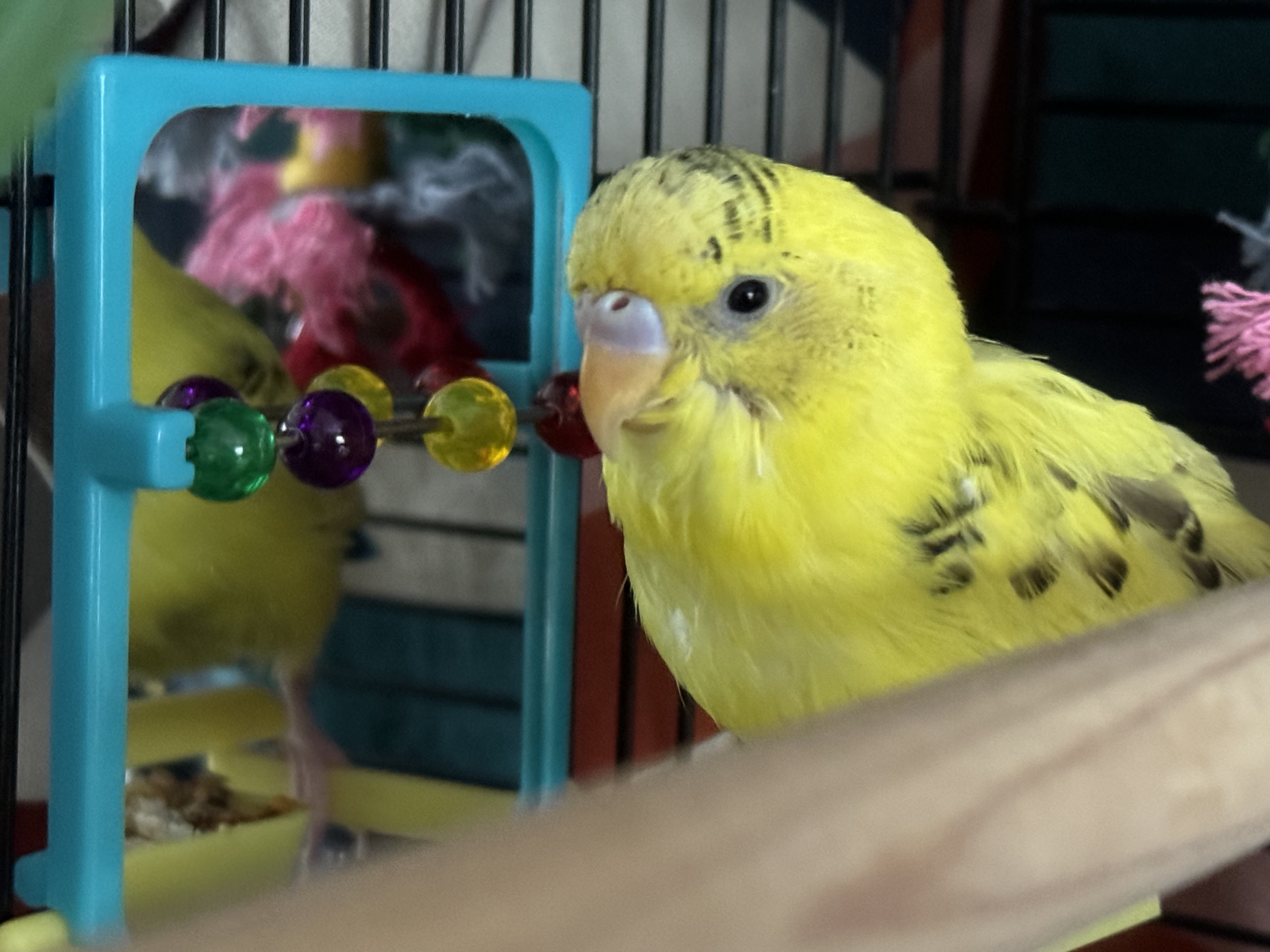
Messy. We didn’t have long enough with him, but the time we did have was special.
The only positive from Messy’s untimely death was that he completely stopped me worrying about a meeting I had at work on the Saturday morning to discuss my absence. I was so worried about him, so sad about what was happening, that any anxiety or nerves I had about going back to that place had been rendered irrelevant. I was not bothered in the slightest. I found it all very easy, and for the first time I said I was prepared to go back to work.
The next morning, we buried Messy in the garden and planted a flower above him. He will never be forgotten. At the time, both I and mum said that we couldn’t contemplate having another pet because it hurt too much when we lost them. How could you love something so much, only for them to break your heart like that? But in the days since I have softened my stance on this. I would love for Messy to have a successor. I’ve even thought about a name – Tidy.
Whether it was the resolve instilled in me by Messy’s death, the medication starting to work, or a combination of the two, I have found the world easier to deal with of late. Last week, I went to London with mum and stayed a night in an AirBnB without feeling anxious at any point. I think the sheer number of people in London, and the way you can blend into the background and move around unnoticed, helped. I have been to a football match, travelling by bus and sitting in my usual seat, without letting my nerves get on top of me. Life no longer feels like a challenge I can’t rise to. I have my moments, and there is no point where you feel completely fine, but you feel like you can be part of society again.
My return to work is approaching. It’s 17th March. I will be starting off by doing shorter shifts, to get back into the swing of things, for the first week or so. But it feels like a big step. And not one I’m having nightmares about any more. I am determined to go back and to show everyone that I am not weak, that I am just as capable as I have ever been and that I might even be better off for the experiences I’ve had since the start of the year.
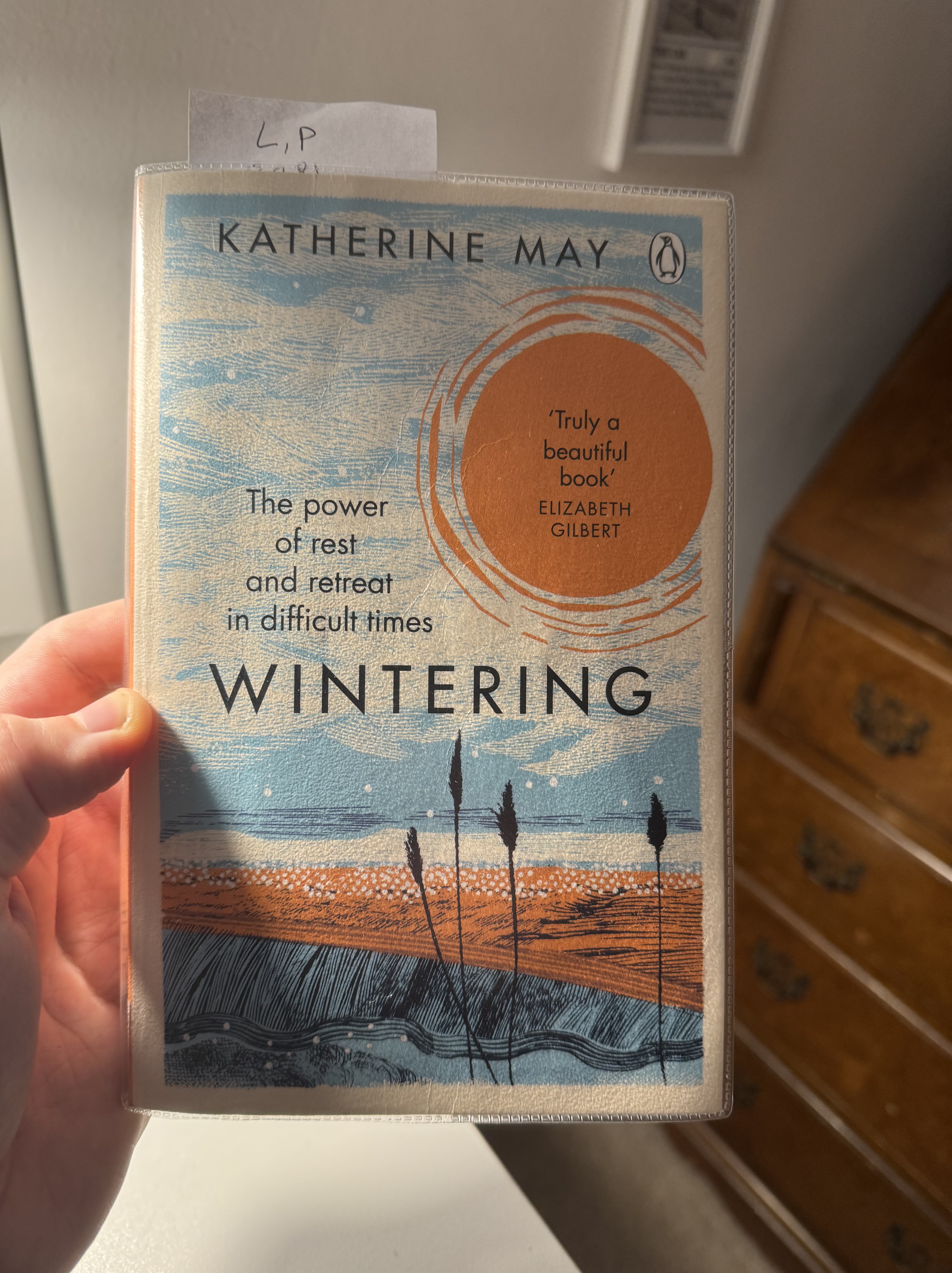
I have been reading a book called Wintering by Katherine May, which I have found helpful. It explores ‘the power of rest and retreat in difficult times’, and it has changed how I see these cold and dark months. It’s not a period where you are supposed to sit and wait it out, eager for the summer to return. It looks at how winter is an important time in itself, and how different people and indeed different animals adapt to it. I have picked out three quotes from it that I have found particularly relevant to me.
Unhappiness has a function – it tells us that something is going wrong.
Our present will one day become a past.
We who have wintered have learned some things.
Robins sing through the darkest months.
Wintering (2020), by Katherine May
You see, I no longer feel like I have failed. I no longer feel like I gave in. I have been ill. My body told me that it needed to rest, to recover, and I have given it time to do that. I can now come back into the world, to feel normal again, and take the things I have learned along with me. I have wintered. And now I am ready for the spring.
If you have made it all the way down this far, you have done extremely well and I thank you for that. This has been a self-indulgent post to say the least. But it has been incredibly therapeutic to feel these words flowing out of me. To be able to make sense of what has happened to me. I feel like this marks my return.
That was it then. Christmas is over and done with for another year. Is it just me, or is Christmas Day itself always a bit of a downer? The best part of the festive season is the anticipation and the build-up. Going to see the lights being switched on, the parties, feeling the atmosphere when you’re out shopping. Everyone is preparing for something. The 25th is the end of it as far as I’m concerned. In fact, I would go as far as to say Christmas Eve is better than Christmas Day.
I obviously angered God this year, as he punished me by making me work on both Christmas Eve and Boxing Day. Walking into the shop yesterday, you would never have known that Christmas had just happened. Every single decoration was gone, the music had stopped, and everyone seemed to have lost the spring in their step.
The three days before the big day were spent helping to hand out several hundred Christmas food orders, which was hard work, but at least it meant I was out of the firing line that the checkouts would have been.
Next on the agenda is, of course, the new year. Let’s talk about that.
Resolutions: I don’t bother with them any more. You can’t go to bed one night and wake up as someone completely different the next morning. Self-improvement is an ongoing, gradual process and it doesn’t do you any good to set a hard deadline like 1st January to change your ways. Yes, I’d like to lose weight but I am not suddenly going to be a health freak as we move into the new year.
I am also feeling, more than I have ever done, that I need a new job. That’s going to be something to crack on with right away.
Things to look forward to: if, like me, you’re into sport then 2024 is going to be a treat. The year ahead features a World Cup in T20 cricket (England are the holders), a European Championships in football (please, Gareth, let them off the reins) and the Olympic Games in Paris (the one hour time difference will be great for viewers on this side of the channel).
In music, there are rumours that Alex Turner of Arctic Monkeys will reunite with Miles Kane for a third The Last Shadow Puppets album – though nothing is confirmed about that yet. As discussed last week, we do know that Blossoms will be releasing an album, promising several collaborations. The Stockport five-piece will play the biggest show of their careers so far at Wythenshawe Park on 25th August, which just so happens to be my 32nd birthday.
Watch/listen/read/play: I recommend watching Mog’s Christmas, which was on Channel 4 on Christmas Eve. It was an utterly charming half-hour of wholesome fun and it featured the unmistakeable voice of Benedict Cumberbatch. Catch up with it here.
That’s it for the second edition of I Write Wednesday. Have a fantastic new year and I’ll see you next week.
A short round up of things on my mind. Things I’ve seen, read, heard etc. From my point of view, it will help me keep my eye in with my writing. As the name suggests, it will be semi-regular and published on Thursdays.
A bit of news: That Mary Earps won the BBC Sports Personality of the Year award last night and I couldn’t be happier for her. I’m not trying to be right-on or anything like that when I say I love watching the Lionesses. They seem to be more of a team than their male counterparts – and more successful. Earps is a brilliant example of the virtue of never giving up. Four years ago, she felt like her football career was going nowhere and was preparing to try something else. Last night, she received the prestigious SPotY award as a Euros winner, World Cup finalist and comfortably the best goalkeeper in the women’s game. Apparently oxygen thief Piers “Morgan” Moron has been whining (for a change) about it. I find a good rule for life is that whatever he doesn’t like is probably a good thing. Well done Mary.
A song I’ve been listening to:Blossoms will be releasing their fifth album next year and the first single from it, To Do List (After The Breakup) is a banger. It’s a collaboration with fellow Stockport musician Findlay and, in true Ronseal style, tells you what you need to do after a break up. I’m a big fan. Watch the video below.
A podcast I’ve been listening to: one I’ve been really getting into recently is The Rest Is Entertainment. It’s a weekly dissection of all things pop culture hosted by Richard Osman (of Pointless, House of Games and Thursday Murder Club fame) and The Guardian journalist Marina Hyde. A recent highlight has been Osman’s insight into this year’s race for the Christmas number one, in which he dropped the bombshell fact that 2004’s Band Aid 20 remains Radiohead frontman Thom Yorke’s only UK number one single. It’s interesting, it’s funny, and it’s been making my journeys to and from work fly by.
Something you should watch this Christmas: it’s not exactly a hidden gem, but nothing gets me into the Christmas spirit quite like the 2008 festive special of Gavin and Stacey. It’s brilliantly observed, and truly captures that sense of anticipation that the big day holds. It makes me miss those big family Christmasses I remember as a child. You can watch it on BBC iPlayer here.
Is that it?
That will do you for this week. Have a very happy Christmas, a great new year and I’ll be back soon.
Just before you go – why are you asking yourself questions?
This year has been one to forget for Norwich City. In fact, it’s been the club’s worst year since… well, last year. David Wagner was appointed as head coach in the first week of January, and I had a good deal of optimism about him, although I would have been optimistic about anyone after the horrors of Dean Smith. He started well, too, with a fitter squad banging in the goals – most notably in a 4-2 win at Coventry where they were 3-0 up after 18 minutes. Looking a good bet for the play-offs, the Canaries faded away badly, failing to win any of their last six games. The talisman that was Teemu Pukki played his final game for the club on the last day of the season at home to Blackpool; when he was substituted in the second half most of the crowd left well before the conclusion of the 1-0 defeat.
A decent start to 2023-24 saw Norwich get three wins and a draw from their first four games (the draw being an incredible 4-4 at Southampton) but defeat at Rotherham and a serious injury to striker Josh Sargent set things on a negative course. Now, the club’s fans are divided, with occasional boos accompanying the frustrated sighs in the stands. Many want Wagner to be sacked, but the sporting director Stuart Webber has been the one to depart instead. Having announced that he would be leaving the club in June, there was a potential for him to remain in his post until March next year, but he left in November.
Away from Norwich, Manchester City became only the second English club to win the treble of Premier League, FA Cup and the Champions League in the same season – although the other team to do it were their cross-city rivals United, back in 1999. Erling Haaland had been brought in to push City to the next level and boy, did he deliver. The Norwegian scored an incredible 36 league goals in his debut season. The celebrations after the 1-0 win against Inter Milan in the Champions League final were so raucous that Jack Grealish is probably still nursing his hangover.
England’s women made it all the way to the final of the World Cup, just a year after so memorably winning the Euros on home soil. They were narrowly beaten by Spain in Sydney, but their victory was overshadowed somewhat by the controversy over the non-consensual kiss from the chief of the Spanish FA, Luis Rubiales, on the lips of captain Jenni Hermoso. So, after a month of showcasing the very best of the women’s game, all anybody could talk about was a creepy white bloke in a suit. Sigh.
England’s cricketers, fresh off the back of a 3-0 victory in Pakistan, started the year on the other side of the world, where they drew 1-1 with New Zealand. The “series” was the best advert yet for two-Test tours being banned – an epic finish in Wellington saw the hosts prevail by just one run. It was only the second time a Test match had been won by such a tight margin.
By mid-June, the long-awaited Ashes were underway. England could have won both of the opening games, but Australia took a 2-0 lead to Headingley. Nathan Lyon and Pat Cummins stood tall to see Australia to their target at Edgbaston, then the tourists embarrassed themselves by throwing the stumps down to remove Jonny Bairstow at Lord’s, when everyone knew the ball was dead. Still, Ben Stokes almost pulled off a miracle. After that, Bazball well and truly came to the party. Only a day and a half of rain at Old Trafford prevented there being a decider at The Oval, but England made it 2-2 there anyway and saw Stuart Broad off into retirement on a high note. The Ashes are still with Australia, but having thrown away a 2-0 lead and still not won a Test series in England since 2001, we came out of it the better.
The less said about the World Cup the better. England’s defence of their 2019 title was as unexpected as it was feeble – they lost to New Zealand, Afghanistan, South Africa, Sri Lanka, India and Australia and finished 7th in the group stage. Their only victories came against Bangladesh, the Netherlands and a consolation win against Pakistan when both sides were already out. The hosts India won all nine of their group games and then the semi-final against New Zealand, only to lose to Australia in the final. The Aussies took home the World Cup for the 6th time. No one else has won it more than twice.
I have never been much of a rugby union fan, but I did enjoy watching the World Cup during September and October. The respect for the referee’s decisions from the players, and the clarity of the Touchline Match Official system, made a refreshing break from the vitriol and incompetence of football. England were unlucky to lose to the eventual champions South Africa in the semi-finals, though the quarter final between the Springboks and hosts France was the best game of rugby I have ever seen. Have a look at the highlights of that one below.
Again, tennis isn’t one of my favourite sports but I do enjoy watching it now and again. Highlights from this year were Andy Murray, 36 years old and with a metal hip, battling through a number of five-set epics at the Australian Open in January and Carlos Alcaraz beating Novak Djokovic in the Wimbledon final.
It’s what literally no one has been waiting for! Part 2 of my write-up of my holiday in Wales. If you haven’t read part 1, click here to get up to speed with Barry Island, Chepstow and Hopwood Park Services.
Day 3 – Wednesday 19th July
Wednesday was mum’s birthday, so the morning involved her opening her cards (I now have a five year streak of producing tears with mine) and presents (the Garmin fitness tracker, a joint gift from me and Dave, was well received). But we didn’t have much time for that, as we had to be on the train fairly early again. We were heading back into England – we were going to Bristol.
The trip to Bristol obviously involves crossing the River Severn again, and on the train it means going underneath it via the Severn Tunnel, not something that mum enjoyed. Anyway, it was quite a short journey and we arrived in one of England’s great cities.
I had never been to Bristol, but read and heard much about it. This was Brunel country, a big city that somehow doesn’t have a top flight football team, and also where a lot of scenes from my favourite sitcom Only Fools and Horses were filmed once it had become too popular to be shot in London. It was exciting to be able to tick off another metropolis.
Unfortunately, we had not planned for our visit to Bristol beyond buying the train tickets, and so on arrival we had no idea where we going or what we were going to do. We walked away from the enormous Temple Meads station and, as it turned out, went the wrong way and ended up in a rough part of town.
Temple Meads station in Bristol
Mum said she wanted a coffee, so I used my phone to find us a place with good reviews not far away. We discovered that this place, Bakehouse, was on an industrial estate. The coffee was ok, the food looked nice but went untried due to how expensive it was, and we found ourselves in the bizarre situation of sitting on a picnic bench amongst industrial units. Only two days before we had been enjoying the spectacular views on Barry Island.
We resolved to find the city centre, and eventually managed it. We went into a few shops and had a nice lunch in a café, but we never saw any of Bristol’s great sights. We didn’t see the SS Great Britain, we didn’t see the Clifton Suspension Bridge, and I didn’t tick off any more sporting venues such as Ashton Gate, the Memorial Stadium or the County Ground. We went to catch the train feeling like we hadn’t really ‘done’ Bristol, and I feel like I need to return at some point.
Day 4 – Thursday 20th July
There was a train strike on Thursday, so we spent the day off the rails, as it were. We walked to Caldicot Castle, not far from our apartment, and were very pleasantly surprised by the experience. It was free to get in, which was unexpected, and there are so many little nooks and crannies of this historic site to explore. A Grade I listed building, most of what we can see today was built somewhere around 1170 and restored in that confident Victorian way by a man called Joseph Richard Cobb, who made it his family home.
What really interested me was the fact that the castle was used to house families who had been bombed out during the Second World War. Down one very narrow corridor was a bath that would have been used by people living there in the 1940s.
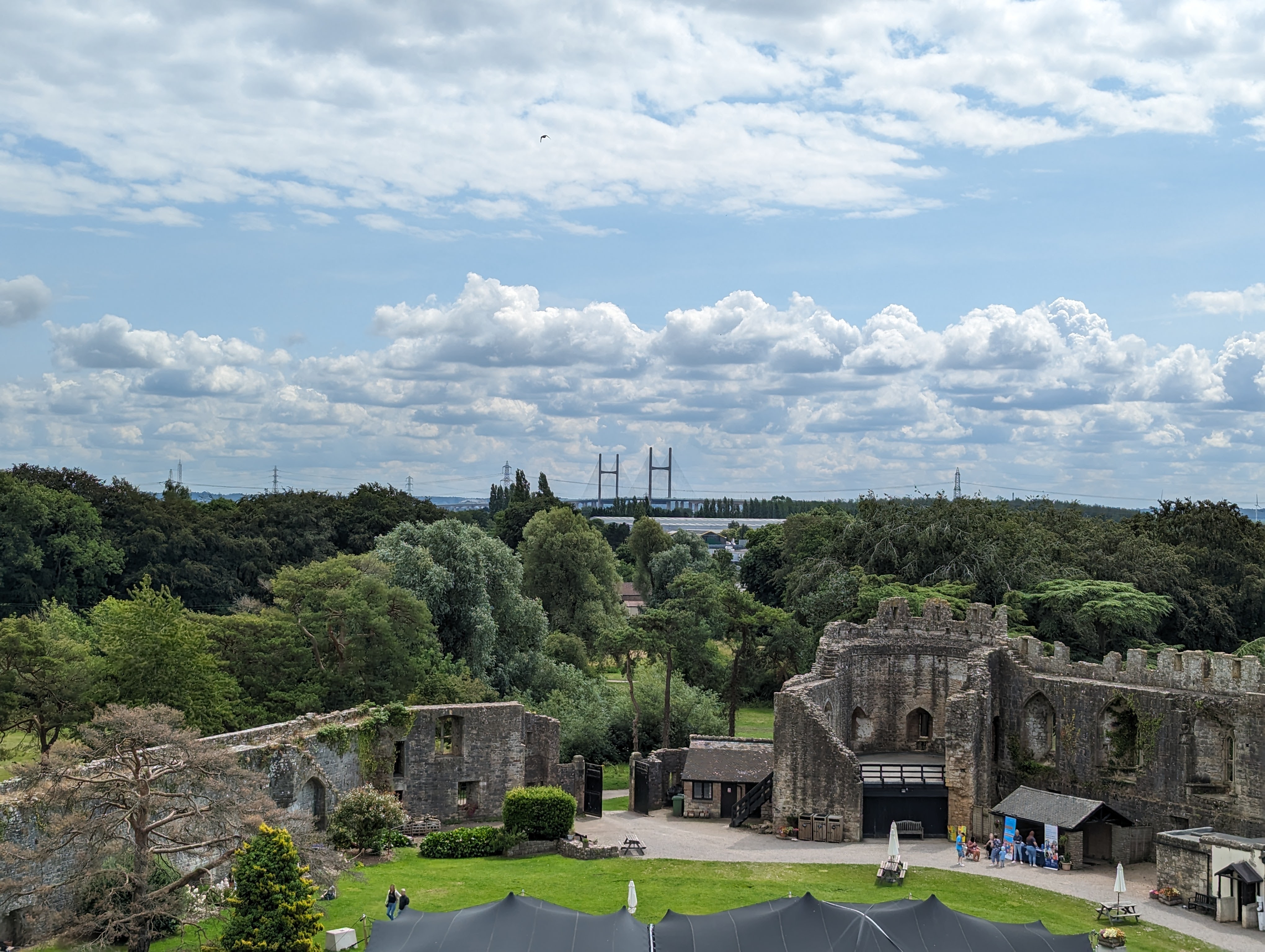
Extensive helical staircases would take us down to the basement, where a grate allowed us to peer into the darkness of the dungeons, and up to the top of the tower, where we enjoyed wonderful views over the Severn Estuary – very much a photo opportunity.
The view from the top of Caldicot Castle, with the Severn Bridge in the background
We enjoyed a snack and a drink from the castle’s tea room before we left. A truly wonderful place, a fantastic thing for the locals to have on their doorstep. The field next to the castle is used for concerts – Noel Gallagher’s High Flying Birds are performing there in August.
Day 5 – Friday 21st July
Our last full day in Wales. We had heard about a place called Dewstow Gardens & Grottoes, which was only about ten minutes away from the apartment by car, so we went there to take a look.
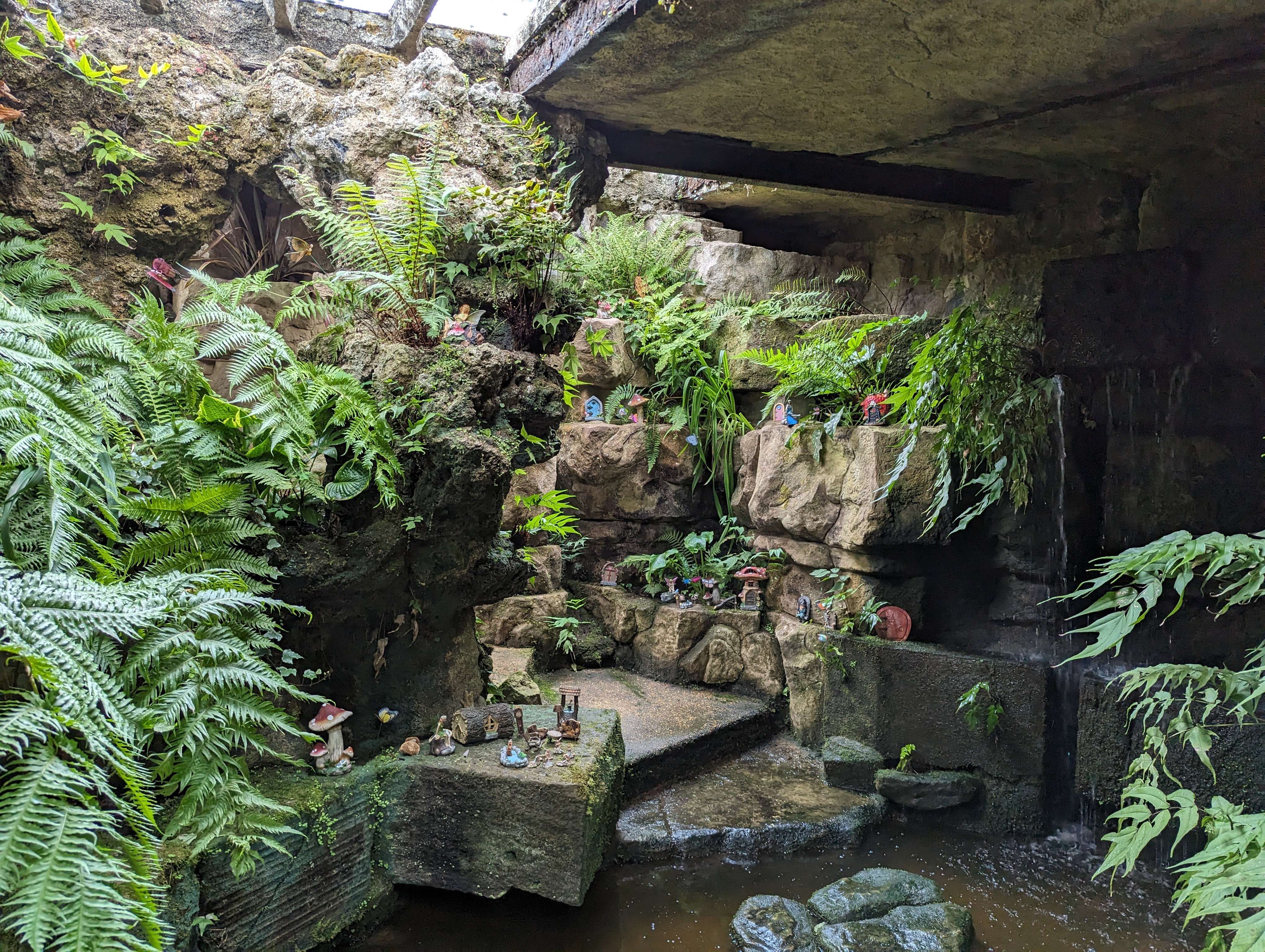
Honestly, if you are ever out that way you must go to Dewstow Gardens & Grottoes. The gardens at ground level are beautiful and incredibly well-maintained, with so many trees, plants and ponds to sit by and enjoy some peace and quiet. But it is when you go underground, into the network of tunnels that go through the stone, that your mind is truly blown. These grottoes are amazing spaces – they really are like stepping into another world.
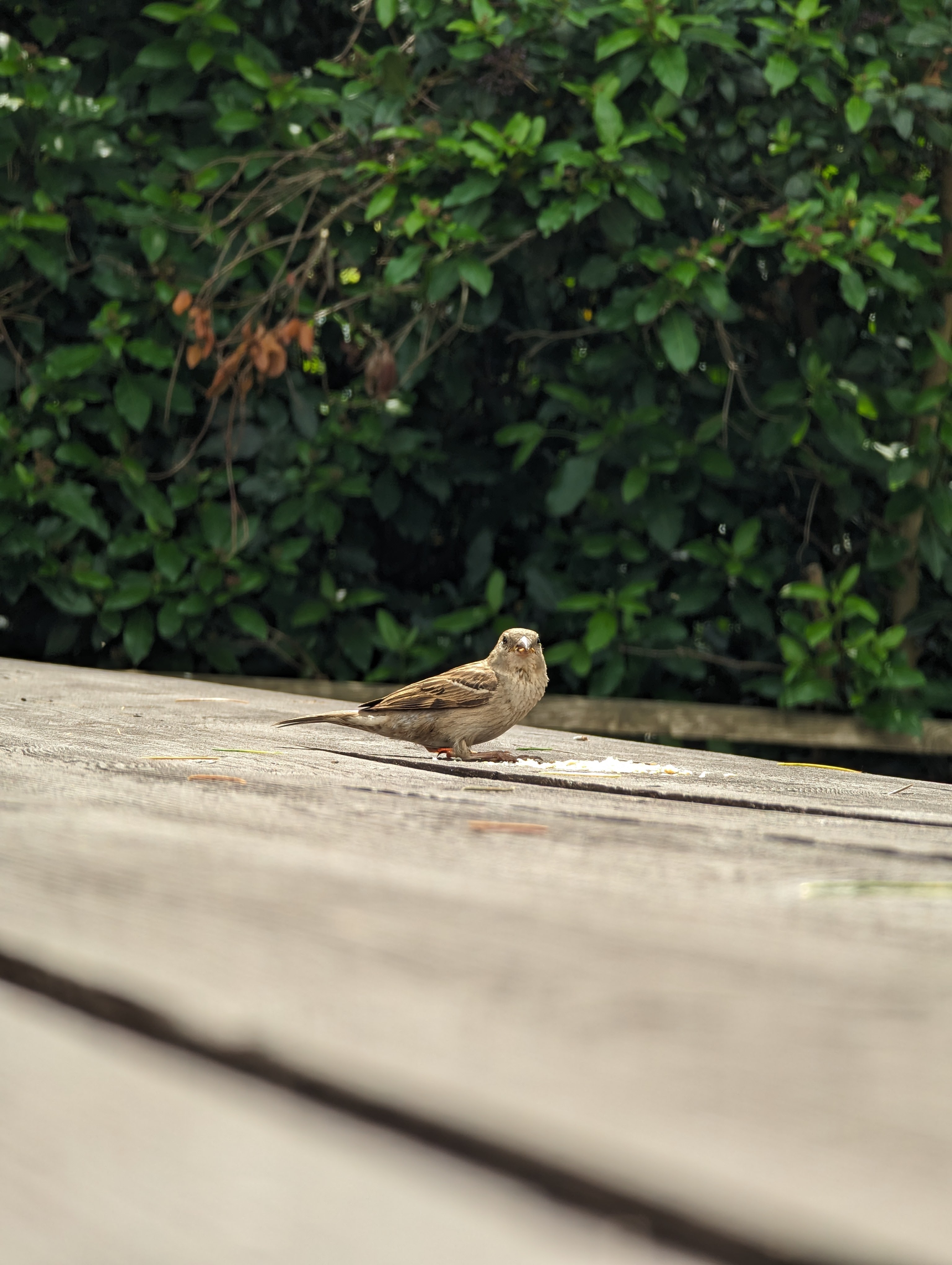
Even better, when I was enjoying a delicious sausage roll and slice of chocolate cake from the café, little birds like to sit on the tables and eat the crumbs that people have left behind. Look at this chap.
We didn’t really have a plan for what to do after we’d left Dewstow, and in an unexpected turn of events we ended up crossing back into England and stopping at Severn View Services. As the name suggests, this is where a short walk will give you the best possible view of the Severn Bridge.
Increasingly weary, next we found ourselves back in Chepstow, but with very little energy left in the tank we didn’t do anything other than visit a Wetherspoons for a meal. I had a pizza (and no, I’m not getting any thinner).
We were knackered, but content. We’d seen so many new places and done so much walking that we knew our holiday in Wales was one we would never forget.
Day 6 – Saturday 22nd July
Time to go home. With the forecast suggesting that a month’s worth of rain in one day would leave Wales looking something like Atlantis before long, we left as early as we could. I put my head down for a nap just after we’d crossed the bridge back into England, and when I woke up we were driving around the suburbs of Reading, which was a surprise as no part of our journey home should have involved the suburbs of Reading.
Apparently, they had said on the radio that there was traffic on the M25 at Slough. This was exactly the part of the M25 we needed to go on, so Dave had made the decision to try to avoid the M25. Well, to say this meant we went home the long way round is an understatement. We must be the only people ever to travel between Wales and Norfolk and stop for a wee at the Tesco in Amersham, Buckinghamshire. After we’d been there I swapped with mum and sat in the front seat to help guide us in the right direction. We took in Chesham, Hemel Hempstead and St Albans but eventually made it to the A14 near Cambridge and back to dear old Dereham.
If you’ve made it down this far, thank you very much for reading. Hopefully I’ve inspired you to go exploring. Whatever you do, make sure you visit Dewstow Gardens & Grottoes!
My chest feels tight. As if someone has wrapped a belt around it. I am short of breath. I need to focus on taking deep breaths. It feels easier to do that hunched over. My heart is racing. I can feel it beating. I have the constant urge to look over my shoulder. As if whatever it is I am running from will be there next time. Caught up with me. Taking me down. I want to run away. I don’t want to be near people. But I can’t. Not here. It’s not an option. Not in this uniform. Not in this place.
It passes. It always does. The pressure on my chest has eased, I can breathe normally without thinking about it, my pursuer has stopped chasing. For now.
The word “anxiety” did not cross my mind when these episodes began happening to me. When I finally told someone about them, it was the first thing they said. Was it a relief to hear that? I mean, at least there was a plausible explanation. Anxiety is medically recognised. There’s an NHS page about it. I could get help for it. People have time off work because of it.
But why am I suffering from anxiety? Why now? It comes on suddenly and goes away just as quickly. But I never know when it will strike next. It is always on my mind.
I’ve not had it before. I’ve certainly been anxious. God, you can’t be as socially awkward as me without getting anxious at some point. But the debilitating, seemingly random attacks on the normal functions of my body are new.
I thought it had gone away. A while ago, those feelings were suddenly absent. My days were clear of them. I didn’t feel like I could call myself an anxiety sufferer. I didn’t feel like I suffered enough. To put myself in the same category as those who need medication, sick notes, would be fraudulent.
But then they came back.
I’ve been drinking chamomile tea, with its supposed calming qualities. But other than that, I don’t really know what to do. I can’t get over the feeling that I’d be wasting a doctor’s time. I’m just waiting for it to pass.
By writing this, I am hoping getting it out of my head will be beneficial. By publishing it, I don’t know. Maybe someone will read it who can identify with it. Maybe they will be able to tell me that yes, I am right, that’s definitely anxiety, because I had it and here’s how I cope with it. Maybe they will see a bit of themselves in my descriptions and feel comforted that it’s not just them.
Maybe there’s no point at all. But I wish it would stop.
My latest musings on Norwich City Football Club are in today’s Eastern Daily Press and Norwich Evening News.
You can read it online here. I know I’ve posted this rather late to encourage you to buy a paper, but in further I’d urge you to consider it – local papers are really important and they won’t be around for much longer if everyone keeps getting all their news online for nothing.
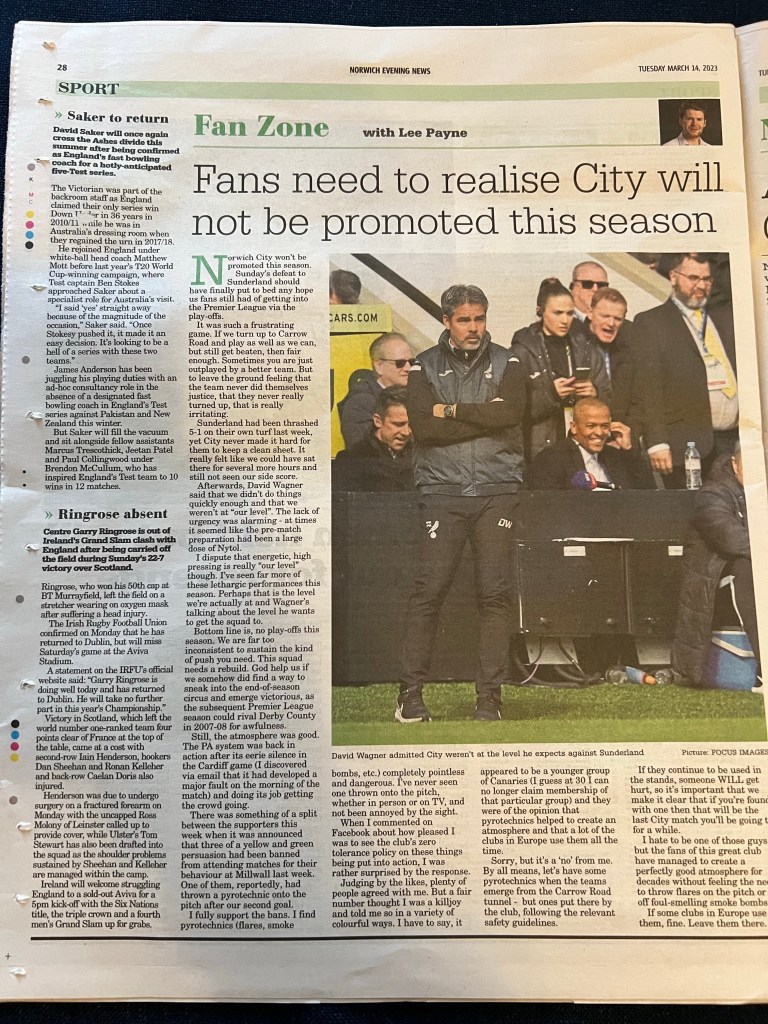
Here is what my column looks like in print. I’ve no idea who the bloke in the photo at the top is – it’s definitely not me but I can assure you they are my words! They must have made a mistake at the paper.
In the column I talk about Norwich’s 1-0 defeat to Sunderland on Sunday, how irritated I was at the result and how I feel it’s the final nail in the coffin for our hopes of making the play-offs. I also make my feelings clear on the use of pyrotechnics by the crowd, an offence for which three City fans have now been banned from attending matches.













 LEE PAYNE