Many would have been tempted to stick to the formula that had brought such huge success, releasing a rinse-and-repeat third album to please the masses. Not Arctic Monkeys.
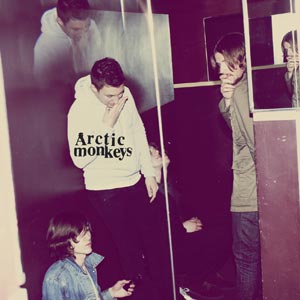
After a whirlwind period in which the Sheffield band’s first two albums had been released within fifteen months of each other, there was more of a gap between 2007’s Favourite Worst Nightmare and its follow up. The front man, Alex Turner, recorded with his side project The Last Shadow Puppets – the resulting album, The Age of the Understatement, also went to number one.
The four members of Arctic Monkeys had first met Josh Homme while playing the support act for his band, American rock outfit Queens of the Stone Age, in Houston. The idea of working together was mooted and in late 2008 they began making music with Homme in his recording studio near Los Angeles. They then continued to work in another studio in the Mojave Desert – about as far away from suburban Sheffield as it is possible to imagine.
Ten tracks, all written by Turner as usual, but this time the lyrics were more abstract and instead of just guitars and drums those lyrics were accompanied by keyboards, xylophones, glockenspiels and shakers.
I won’t go into detail about each song, but here a couple of things I want to say: Fire and the Thud was written about Turner’s then-girlfriend Alexa Chung, and Cornerstone contains my favourite lyrics in the entire Monkeys canon.
Tell me, where’s your hiding place?
I’m worried I’ll forget your face
And I’ve asked everyone
I’m beginning to think I imagined you all along
Cornerstone by Arctic Monkeys
Humbug was released in the UK on 24th August 2009, which was not just the day before my 17th birthday but also five days before Arctic Monkeys headlined Reading Festival with a set that included seven of the new album’s ten tracks. They were almost unrecognisable from the band that had performed on the same stage just three years earlier – the hair was longer, the guitars louder, the mood darker.
Arctic Monkeys headlining Reading Festival in 2009
As such a major departure from their earlier work, it took some fans time to get their heads around Humbug but it was another number one album for the band and is now seen as something of a gateway for them – a record that allowed them to break out of the image of cheeky indie lads and into bona fide rock stars. It paved the way for AM, the album that broke America, and the other-worldly Tranquility Base Hotel & Casino.
Yes, I’m well aware that I’m biased (I’ve listened to Arctic Monkeys nearly every day for years), but I urge you to give this album a listen.
Yes, I’m writing about Arctic Monkeys again. To go with my pieces on their first, second and sixth albums, I am going to take you track-by-track through the record that cracked America for the four-piece from Sheffield.
One of the things I admire so much about Alex Turner, Jamie Cook, Nick O’Malley and Matt Helders is how they have evolved over time. They have never been afraid to go in a completely different direction and, to them, making the same music over and over again is a crime. Listen to their first hit single, 2005’s I Bet You Look Good on the Dancefloor, and One Point Perspective, my favourite track from the 2018 album Tranquility Base Hotel & Casino, and you can scarcely believe that the two songs were written and recorded by the same band.
By the time AM was released on 9th September 2013, Arctic Monkeys had transformed from the scruffy indie kids in baggy jeans they were when they started out to rockers with slicked-back hair and leather jackets. The music had gone through a similar process.
In an interview with BBC Radio 1 at the time of release, frontman Alex Turner said:
“…it feels like this record is exactly where we should be right now. So it felt right to just initial it.”
AM was born – with more than a nod to VU, released in 1985 by the Velvet Underground.
The album’s opening track Do I Wanna Know? features what I consider to be one of the great guitar riffs. If you happen to be walking somewhere listening to it through headphones, I promise that you will feel approximately 94% cooler than you really are. The song is about unrequited love, how difficult it is to move on when you’ve been obsessed with someone and ponders whether the narrator really wants to know ‘if this feeling flows both ways’ or not.
Another reason why this band means so much to me is that I really identify with the lyrics. There’s a line in the song – ‘maybe I’m too busy being yours to fall for somebody new’ – that completely nails how I’ve felt in the past, in a way that I hadn’t been able to figure out for myself up to that point. Do I Wanna Know? was the first Arctic Monkeys song to make the Billboard Hot 100 chart in the US and was the opener to every gig the band played when touring the album. If you’re a fan of Peaky Blinders you might recognise it too.
The band wanted to make a record that sounded good in a car and after that strong start they follow it up with R U Mine?, which sounds a bit like an up-tempo version of Do I Wanna Know?. The rapidly delivered lyrics are about missing the object of your desires and having a sincere feeling that every moment spent without them is wasted. The video for the song won the NME award for Best Video:
The award winning video for R U Mine?
One For The Road is the first example on the album of the continuing influence of Josh Homme on Arctic Monkeys. The frontman of Queens of the Stone Age first worked with the Monkeys on their third album Humbug and has been close to them ever since. In this song, you get the sense that Homme – who features on vocals – is moving their sound away from their native Sheffield and towards a kind of Americana. This was not a popular move among some of the fans but, for me, it’s really good if done well – which it is here.
“And when she needs to shelter from reality she takes a dip in my daydreams”
— Lyric from Arabella
Alex Turner would introduce a performance of the fourth track from the album by informing the crowd ‘I want to tell you about a girl called Arabella!’. The lyrics are poetic, full of metaphors and a sign of how Turner’s songwriting has matured from, as he put it, ‘pointing at things and talking about them’ to speaking more from within. The song is essentially all about how awesome the aforementioned Arabella is.
I Want It All and Mad Sounds are as close as this album gets to filler – very listenable songs, both achieve the aim of sounding great in the car – but just not particularly ground breaking. Between those tracks sits No. 1 Party Anthem, the obligatory ‘slow’ number on the album. I’m not sure why, but it feels to me like a bit of a tribute to the band’s debut single I Bet You Look Good On The Dancefloor. It contains some cracking lyrics too, my favourite being ‘It’s not like I’m falling in love, I just want you to do me no good/And you look like you could’. The performance of it at Reading festival in 2014 was a highlight of their set.
No. 1 Party Anthem live at Reading Festival in 2014
Take in Fireside for its tale of how love can be unpredictable, the much-covered Why’d You Only Call Me When You’re High? for its story of frustration and try to get over that special someone with Snap Out Of It.
Knee Socks is another song featuring the voice of Josh Homme, which might explain why I’ve always found it very similar to One For The Road.
Most people would agree that Arctic Monkeys is a terrible name for a band. The story goes that it was guitarist Jamie Cook who came up with it but they were always looking to change it, until the performance poet John Cooper Clarke was apparently the first person to say he actually liked it. Clarke had always been a hero of Alex Turner’s, which isn’t surprising what with his proficiency with language, and performed at the Sheffield bar Turner was working in one night. Turner plucked up the courage to tell Clarke about the band he was part of and Clarke said ‘that’s a name I can imagine in the hit parade!’. The name has stuck ever since, and one of Clarke’s poems was slightly tweaked to turn it into the closing song on AM.
I Wanna Be Yours, with its quirky lyrics including ‘let me be your vacuum cleaner, breathing in your dust’, seems the perfect way to finish off the record – it’s a love song, but one that’s down to earth and not too mushy. And for a brooding, confident album there seems no better ending.
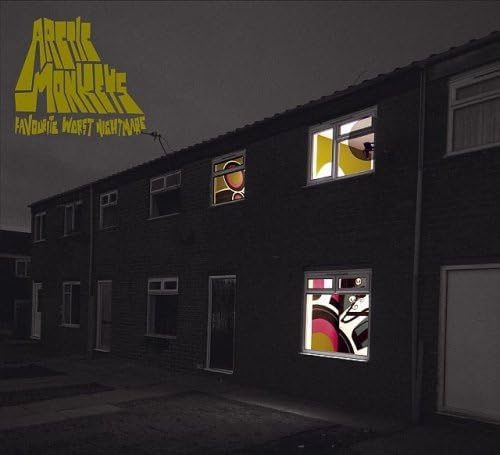
It was only the year 2007 and yet it had already been quite the ride for Arctic Monkeys. Entering their fifth year since forming, they already had two number one singles and the fastest selling debut album by a band to their name. The Prime Minister, Gordon Brown, even claimed to be a fan – though when pushed he couldn’t name any of their songs. The time had come to tackle the difficult second album.
On 23rd April 2007, Favourite Worst Nightmare was released. Not as raw as the previous year’s Whatever People Say I Am, That’s What I’m Not, the twelve songs feel more polished. Alex Turner’s superb observational lyrics go a little deeper and branch out further than musings on Sheffield’s nightlife.
The album opens with Brianstorm, a loud and confident start which apparently describes a man the band met backstage after a gig in Tokyo. ‘Brian’ left such a big impression on the Monkeys – ”Cause we can’t take our eyes / Off the t-shirt and ties combination?’ – that he became the subject of a song. Brianstorm has become an absolute staple of their live sets, a real crowd pleaser, and they are still performing it now. Here it is from Lollapalooza in Argentina in 2019:
Next comes Teddy Picker. If you’ve ever been to one of the arcades at the seaside, you’ll know what a teddy picker is – those machines that have a claw you try to grab prizes with. Turner uses those teddy pickers as a metaphor for the pursuit of fame and the downside of it. ‘And it’s the thousandth time that it’s even bolder / Don’t be surprised when you get bent over / They told you, but you were gagging for it’. It’s basically a warning to be careful what you wish for.
Track three is D Is For Dangerous, the chorus of which gives the album its title:
‘D is for delightful And try and keep your trousers on I think you should know you’re his favourite worst nightmare’
Love is certainly not an unexplored topic in music, but I have always admired the slightly different way Alex Turner approaches the subject. Like in the first album’s Mardy Bum, which describes a row between a couple, D Is For Dangerous is about being in love with someone you know it won’t be easy to deal with.
Matt Helders, Alex Turner, Nick O’Malley and Jamie Cook in 2007
The album moves on to a song about casual sex. Balaclava, with its catchy bass throughout, is all about not becoming emotionally attached to the girl you’ve just pulled. ‘The confidence is the balaclava’.
Next is my favourite song on the album, Fluorescent Adolescent. It’s probably the best known one on it, and the one you’re most likely to have heard somewhere else (it was, for example, on the soundtrack to The Inbetweeners). It starts with two guitars crashing into each other, leading into Turner’s lyrics about getting older. I can do no better than to relay the whole of the first verse:
‘You used to get it in your fishnets Now you only get it in your night dress Discarded all the naughty nights for niceness Landed in a very common crisis Everything’s in order in a black hole Nothing seems as pretty as the past though That Bloody Mary’s lacking in Tabasco Remember when you used to be a rascal?’
Turner was just 20 years old when he wrote that with the help of his then-girlfriend Johanna Bennett.
The band slowed the song down and added a snippet of Dion’s Only You Know to it to make for a highlight of their headline set at Reading in 2009:
Like most albums, Favourite Worst Nightmare has a slower tune in the form of Only Ones Who Know. I would almost describe the guitars on this song as haunting. It’s great to listen to with headphones on. It feels like a sad song, and sets this album apart from their debut, which had a cheekier tone throughout.
In Do Me a Favour Turner once again turns the classic break up song on its head by writing it from the perspective of the person in the wrong. It starts with Matt Helders thundering on his drums and describes, in Turner’s words, ‘a goodbye’.
‘It’s the beginning of the end The car went up the hill and disappeared around the bend Ask anyone, they’ll tell you that it’s these times that it tends To start to break in half, to start to fall apart, hold on to your heart’
We are into the second half of the album and This House is a Circus signals a change in tone for the album. A wild night out is described in what Turner calls his favourite song from the record.
Next, it’s If You Were There, Beware and we are back onto the topic of fame. In this one, Turner talks about how annoyed he is at the way the media treats his loved ones. In terms of the instrumentation it’s the clearest hint we get of what was to come on the third Monkeys album, Humbug, which represented a major shift in sound for the band. Lyrically, it seems Turner’s girlfriend is being hounded by the paparazzi:
‘If you were there, beware the serpent soul pitchers Can’t you sense she was never meant to fill column inches Ain’t you had enough? What you’re trying to dig up Isn’t there to be dug; the thieves help the thugs As they’re trying to beat the good grace of a sweetheart Out to the point she’ll comply’
The bad thing in Do The Bad Thing is having an affair, and Old Yellow Bricks is all about finally getting out of your hometown and realising that the rest of the world isn’t up to much after all. An interesting one, given that nowadays two of the band live in Los Angeles while the other two have settled back down in their native Sheffield.
The album closes with 505, a song recently named the best of all Arctic Monkeys songs in a radio station poll and a track the band have used to bring the curtain down on countless live performances over the years. It starts off with the sound of an organ, the same chords you can hear in the Western film The Good, The Bad and The Ugly, and suddenly ups the tempo in the final third of what Turner described as ‘the first proper love song we’ve done’. Additional guitar for this track was provided by Miles Kane, who would form the supergroup The Last Shadow Puppets with Turner later in 2007.
So there we have it – the twelve songs that made the difficult second album something of a breeze for Arctic Monkeys. Favourite Worst Nightmare went straight to the top of the album chart and secured the band their first headliner slot at Glastonbury. I will leave you with the band’s brilliant performance of 505 from Glastonbury 2013.
Every now and again I am going to present a track I think you should listen to under the title ‘Listen To This’.
I have written before about my favourite band Arctic Monkeys and their sixth studio album Tranquility Base Hotel & Casino. My first track for this feature is a Monkeys song, but this one was released as a standalone single in 2006 between their debut album Whatever People Say I Am, That’s What I’m Not and their second release Favourite Worst Nightmare.
It’s called Leave Before The Lights Come On.
I think the band’s frontman Alex Turner is a lyrical genius and the words to this song would fit in very well with their phenomenally sucessful debut album.
That was essentially a concept album about nightlife in a big English city. Turner drew on his experiences of nights out in his native Sheffield to craft a compelling collection of songs that almost everyone between the ages of 16 and 21 in the country could relate to.
Leave Before The Lights Come On basically describes a one night stand. It would have slotted nicely onto the album but it says something about it when a song as strong as this doesn’t make the cut. When the band performed it at Reading festival in 2006, Turner described it as ‘the black sheep of the family… but we love it all the same.’
And how can you wake up with someone you don’t love
And not feel slightly fazed by it?
Arctic Monkeys – Leave Before The Lights Come On
Turner’s lyrics are well supported by the rest of the band. Each of the four members has to work hard on it, and that was one of the things that makes me love it so much. Matt Helders gets it going with his pounding drums, Andy Nicholson (and latterly Nick O’Malley) come in with the bass and Jamie Cook combines brilliantly with Turner on guitar. The song feels very well structured – it tells a story from start to finish in 3 minutes and 47 seconds. If I was in a band, I’d definitely cover it as everyone in the band would have a big part to play.
The music video for the song features the actor Paddy Considine, who was in 24 Hour Party People, Submarine and Hot Fuzz amongst other things.
Finally, here is the band performing the song during their headline set at Glastonbury in 2007.






 LEE PAYNE