Tag: second

  • There’s history everywhere if you look hard enough – my little trip to Mundesley

    I’ve got some much needed time off work this week and, not wanting to waste it sitting around at home (though the snow has rather forced my hand on that one for the last couple of days), on Wednesday mum and I decided to go and see the sea.

    We ended up in Mundesley, a village I hadn’t been to that often and didn’t know that much about. I knew that a teacher I didn’t like at primary school lived in Mudesley, and I knew that Mundesley was the first place mum and dad took me for an outing after I was born. I don’t remember that, obviously, but I’ve been told about it. I’ve also been to Mundesley with my friend and her dog for a walk.

    When we arrived, the village was very quiet indeed, as you might expect in winter with the wind blowing and the temperature hovering just above freezing. Mum and I went to the cafe nearest the car park, where we sat in the window watching a procession of dog walkers heading down and then re-emerging from the ramp that leads to the beach. I had a coffee and a bacon and sausage roll. I’ve become something of a connoiseur of various pig products presented between two slices of bread, as my expanding waistline will attest to – Mundesley’s, for the record, was acceptable. Not the best I’ve ever had, but not too bad.

    After the cafe we went for a walk, taking in the Norfolk coast path and the various sights along the way. Mundesley is actually a very interesting village in an architechtual sense – there are a number of old buildings, quite grand in appearance, that I wish I could find out more about.

    Look at this building, for instance. I’ve had to get this image from Google Maps as I didn’t take many when I was there (my hands were too cold to hold my phone) but I can tell you that it looks exactly like this now. Empty.
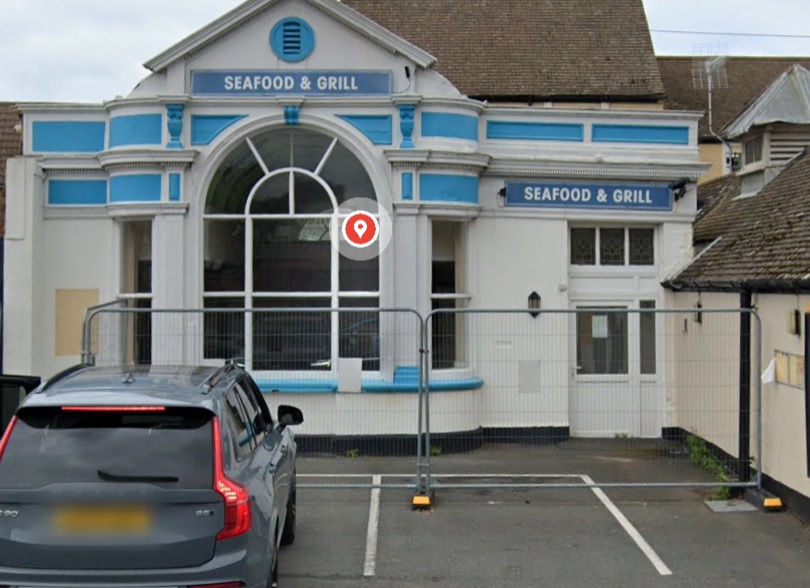
    The architecture looks kind of art deco, I would say. It’s attractive, with its curves and big window. Yet it is underused, not being utilised to the extent that I’m sure the people who put it there invisaged.

    The research I’ve done suggests that this building, somewhat surprisingly, isn’t listed and that it was once called Bar Victoriana. Judging by its Instagram account, Bar Victoriana marketed itself as a trendy cocktail bar and occasionally had live music. The bar’s website is now dead, but on Facebook it appears to have closed in July 2019, with the promise of a ‘new seafood & grill restauarant’ on the way, which would explain the signs still on the outside. I can’t find anything about what happened afterwards, but I would suspect that the business may have been a victim of the pandemic.

    The building as it was in September 2008

    Mundesley has plenty of Victorian buildings, probably due to the arrival of the railway (long gone) in that period that turned the village into a holiday resort. Some of them are made out of local stone, given them an unusual appearance, while others are built from the red bricks you would expect of the Victorians.

    There are two imposing former hotels in Mundesley that demonstrate its past glory as a Victorian seaside resort. The photo below shows The Grand Hotel, as it was originally known, in around 1960:
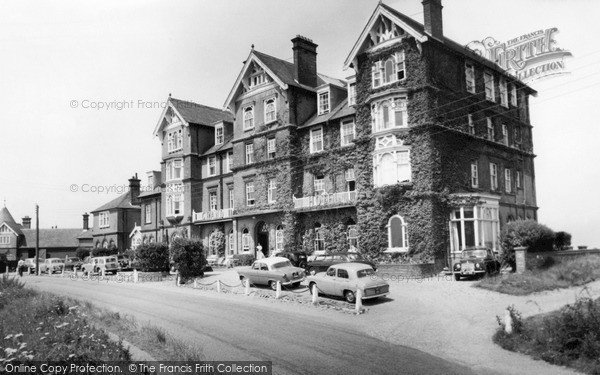
    From what I’ve been able to find out, the hotel was renamed the Hotel Continental at some point after the Second World War. G. Laird, who took the more recent photo below, remembers three summer holidays in Norfolk during the 1960s and said the Hotel Continental ‘was then a very elegant building and was clearly a popular hotel’.

    It would seem the hotel later became apartments.

    Old hotels fascinate me – especially abandoned ones. You see, history isn’t about being nerdy and reeling off dates all the time. My interest in history comes from mentally taking a trip into the past and thinking about what the buildings and the places I can see used to do, and of the scores of people that would have used them in a former life. Think about all of the Victorians who would have come to that hotel for their bucket-and-spade holiday. How excited they must have been to be out of the city for a few days. Imagine them, dining in the hotel with a view over the sea. What would they think of it now? A bit run down, a shadow of its former self. That’s what intrigues me about this kind of thing.

    The other old hotel in Mundesley is the Manor Hotel. It was built in 1900, so slightly newer than the Hotel Continental, and was – as the name suggests – originally a manor house, converted into a hotel as the tourism industry took off. According to this newspaper article, the hotel ceased trading in December 2019 and a month later was up for sale (for what seemed like quite a reasonable £450,000). Of course, the pandemic was on its way shortly after, bringing with it a complete halt to tourism and leisure activities, so I don’t know what happened after that. The building stands empty, still showing evidence of the business that continued there until 3 years or so ago. Below is a photo I found online of the hotel in the month it closed:

    Our walk also took in the impressive All Saints church, which stands alone and imposing on the cliff top. The church has Norman origins, but I learned that it stood virtually in ruins for about a hundred years until being sensitively restored (unusual for the time, I think) between 1899 and 1914 – this coincides with the railway and subsequent tourist trade coming to Mundesley, so they probably felt like they wanted to smarten the place up for all of its new visitors. The church is described in much finer detail than I can manage here.
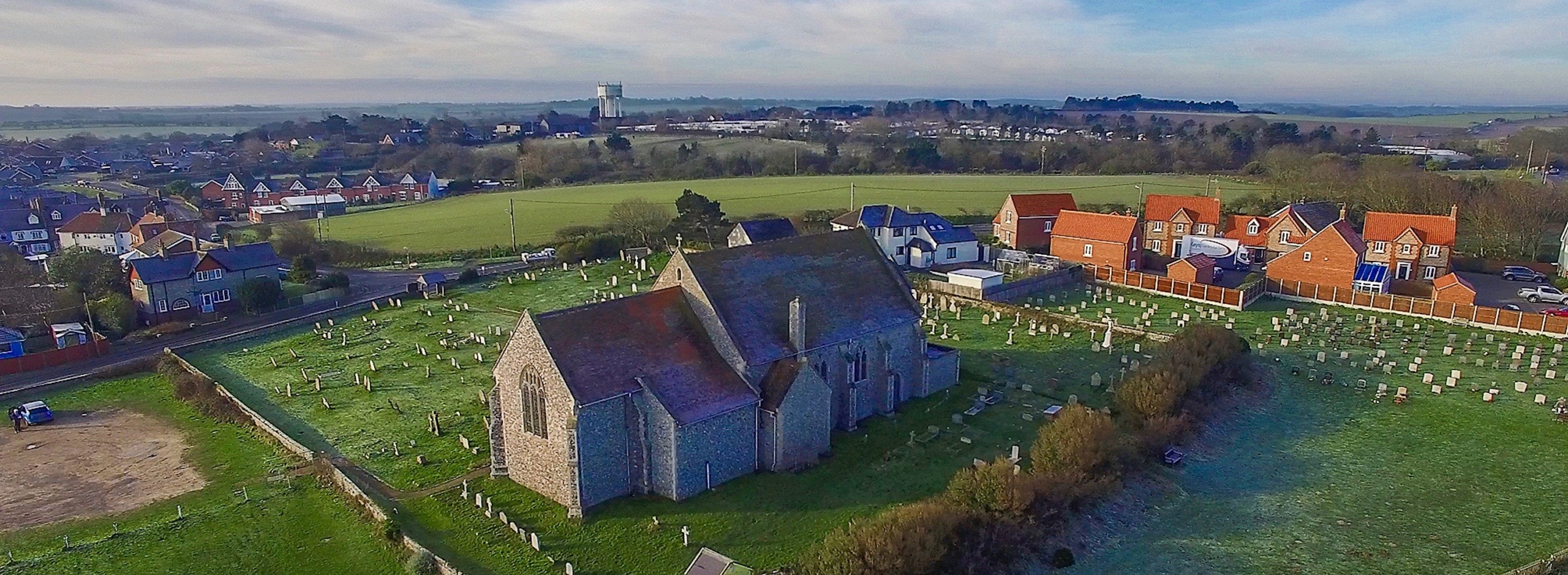
    The church of All Saints, Mundesley

    On the wall of the church, we noticed a plaque dedicated to the residents of the London borough of Haringey who had died at Clarence House in Mundesley. We found The Clarence House later on in our walk, and it is a care home in what looks like it might have been another former hotel, but even looking online I can’t find anything about this perculiar dedication to people who came there from the capital. My theory is that some elderly residents of Haringey may have been moved out of bombed-out London to calmer, safer surroundings on the Norfolk coast, but I have no idea if I’m thinking along the right lines. If anyone reading this happens to know more, please do let me know.

    Speaking of the war, there is a large amount of evidence of Second World War defences in Mundesley. As well as a few pillboxes, there is a gun emplacement, built in 1940 or 1941. There is a newspaper article here about the community’s efforts to have the gun emplacement protected by Historic England. The gun emplacements are a stark reminder of how worried Britain was during the war about the enemy invading by sea and its extensive efforts to protect the coastline. The guns themselves were removed by 1946, but under the structure remains what would have been an accomodation area complete with bed frames. The future of the gun emplacement is a concern, with the underground section apparently now full of water and coastal erosion bringing the whole thing ever close to the edge of the cliff. I’m not that into war history, but I’d recommend visiting the gun emplacement at Mundesley while you can.

    The gun emplacement at Mundesley, pictured in 2016

    Part of our walk also took in Sea View Road, an untarmacked street separate from the main road. We found the number of seemingly empty but reasonably well-kept properties along this road odd, eventually concluding that this is probably an area of second homes – rich people, coming from outside Norfolk, who own properties on the coast that they only live in for some parts of the year. It’s a growing point of contention around here, and is already a massive problem in places like Cornwall.

    Our walk also took in this old brick kiln, right in the middle of what is now a caravan park and one of Mundesley’s listed buildings, and some evidence of coastal erosion:

    With a little help from a bus, we were back where we started and some (very good) chips for lunch brought a lovely little trip to the seaside to an end. I left knowing more about this small village of the North Norfolk coast, and reminded that everywhere has a story to tell if you look hard enough. I urge you to go out there and explore!

    The route of our walk
  • This is what Norwich was like just before Elizabeth became Queen

    This is a post I’ve been planning to write for a few weeks. With the events of the last few days marking the end of the second Elizabethan age, I realised that it will be more poignant.

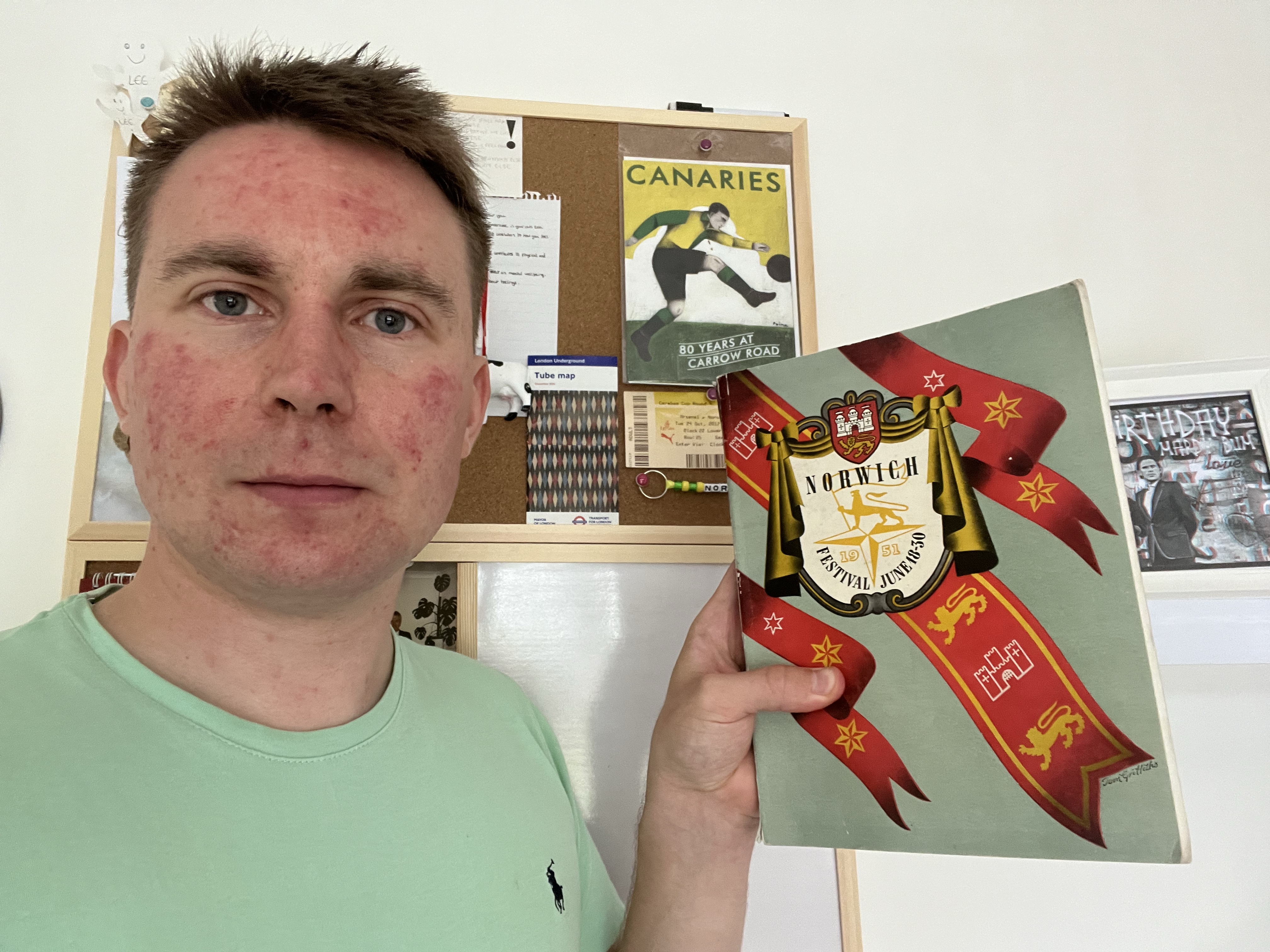
    I recently returned to the ‘retro shop’/garden centre that I had found a football magazine from 1964 in back in March. The pile of magazines and comics had gone, but I did discover a fascinating artefact of local history: the official guide to the Norwich Festival of 1951.

    The Second World War was still fresh in the memories of the nation. Times were tough – austerity and food rationing had people in low spirits. The Labour government of the time planned a celebration of Britain and its achievements, to be held in the centenary year of the Great Exhibition. While the centrepiece was on the South Bank in London (it’s where we got the Royal Festival Hall from), events took place across the country, including in Norwich.

    On 18th June 1951, Princess Elizabeth – later, of course, to become Elizabeth II – opened the Norwich Festival from the balcony of City Hall.

    Princess Elizabeth arrives at City Hall in Norwich, 18th June 1951

    At the time of the Festival, the country was under the reign of King George VI. Elizabeth would ascend to the throne upon her father’s death a year later. This means that the Festival, and its guide book, are a wonderful insight of what Britain was like immediately before the Elizabethan age we have all lived through.

    The book is full of articles about the city and adverts from local businesses. The two are worth a post each, so I’m going to focus on the adverts today. They provide a window into a Norwich of yesterday – a city that made things (mainly shoes) and a city dominated by local names rather than high street chains. But they also show names that are immediately familiar.

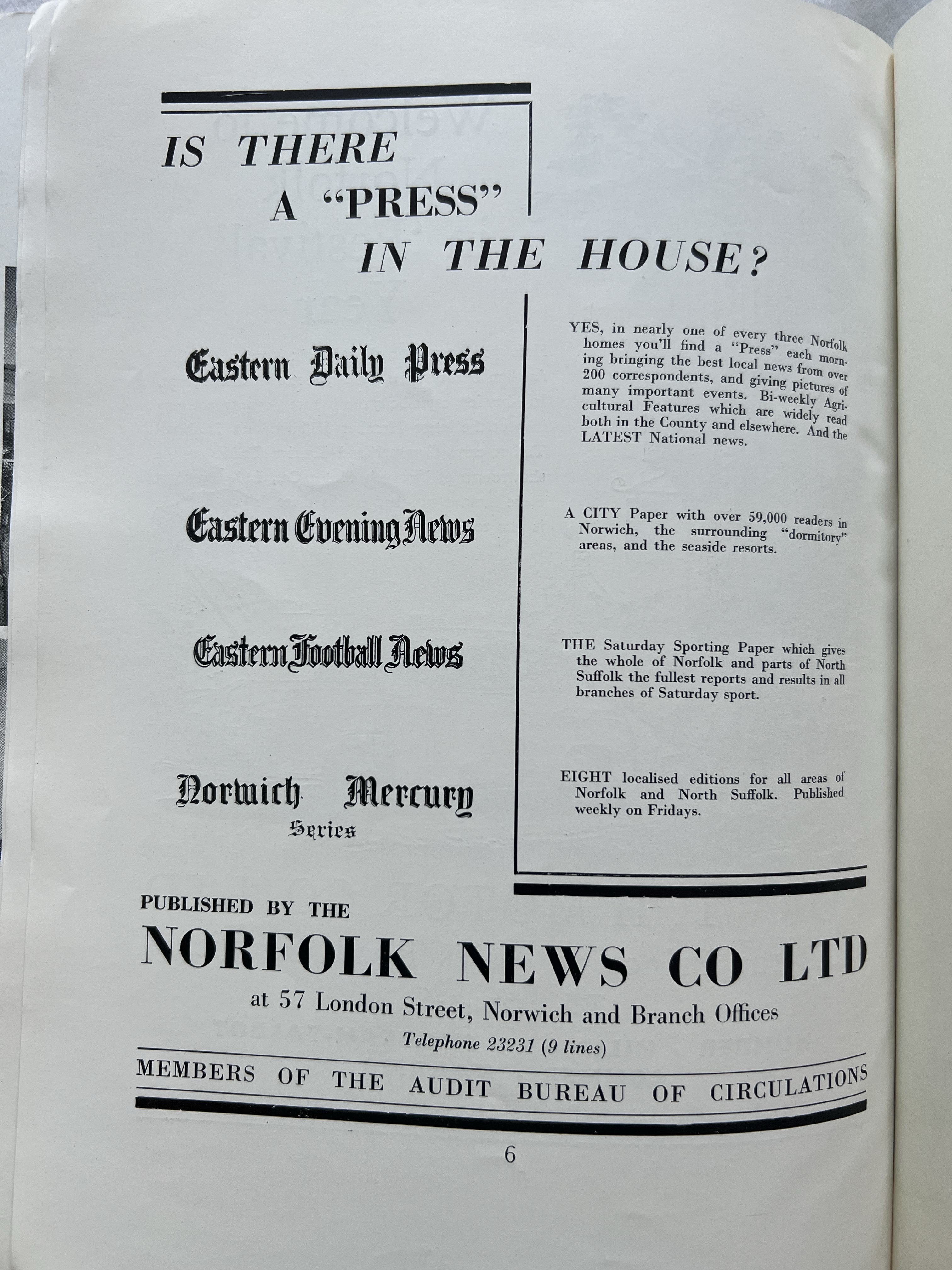
    I’ll start with this one, advertising the local newspapers of Norwich and Norfolk. The Eastern Daily Press and the Evening News are still in publication, though the EDP’s claim that ‘nearly one of every three Norfolk homes’ will have one is fanciful in this internet age. I bet their overworked staff wish they still had 200 correspondents to call upon as well.

    The Eastern Football News, due to the pink paper it was published on, was known as The Pink ‘Un, a name still used by Archant today for its football coverage.

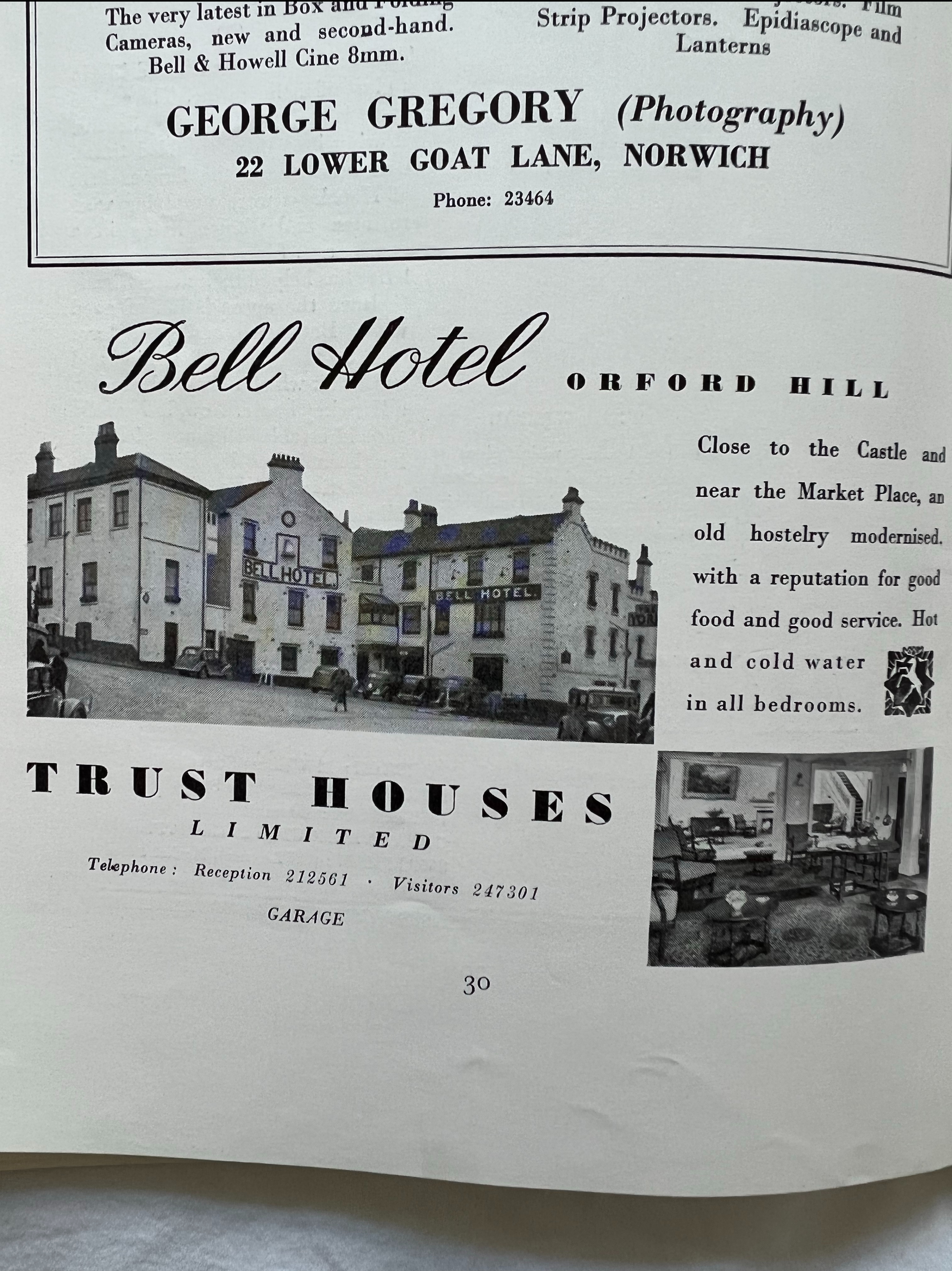
    Recognise this place?

    The Bell Hotel has hardly changed, on the outside at least, for 71 years.

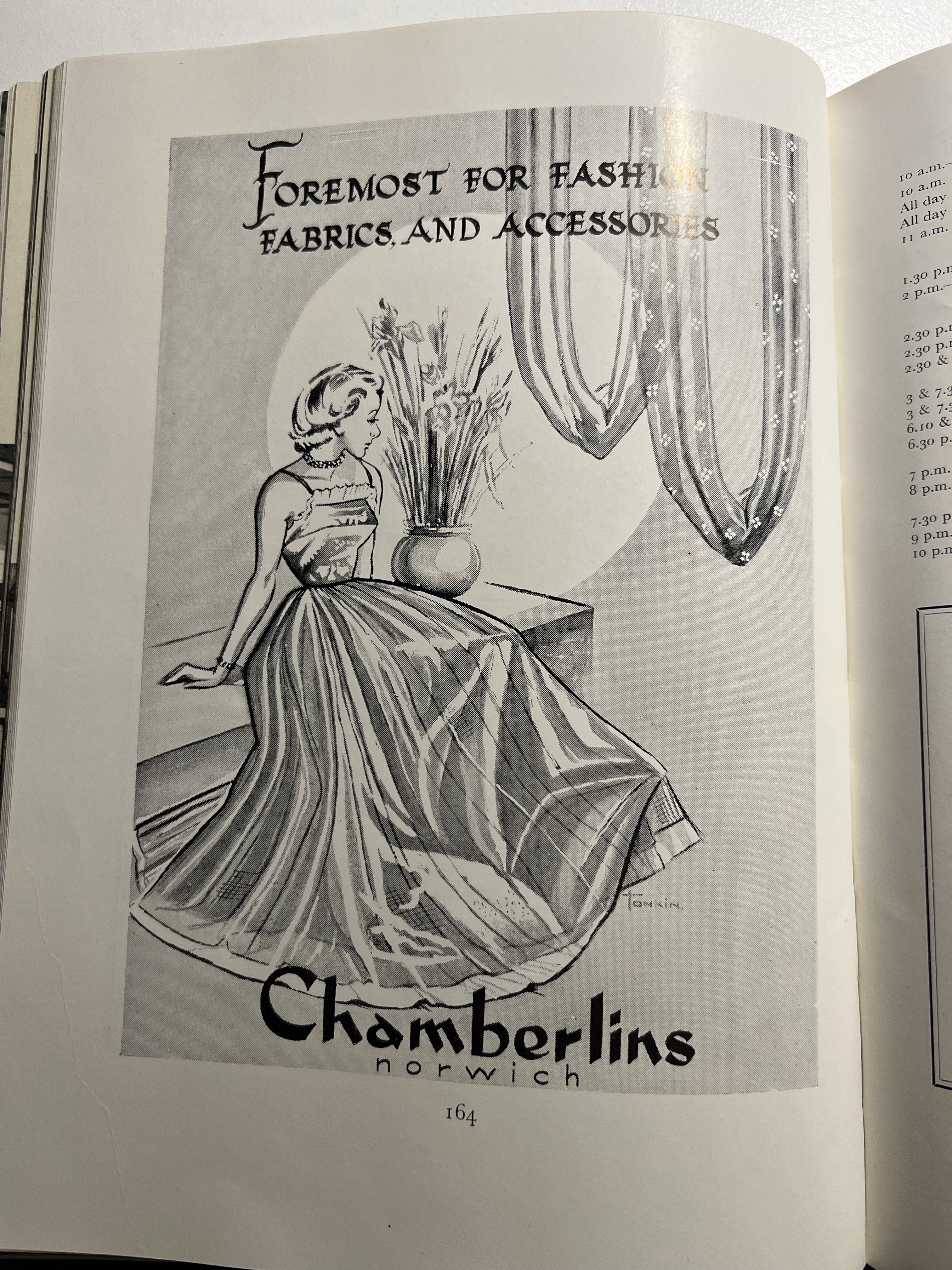
    Now, we’re off to Chamberlins.

    The building was until recently partly used as a branch of Tesco Metro, opposite the Guildhall. Plans are to turn it into a hotel.

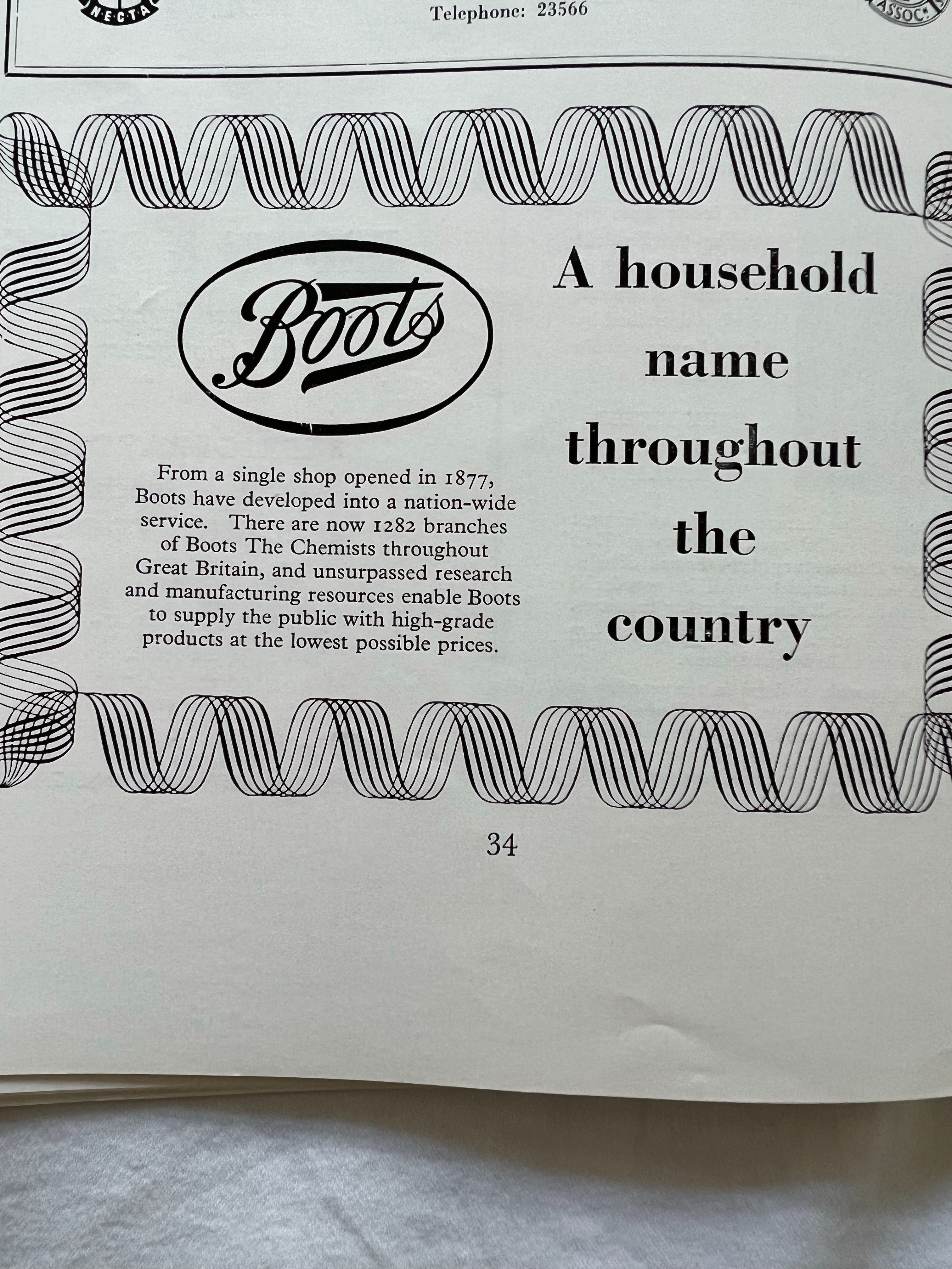
    This advert for Boots caught my eye only because the pharmacist’s logo is almost the same as it is now.

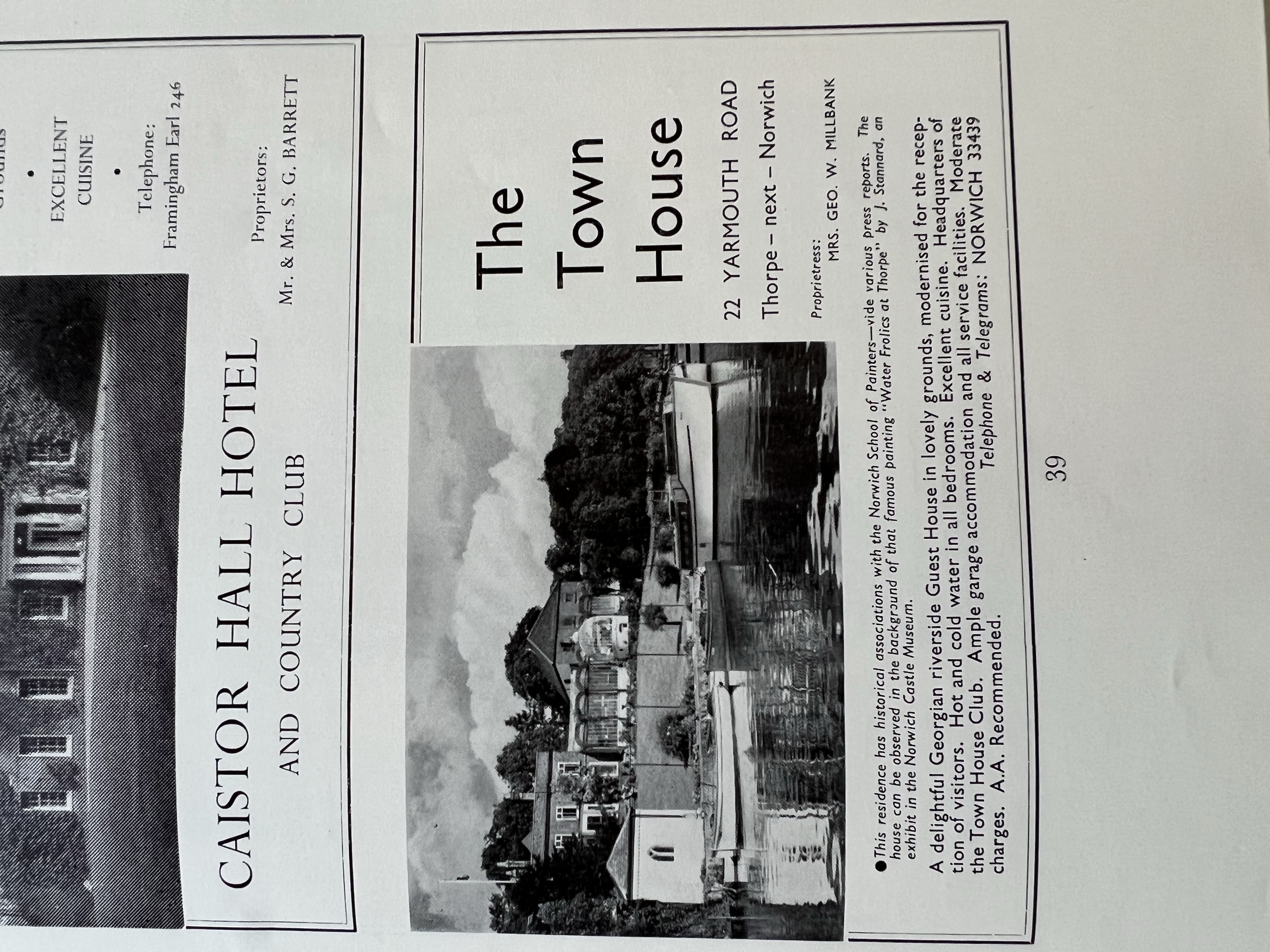
    The Town House is advertised, with a photo taken from its more attractive river side. You can still enjoy a meal and a drink there today.

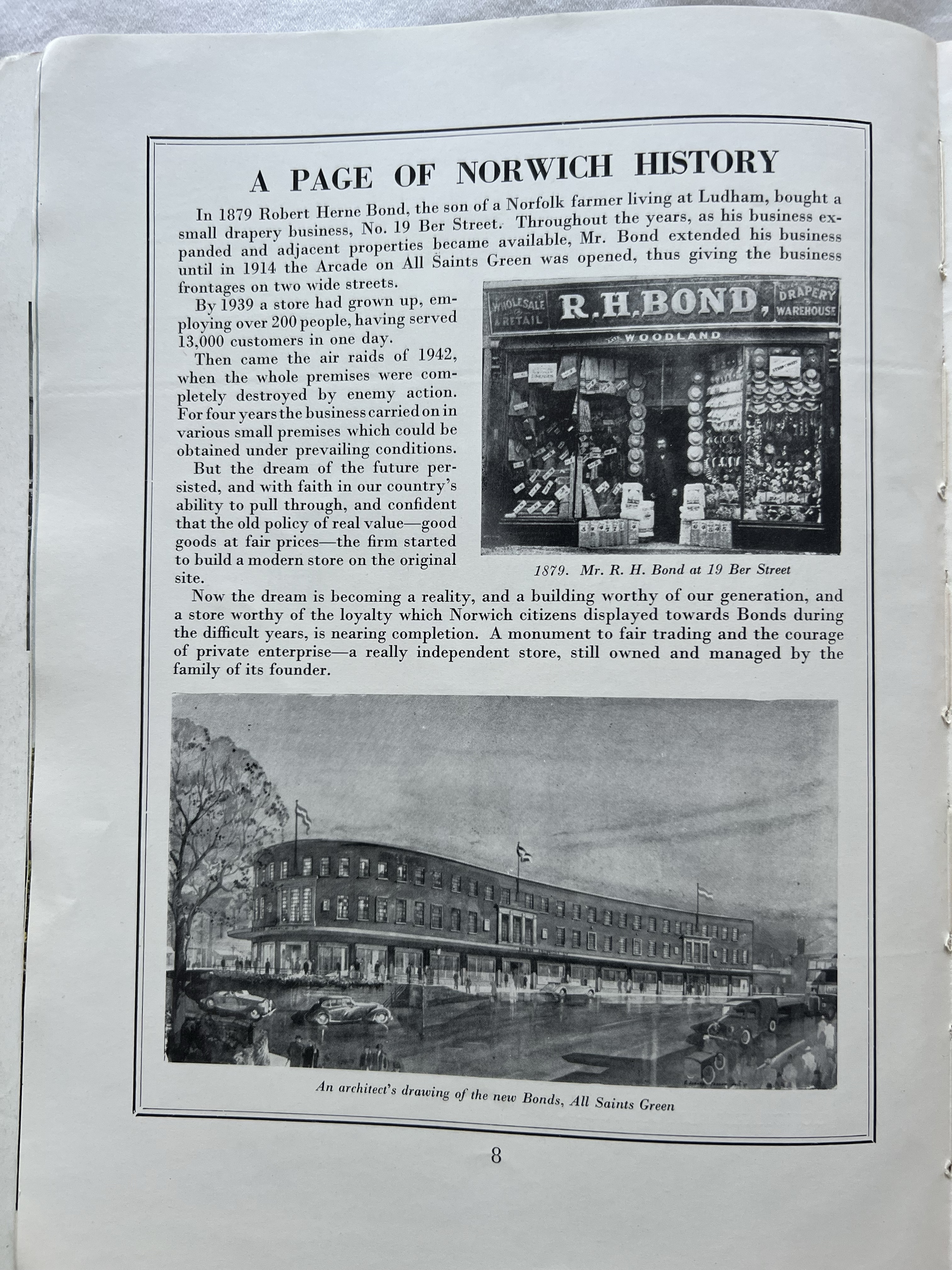
    Bonds department store in the city was destroyed in the Blitz. By 1951, its shiny, new building was nearing completion. The architecht’s drawing featured is pretty much exactly how it turned out.

    Bonds became John Lewis in 2001.

    The Bonds building as it stands today

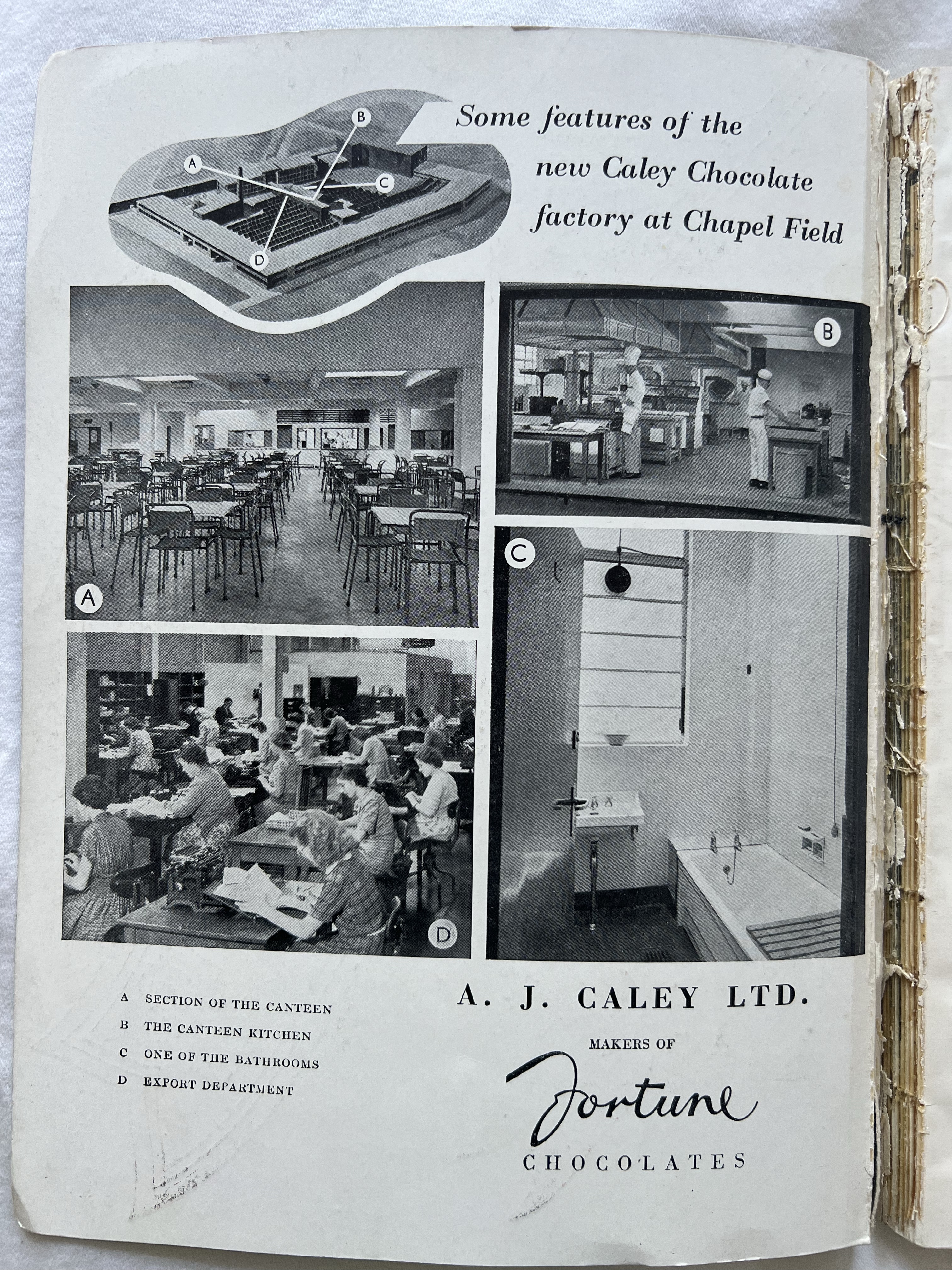
    Caleys used their space in the book to show off their new chocolate factory. The building is now long gone, demolished and replaced by what is now called Chantry Place shopping centre.

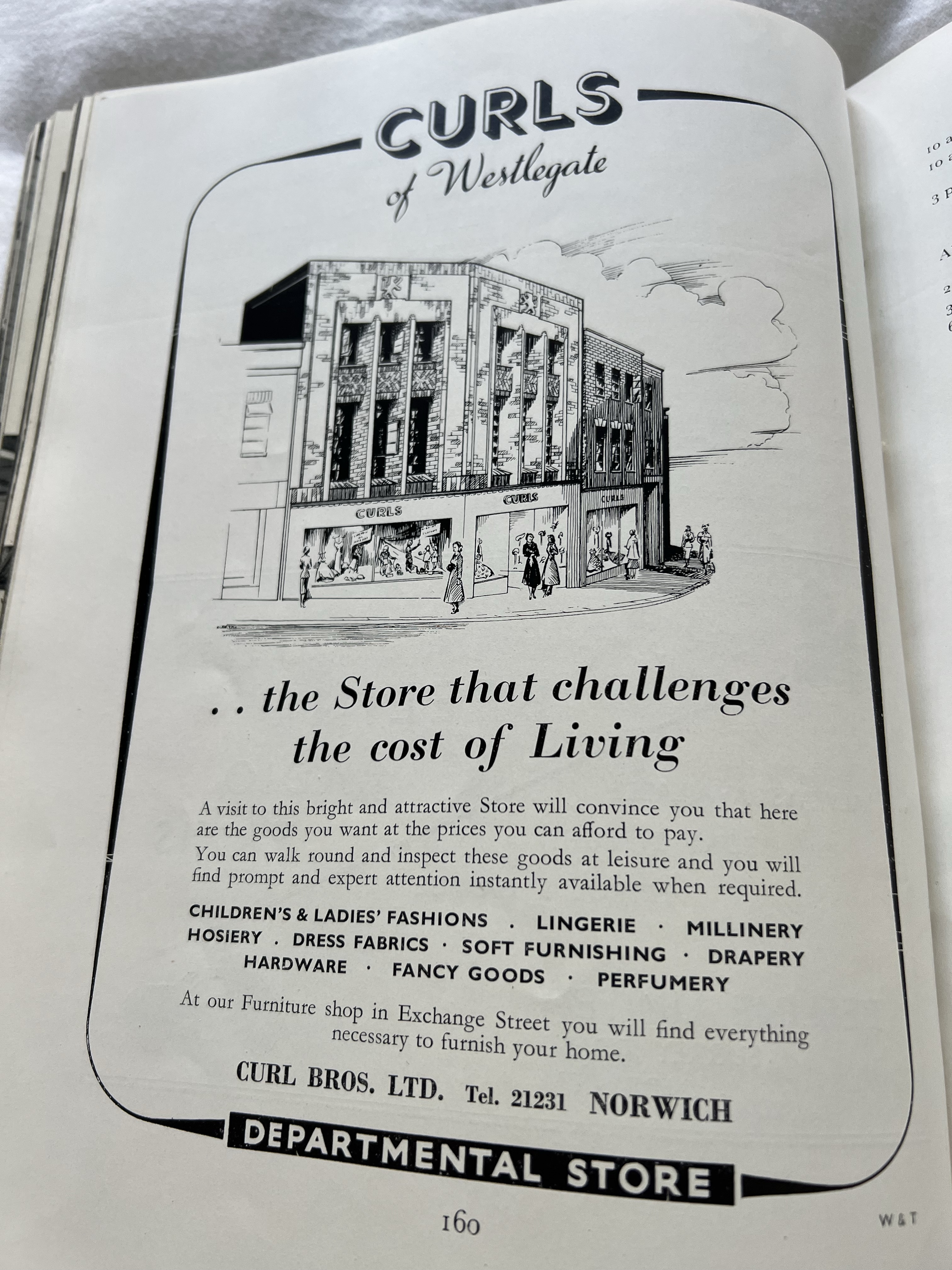
    The cost of living – now there’s a phrase we hear a lot these days. It was a problem in 1951, as well, but Curls thought they had the answer. Curls would go on to be Debenhams, though even that has gone now and the building remains empty for the moment.

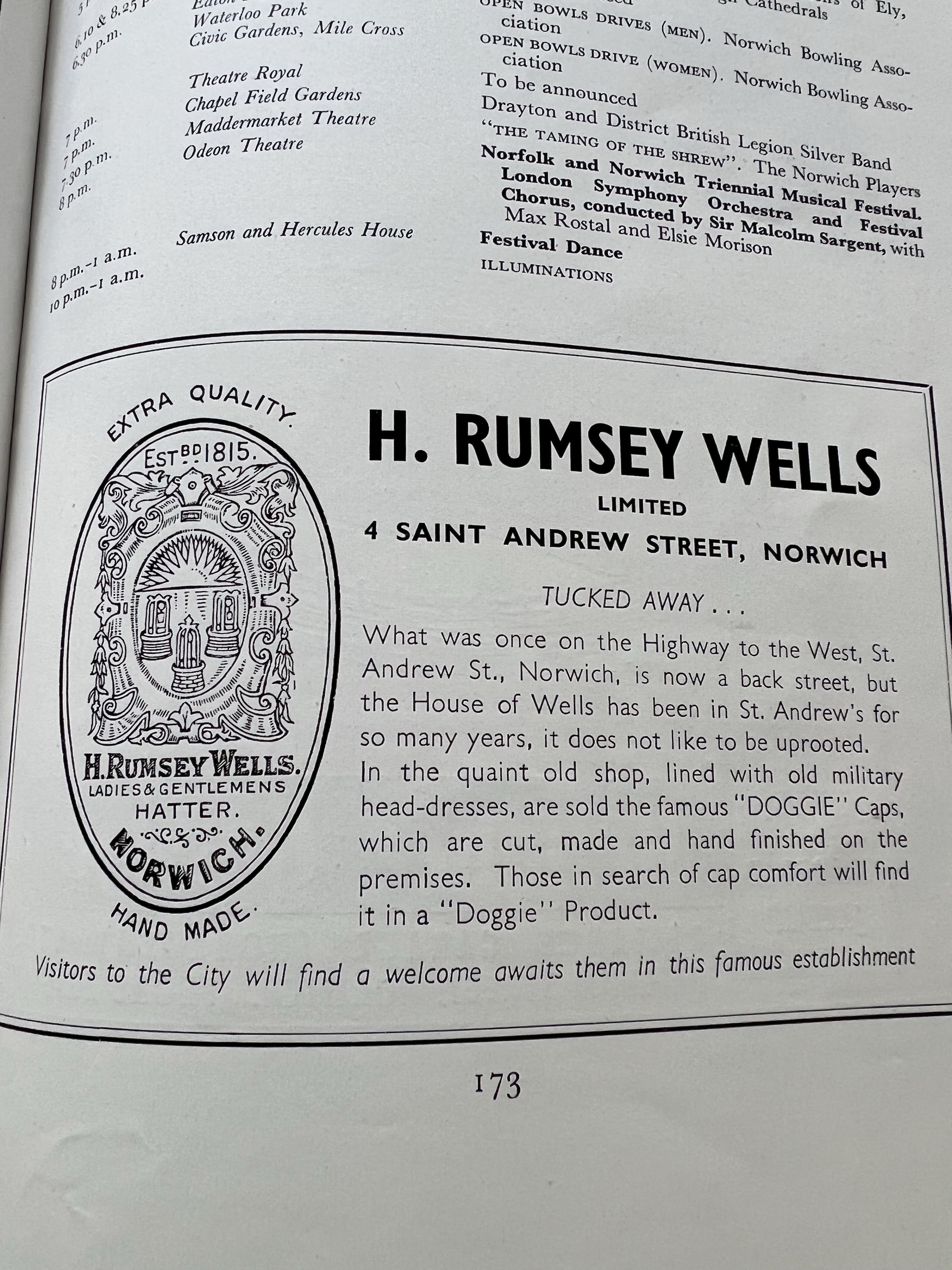
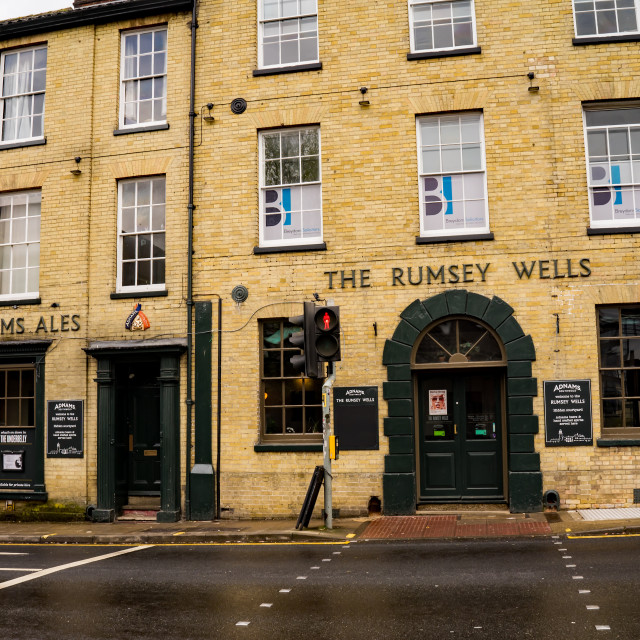
    And finally, here’s an advert from hat maker H. Rumsey Wells. The shop closed in 1974 but, if the name sounds familiar, it’s because the name of the shop lives on in the name of a pub that now stands on its site.

    The pub carries on the name of the hat maker on the site of his shop

    This is merely a few of the many adverts that give a glimpse into the Norwich of 1951. I may well dip in again some time. I hope you’ve enjoyed reading this, and may we enter the reign of King Charles III with optimism. Stay well, everyone.

  • Cricket is better than football

    England vs New Zealand
    2nd Test (of 3)
    Trent Bridge, Nottingham
    10th, 11th, 12th, 13th, 14th June 2022
    Result: England (539 & 299-5) beat New Zealand (553 & 284) by 5 wickets

    Jonny Bairstow’s astonishing century won the second Test for England

    Sport is my strongest passion. My life is essentially a continuous festival of sport, and football and cricket are the headline acts. I love them both, but it might surprise some to learn that in the unlikely situation I was forced to sacrifice one to keep the other cricket would be my number one.

    It’s not easy to argue cricket’s case in the face of a sport that dominates as football does. Governing body FIFA estimates that 4% of the world’s population are active players or referees, and 3.2 billion watched the 2018 World Cup on television. In Britain, it feels like someone you meet is more likely to be a football fan than not and it is often a safe bet to use a following of the game as an ice breaker.

    Cricket is actually the second most popular sport in the world, though the numbers are boosted somewhat by its obsessed following in very large countries such as India and Pakistan. Here, it is not so common to come across a fellow cricket fan (even less so one in their twenties like me) and it at times feels like a passion – a guilty pleasure – to be kept a secret, fearful of hearing some nonsense about it being “boring”.

    I expect many to scoff at this, but I believe cricket is far from a boring sport and actually more exciting than football. You see, in football the sole aim of the game is to score a goal. Everyone watching is waiting to see a goal. Some will say they are interested in the tactical battle or the attractive passing style of play, but deep down they just want to see a goal. Even when a goalkeeper makes a great save, what the neutrals really wanted to see was a goal. Absolute goal fests in high level professional football are, however, very rare – that’s why they get talked about so much when they do come along – so in reality most football fans are disappointed and bored more often than not. People keep watching, keep turning up for each game because maybe, just maybe, the next one will be the one with all the goals in it.

    Every ball of a cricket match is an event. It has lulls of course, every sport does, but it can’t possibly be boring in comparison to football because you could see the equivalent of a goal every few seconds. Each time the bowler approaches the crease, there is so much that can happen. Perhaps a wicket will be taken – stumps flying everywhere, a stunning catch – or maybe the batter will whack it out of the ground, or try a risky reverse sweep. No one has ever unironically enjoyed a 0-0 result in football, either, while in cricket a draw can sometimes be among the most thrilling things ever to happen in any sport.

    Daryl Mitchell scored a century and a half century in the match but was on the losing side

    With three distinct forms of cricket (four if you count the Hundred, which I don’t), the thrills come in many ways. The five day Test match is my favourite and the game that finished on Tuesday, with England winning at Trent Bridge, is one of the best I’ve seen in nearly twenty years as a fan.

    A flat pitch and a small ground meant a total of 1,675 runs were scored, compared to 837 in the first Test at Lord’s last week. 249 boundaries were hit across the five days, a record for a Test match. New Zealand, missing their captain Kane Williamson because he tested positive for Covid on the eve of the match, made the most of being put into bat by racking up 553. Nine of the eleven batters made it into double figures, with Daryl Mitchell adding 190 to his century at Lord’s and Tom Blundell joining him with 106. On Saturday, many were saying that England had gone back to their old ways – they got the decision at the toss wrong, they didn’t bowl well, they were wasting reviews.

    The new approach from the skipper Ben Stokes and coach Brendon McCullum is always to take the positive option, and England were certainly positive with the bat. Scoring more than 500 in the first innings will usually ensure that you don’t lose the Test, at least, but New Zealand remarkably found themselves beaten by five wickets with a whopping 22 overs unbowled on the last evening.

    From Alex Lees starting to express himself as a Test opener with 67 and 44, to Ollie Pope’s long awaited second Test century, Joe Root continuing his astonishing run of form with 176 and Ben Stokes seeing England over the line with 75 off just 70 balls, it has been a series to savour for the batters.

    Then there’s Jonny Bairstow. In my piece about the Lord’s Test, I was dropping Jonny for Trent Bridge and criticising his recent lack of red ball cricket. More fool me. Unleased, given licence to go full on white ball mode, he cracked one of the great Test innings. 136 off 92 balls makes it the second fastest century by an England batter in this form of the game and, though he nicked behind and wasn’t there at the end, he had certainly “broken the back of it” in his words. An extraordinary cricketer.

    England complete a win that will live long in the memory

    At the end of it, England have won a series for the first time in 18 months and go to Headingley for the last match full of confidence. For all the positives, Zak Crawley contributed only 4 runs in the game and Jack Leach sent down some very uninspiring spells of slow left arm bowling. So, will they be tempted into a change for Leeds? Here is who I would pick:

    1. Alex Lees
    2. Rory Burns/Ben Compton
    3. Ollie Pope
    4. Joe Root
    5. Jonny Bairstow
    6. Ben Stokes (c)
    7. Ben Foakes (wk)
    8. Stuart Broad
    9. Matty Potts
    10. James Anderson
    11. Matt Parkinson

    I maintain that there is still a Test match opener in Rory Burns, who scored a timely century for Surrey this week. Ben Compton is still in excellent form for Kent so should also be in with a shout. I expect them to stick with Crawley, mind. They might decide to rest one or both of Anderson and Broad, the veterans having played two in a row. Jamie Overton has been called into the squad. Matty Potts deserves another go. I completely understood the decision to stick with Jack Leach, who never got the chance to make an impact at Lord’s as he left with concussion after about an hour, but it just doesn’t seem like he’ll ever worry a batter. Parkinson should play in his place.

    Just over a year ago, New Zealand sportingly set England 273 to win from about 75 overs at Lord’s. There were no World Test Championship points on the line in that series, so not much to lose. They didn’t go for it, and trundled to 170 for 3 and a draw. It’s incredible how much things have changed. 299 in 72 overs is a stiff ask, and at 93 for 4 even I would have been inclined to shut up shop and take the draw, but this England side are afraid of nothing. That last day needs to be seen to be believed, so I’ve put the highlights video below.

  • This week in the Euros #2… and #3

    For some reason, I failed to write about the second week of Euro 2020. Having made this great declaration of rounding up each week of the tournament, skipping one when it only lasts for four is poor form. Apologies. Let’s get back on track.

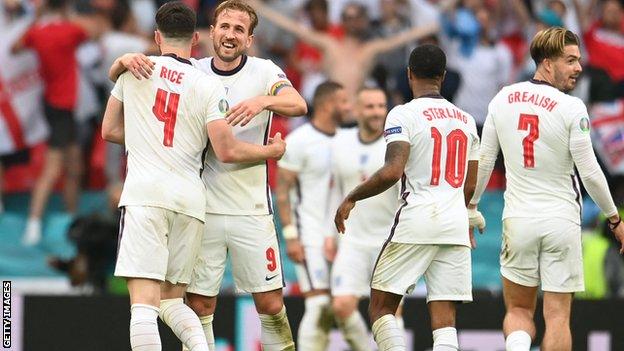
    England beat Germany in a knockout match for the first time since 1966

    Here’s what happened in the second week

    Since my last post, Scotland had their little moment with a heroic 0-0 draw with England (sarcasm is the lowest form of wit) before losing to Croatia and exiting the tournament. Their first major tournament in 23 years was over in eight days, and they’d scored just one goal.

    Hungary held world champions France to a draw before Germany brought their campaign to life with a 4-2 dismantling of Euro 2016 winners Portugal. On Sunday 20th June the final round of group games began with Switzerland sending Turkey – who some of the pundits had picked as their ‘dark horses’ – home winless, while Italy kept up their 100% record with a narrow victory over Wales. The Welsh didn’t mind, though, as they went through to the last 16 along with the Azzurri.

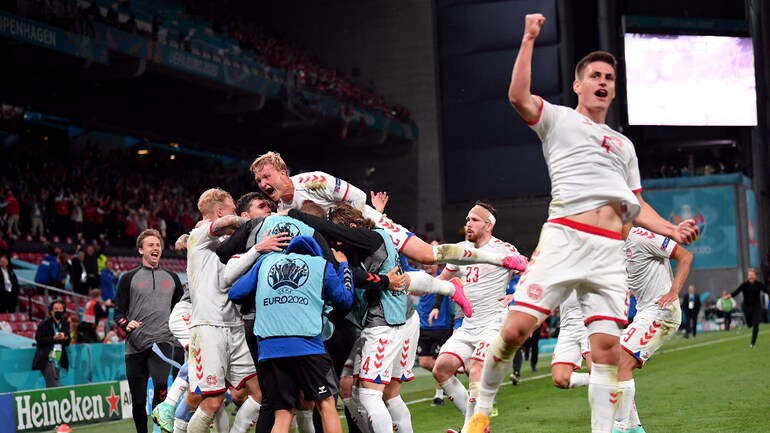
    In Group B, a stirring performance from Denmark saw them thrash Russia 4-1 in Copenhagen, marking a delightful fightback from the trauma of Christian Eriksen’s cardiac arrest and sending them through. At one point it looked like Teemu Pukki and Finland might sneak through but their defeat to Belgium coupled with the Danish result brough their first major tournament to an end at the group stage. On the same day in Group C, unfancied Austria found a way into the second round by beating Ukraine, while plucky North Macedonia bowed out to the flying Netherlands.

    Denmark were superb in beating Russia 4-1 to make it into the second round

    England secured their passage through the group without conceding a goal by beating the Czech Republic at Wembley. Having finished top, they knew they would face the runners up of the feared Group F. The final round of games in that group were thrilling, topsy-turvy affairs – at various stages all four teams occupied second place. Eventually, a pair of 2-2 draws meant that it would be the old enemy Germany who would face England. In the other group, disappointing Poland were knocked out after a 3-2 defeat to Sweden, while Euro 2008 champions Spain reminded everyone what they were capable of with a 5-0 thumping of Slovakia.

    With a 24 team tournament moving into a knockout round of 16 sides, only 8 actually took their leave after the group stage. As well as the top two from each group, the four best third placed sides also got through – Finland and Slovakia were the unfortunate ones to miss out.

    The Welsh are sent packing

    Euro 2016 was the first time since the 1958 World Cup that Wales had appeared at a major tournament, and they memorably made it all the way to the semi-finals before being beaten by the eventual winners Portugal. Having got through the group stage the Welsh had hopes of emulating that achievement. Denmark, however, had other ideas and on a chastening evening in Amsterdam ran out 4-0 winners. The scoreline was a tad harsh (it was only 2-0 until the 88th minute, and Wales received a very dubious red card in stoppage time) but it was a sad end for a proud nation. Their captain and talisman Gareth Bale was rather rudely asked on the pitch immediately afterwards if he would be retiring from international football – the 31-year-old decided the question wasn’t worthy of an answer and simply walked away.

    It took Italy extra time to finally overcome Austria. Former Stoke and West Ham striker Marko Arnautovic thought he had given the underdogs the lead, only for his headed goal to be disallowed by the VAR for offside. Eventually Italy’s quality found a way through and they scored twice in the extra time period, though they did concede their first goal of the tournament with six minutes to go. Austria couldn’t find an equaliser but left Euro 2020 with their heads held high.

    It was a bad day for Gareth Bale and Wales as they were knocked out by Denmark

    The Dutch despair and the champions bow out

    The Netherlands were the favourites going into their last 16 tie with the Czech Republic. Having failed to qualify for both Euro 2016 and the 2018 World Cup, the Oranje had been a welcome addition to the tournament. However, in a cagey game, it was the red card shown to centre half Matthijs de Ligt in the second half that gave the Czechs the impetus. The referee, with the help of VAR, decided that de Ligt’s handball had denied a clear goalscoring opportunity. The Juventus player was sent off, the Czechs scored twice and the Dutch were out.

    Also on their way out were defending champions Portugal, who were beaten by Belgium in a game far more entertaining than the 1-0 scoreline suggests. Half time was approaching when Thorgan Hazard – brother of Eden – curled in from outside the box. Despite their best efforts in the second half, the Portugese couldn’t find a way back, and you have to wonder if Cristiano Ronaldo – who will be 39 by the time of the next one in 2024 – has played his last match at a Euros.

    Manic Monday

    If there is a more exciting day of this tournament than Monday 28th June it would have to be really special. The first game saw 2018 World Cup finalists Croatia take on Spain, and it looked like the Spaniards had sealed their place in the quarter finals with a 77th minute goal from Manchester City’s Ferran Torres putting them 3-1 up. The Croatians weren’t about to give up, however, and a 92nd minute equaliser from Mario Pasalic took it into extra time. You might have thought the momentum would be with Croatia after that but, alas, Spain scored twice in the first period of extra time to finally win 5-3.

    The second match of the day, between France and Switzerland in Bucharest, had a lot to live up to – and it did. Haris Seferovic gave the Swiss a shock lead fifteen minutes in, and they were still leading into the second half when they were awarded a penalty. Defender Ricardo Rodriguez took it, but the chance to give his side an astonishing 2-0 lead went begging as Hugo Lloris of Spurs saved his spot kick. Within four minutes of that failure to convert the penalty, France were in the lead. Karim Benzema – not a nice man – scored twice as the world champions started to show why they were most people’s favourites for the tournament. With fifteen minutes remaining, a fantastic strike from Manchester United midfielder Paul Pogba seemed to put the tie beyond doubt.

    Switzerland pulled one back through Seferovic’s second headed goal of the game, and then in the 90th minute substitute Mario Gavranovic finished superbly to spark wild scenes of celebration. It was 3-3, and just like Croatia v Spain, the game was going into extra time. Unlike Croatia v Spain, neither side could find a goal in the additional 30 minutes and so the first penalty shootout of Euro 2020 was upon us. Switzerland scored all five of theirs. France scored their first four, but their superstar Kylian Mbappe had his saved by goalkeeper Yann Sommer to seal a remarkable victory for the Swiss. In the space of two days the defending European champions, the World Cup winners and the World Cup runners up had all been knocked out.

    Yann Sommer saves Kylian Mbappe’s penalty to send France home

    England finally beat Germany in a knockout match

    The German football team is not what it once was. Having won the 2014 World Cup, they were eliminated at the semi-final stage of Euro 2016 by France and suffered an embarrassing group stage exit at the 2018 World Cup, losing to Mexico and South Korea. In the run up to this tournament they had been beaten at home by North Macedonia and thrashed 6-0 by Spain. But they are still Germany, and England hardly ever seem to beat Germany when it matters. The last time they had managed to do it in a knockout match was the 1966 World Cup final. England’s exits at Italia ’90, Euro ’96 and the 2010 World Cup had all come at the hands of the Germans. Despite possessing the best squad of players in years it just didn’t feel like it could possibly happen for England.

    Well then. At a raucous Wembley containing 45,000 fans, the home side showed their opponents plenty of respect in the first half, being very cautious at the back and hardly venturing forward. On the stroke of half time, a tackle on Raheem Sterling saw the ball loop towards Harry Kane to the left of the German net. The England captain was presented with a golden opportunity to score his first goal of the tournament, but his attempt to take the ball past keeper Manuel Neuer gave defender Mats Hummels the time to put in a crucial tackle. With 75 minutes on the clock, thoughts were already drifting to the prospect of a penalty shootout. But the introduction of Jack Grealish as a substitute had made England more of a threat going forward, and the Aston Villa man laid the ball off for Luke Shaw to drill it across the box, where Sterling was waiting to tap in. Wembley has rarely been louder. England were in front and with less than a quarter of an hour to go.

    Sterling very nearly went from hero to zero as a careless pass backwards allowed Chelsea’s Kai Havertz to put Thomas Muller through on goal. Muller has often been a thorn in the English side but on this occasion he rolled his shot just wide of Jordan Pickford’s right hand post. ‘That never happens!’ bellowed BBC commentator Guy Mowbray. Written in the stars? Maybe. Shortly afterwards, Grealish found himself in a crossing position and played the perfect ball onto the forehead of Kane, who expertly guided it into the ground. The ball bounced up, out of the reach of Neuer and into the net. After a few seconds where no one could believe what they were seeing, the celebrations reached another level as it dawned on us that, this time, it was happening. Germany had no time to make a comeback. England had beaten them in a knockout game for the first time in 55 years.

    The fans inside Wembley marvel at England’s victory over Germany

    England would play the winners of the game that kicked off later that evening between Sweden and Ukraine. Manchester City left back Oleksandr Zinchenko put Ukraine ahead with a thumping finish but Emil Forsberg equalised for Sweden before half time. There were no goals in the second half so extra time was needed – the fourth of the eight knockout matches to go to the additional half an hour. Sweden’s Marcus Danielson was sent off in the first period for a nasty tackle on striker Artem Besedin, a tackle which has since ruled the Ukrainian out for six months. Extra time was an awfully scrappy, stop-start affair which by the end of it saw Ukraine looking like the walking wounded. Just as penalties looked nailed on, Artem Dovbyk headed in an excellent Zinchenko cross to win it for Ukraine and break Swedish hearts.

    The Italians look like the real deal

    After a two day break, the quarter finals got underway with Switzerland taking on Spain in St Petersburg. Spain took an early lead when Jordi Alba’s half volley from a corner was deflected in by the unfortunate Swiss midfielder Denis Zakaria. The Spaniards created plenty of chances but couldn’t add to their advantage against a dogged Switzerland side. Liverpool’s Xherdan Shaqiri equalised in the 68th minute, and despite Remo Freuler being shown a straight red card for a bad tackle thirteen minutes from time, the Swiss held out to take the game all the way to penalties. Sergio Busquets hit the post with the first Spanish penalty, giving Switzerland hopes of repeating their epic victory over France four days earlier, but they missed three of their spot kicks to give Mikel Oyarzarbal the opportunity to put Spain into the semi-finals.

    Later on, a pulsating first half saw Italy go in at the break 2-1 up against Belgium, ranked number one in the world. Nicolo Barella and Lorenzo Insigne scored excellent goals to give their side a two goal advantage, but a penalty in first half stoppage time from Romelu Lukaku kept the Belgians in it. To some surprise there were no goals in the second half but there was some superb football on display from both sides. Italy have been tight at the back, with elder statesmen Giorgio Chiellini (36) and Leonardo Bonucci (34) in the centre, and thrilling to watch going forward. Federico Chiesa seems to shoot every time he gets the merest glimpse of the goal, and this performance really set Italy out as the favourites to go on and win the tournament. As for Belgium, their much vaunted ‘golden generation’ are left trophyless once more, and with an ageing squad and manager Roberto Martinez leaving their chance to win something may have passed them by.

    So there we have it – you are now up to date with Euro 2020. As I write this it’s Saturday afternoon and the other two quarter finals, Czech Republic v Denmark and England v Ukraine, are a few hours away. The next time I write one of these will (hopefully) be just before the final. It’s been a brilliant tournament. What has it got left in store for us?