Tag: tv

  • Having a Blast: my trip to Old Trafford

    On Sunday I went to Old Trafford for the T20 Blast match between Lancashire and Durham.
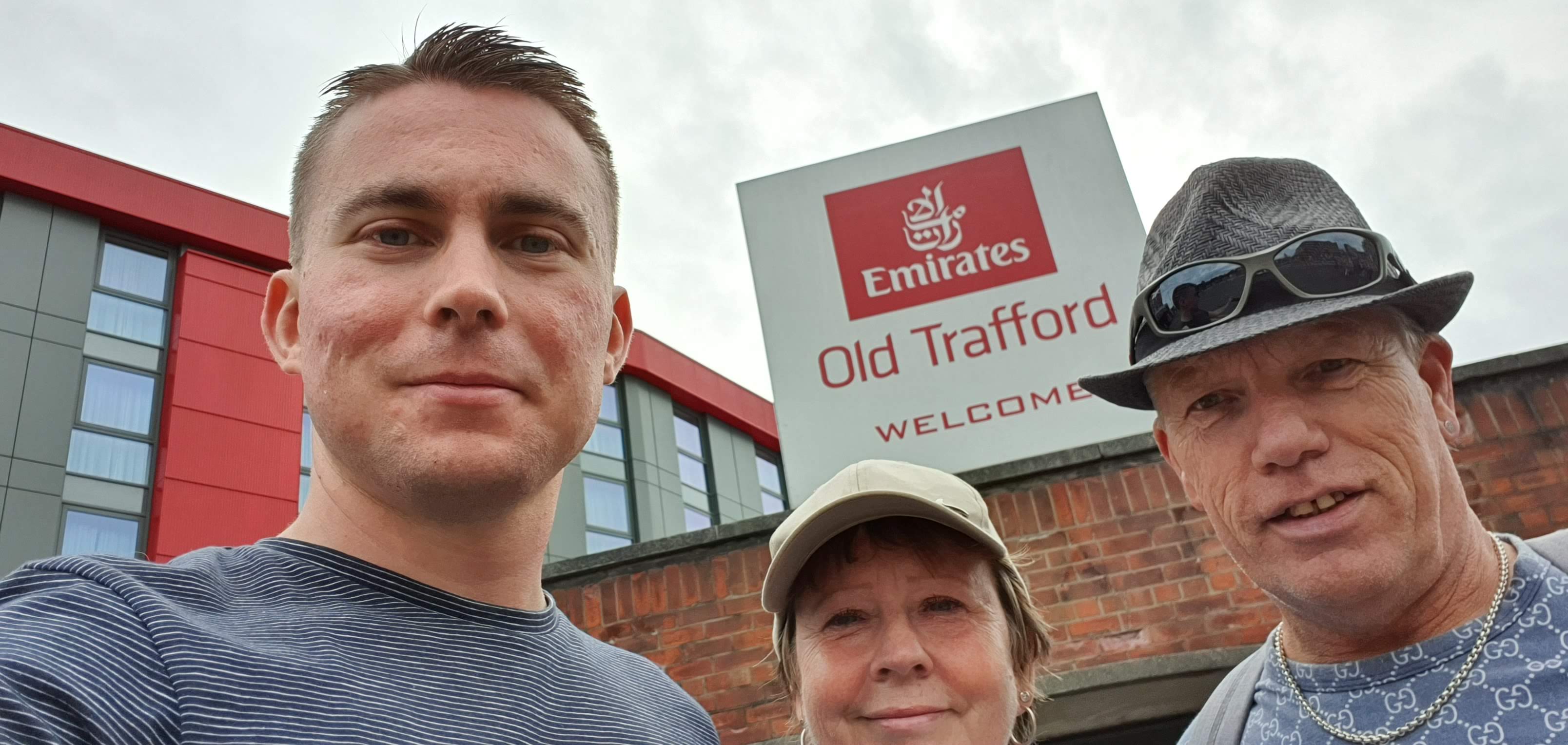
    Me, my mum and her partner at Old Trafford

    A week on from England becoming world champions (I will never get tired of saying that), cricket is enjoying a boost in popularity. The Cricket Paper reports that counties have noticed an increase in ticket sales for the T20 Blast as people who maybe haven’t been to a match for a while, or indeed at all, seize the opportunity to see the game in the flesh.

    This includes – crucially – children. Most of the crowd in Manchester, which was huge for a domestic game, were families with youngsters. I’m not a big fan of kids – they are noisy, carry illnesses and can’t sit still for five minutes – but they are vitally important for the future of cricket. They all seemed to be having a great time, and that’s key. Children need to think of going to a cricket match as a normal thing to do, and something to look forward to. They will be the next generation of players and fans and will hopefully pass on their enthusiam to their own kids in years to come.
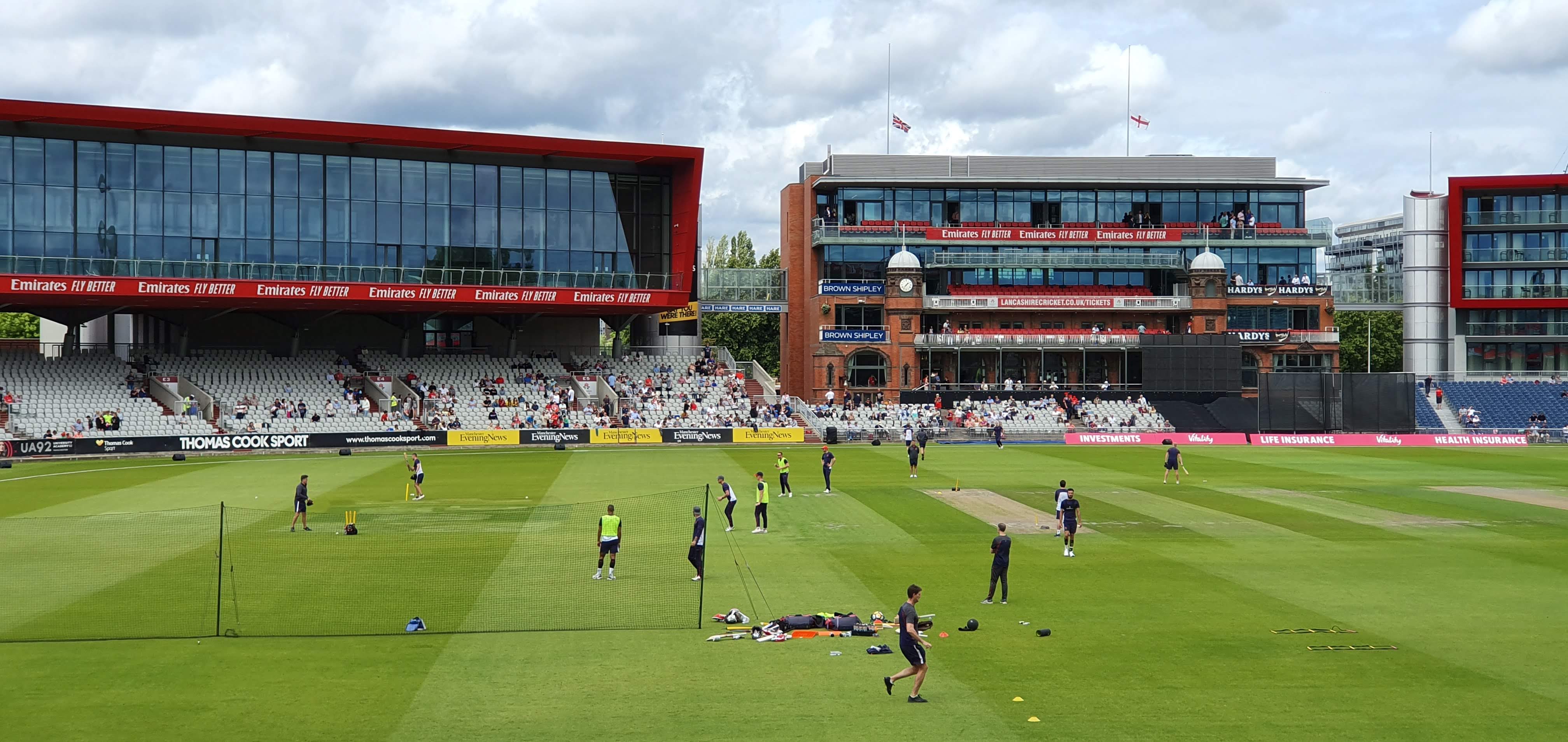
    The players warm up at Old Trafford, Manchester about an hour before the start of play

    I had been to Old Trafford before, for the Test match between England and India in 2014, and enjoyed the laid back atmosphere and friendly stewards. This makes it the ideal venue for 20 over cricket compared to, say, Lord’s which I find stuffy and inaccessible. The emphasis was on fun, with the Lancashire mascot Lanky the Giraffe dancing on the boundary before play began.

    As for the match itself, T20 is perfect for those who are unfamiliar with cricket. It’s short and sharp and you get to see plenty of big sixes and wickets. Lancashire batted first in their opening home game of the tournament and amassed 189-3, opener Steven Croft top scoring with an unbeaten 65 from 43 balls. The star of the show, however, was Australia international Glenn Maxwell. The world number one ranked all rounder in T20s hit 58 off 33 balls with four sixes. Each boundary was received with loud cheers and a burst of pop music. It was interesting to see how partisan the crowd was, a lot of the people there seemed to feel for the Lancashire cricket team the same way I feel for Norwich City Football Club. They weren’t just there to enjoy a day out, they were there to see the home side win.
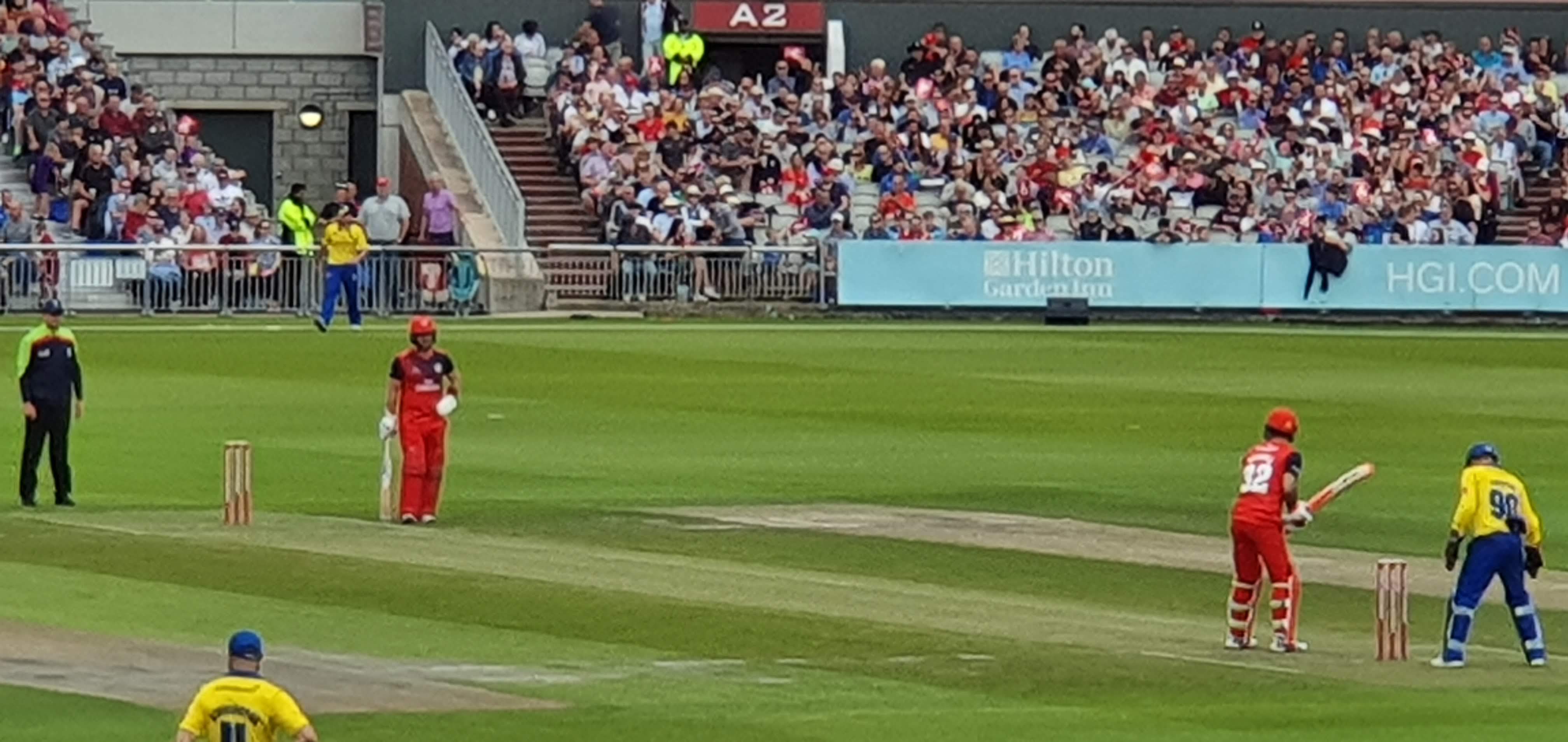
    Australia international Glenn Maxwell bats for Lancashire in front of a huge crowd at Old Trafford

    Durham never looked like chasing the 190 they needed to win and were all out for 117 within 17 overs. Scott Steel had scored 58 from 46 balls but the next highest score for the visitors was 12. Lancashire won by 72 runs and a couple of run outs were enough to secure Maxwell the player of the match award.

    Maxwell played for Australia in the World Cup (having won it in 2015) so he was the main attraction for the kids. They gathered round to watch him be interviewed at the end of the match, taking photos and hoping for an autograph. The occasion was slightly lacking in big names. Both sides were packed with solid professionals and the standard was high but aside from Maxwell only D’Arcy Short, another Australian, would have been recognisable to most of the crowd. Short was not involved in the World Cup but has played for his country, as well as in T20 leagues around the world. Also on show was Keaton Jennings, who has scored a Test century for England but has otherwise struggled at the highest level and has been dropped from the most recent squad.
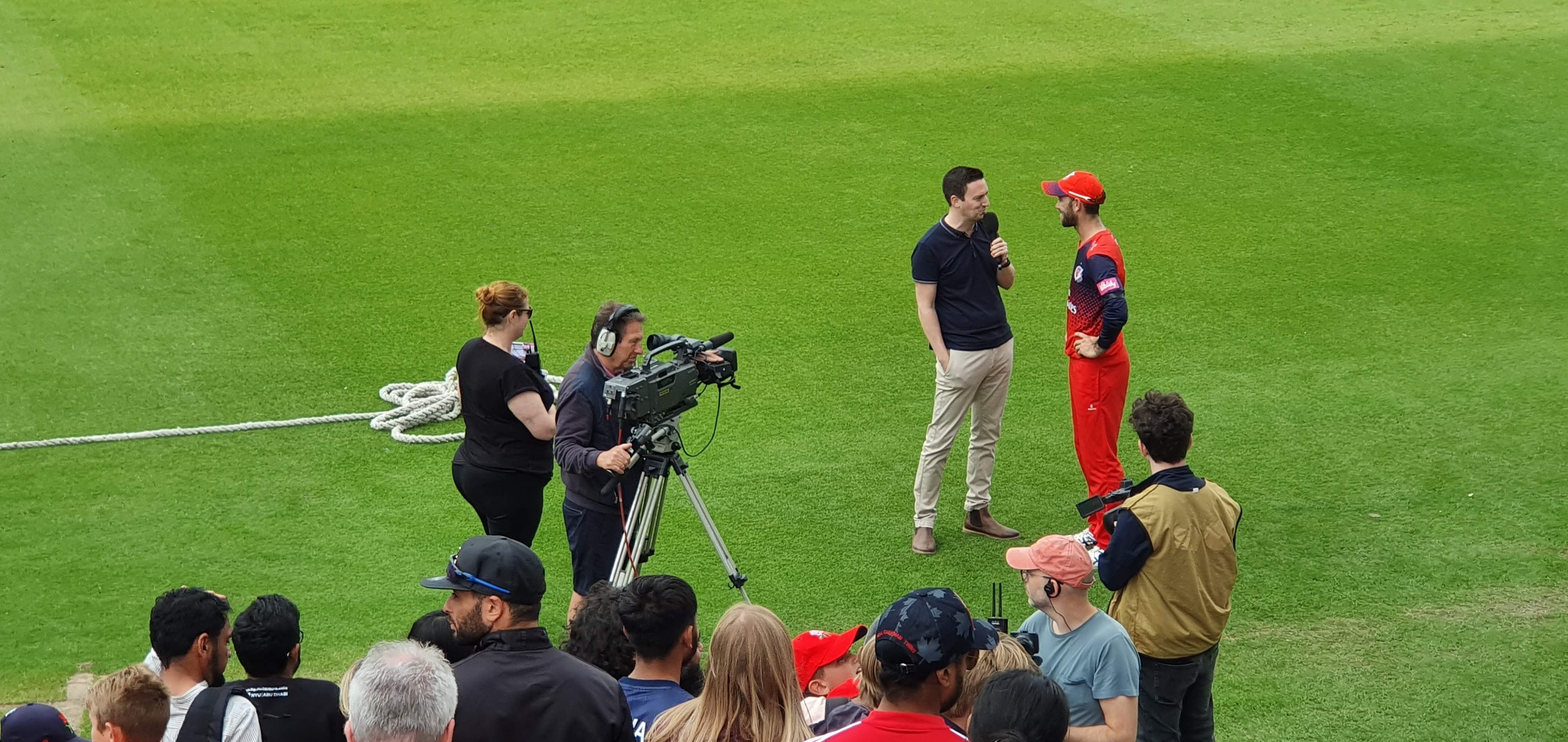
    Player of the match Maxwell is interviewed after Lancashire’s 72 run win

    The majority of the England players involved in the victorious World Cup campaign were getting a well deserved rest, with the seven week long tournament soon to be followed by a Test match against Ireland and the five match Ashes series against Australia. Part of me, though, wished that there could have been a way to get those stars involved in the first couple of rounds of T20 Blast fixtures to really capitalise on the current popularity of cricket in this country.

    Had those England players been available, the Lancashire side would have featured Jos Buttler and Durham’s side would have boasted Ben Stokes, who was player of the match in the World Cup final. Mark Wood is also a Durham player but is injured and out until September. It would have been fantastic for the crowd to have been able to see their new heroes, but I understand that with a packed schedule it was almost impossible. Wood and Stokes paraded the World Cup trophy around Durham’s home ground the Riverside on Saturday, as captain Eoin Morgan had done around Lord’s, where he plays for Middlesex, on Thursday. I had a faint hope that Buttler might have done the same around Old Trafford on Sunday but it was not to be.

    The T20 Blast is a fantastic product. Now in its 17th season, the crowds are big, the standard is high and overseas stars want to play in it. If some of it was on Free-to-air television instead of it all being on Sky Sports I have no doubt it would be a massive annual summer event.

    Walking away from Old Trafford, I couldn’t for the life of me fathom why the authorities have felt the need to invent an entirely new format of the game to try to attract new fans. Next year will see the launch of The Hundred, a convoluted version of the game with the simplest part being one hundred balls per innings. Eight completely new teams, based around the major cities and with awful names like London Spirt and Leeds Superchargers, will take part. These teams will have to start from scratch, with none of the existing loyal following of the county sides. The only thing going for it is that some of it will be on BBC TV. It makes absolutely no sense and from what I can see it is doomed to fail.

    My visit to Manchester on Sunday was conclusive proof for me that the England and Wales Cricket Board already has everything it needs to make cricket the undisputed second sport of the nation again. I can only hope that their seemingly muddled thinking doesn’t mean they miss the opportunity.
  • The Cricket World Cup – what’s all the fuss?

    For a mad keen cricket fan like me, 2019 is like a birthday and Christmas present rolled into one. The World Cup is being held in England and Wales, with England the favourites to win it, and in August the Ashes start with England and Australia renewing their famous rivalry.

    I have friends who may not quite understand much about cricket and why I’m so excited about this year – so I’ve written this for you.

    Hosts England are favourites to win the cricket World Cup

    When does the World Cup start?

    The World Cup is just one week away. It starts on Thursday 30th May when England play South Africa at The Oval in London. The final is on Sunday 14th July at Lord’s.

    How does the World Cup work?

    There are ten countries playing in the World Cup. That’s not many compared to other sports. Compare it to the last football World Cup – where 32 teams were involved – or the rugby World Cup later this year, which will feature 20 teams.

    Those 10 teams are:

    Afghanistan
    Australia
    Bangladesh
    England
    India
    New Zealand
    Pakistan
    South Africa
    Sri Lanka
    West Indies

    The teams all play each other once, with the top four going through to the semi-finals. There, 1st place will play 4th place and 2nd will play 3rd. Then, of course, the winners of those matches will play in the final.

    There will be one match a day (two on Saturdays) between the start of the tournament on 30th May and the conclusion of the group stage on 6th July.

    Where are the matches being played?

    Ten grounds will host matches in the World Cup, stretching as far north as County Durham and as far south as Hampshire. They are:

    The Riverside (Durham)
    Headingley (Leeds)
    Old Trafford (Manchester)
    Trent Bridge (Nottingham)
    Edgbaston (Birmingham)
    Lord’s (London)
    The Oval (London)
    County Ground (Bristol)
    Sophia Gardens (Cardiff)
    County Ground (Taunton)
    Rose Bowl (Southampton)

    The iconic Lord’s will host the cricket World Cup final on 14th July

    How can I follow it?

    Every single match of the World Cup is live on Sky Sports, so you’ll need to pay to watch it on TV. Now TV is the best way in my opinion – you can buy one of their devices and buy a Sky Sports month pass for £25. Two of those will see you through the World Cup.

    Highlights of every match will be on Channel 4.

    If you prefer listening to the radio, commentary will be available on the BBC’s famous Test Match Special on Radio 5 Live Sports Extra.

    Why are you so excited about it?

    This is the first time England have hosted the cricket World Cup since 1999. Back then, I was a nearly-7-year-old who didn’t know what cricket was. England are also the favourites for it, going into the tournament as the number one ranked One Day International (ODI) team in the world.

    Australia won the last cricket World Cup in 2015

    It’s going to a close run thing, too – out of the ten teams playing, I reckon seven have a genuine chance of winning it. I think Afghanistan, Bangladesh and Sri Lanka will struggle but the other seven will be fighting for the four places in the semi-finals. Even those three I’ve mentioned are capable of causing a few upsets.

    I hope you’ve found this guide useful and you might indulge in a bit of cricket over the next eight weeks or so. I’ll be writing about the games you should watch as we go along.

  • Cricket 4 The Masses

    I found this video on YouTube recently. Uploaded by madmusician91, who must take all the credit for it, the video shows the last few minutes of Channel 4’s excellent live coverage of cricket:

    England had just won the Ashes for the first time in 18 years, in what is regarded as the greatest Test series ever played. Cricket was in the public consciousness like it had not been since Botham’s Ashes of 1981, enjoying popularity akin to football, being talked about across the country. Ironic, then, that that series was to be the end not only of Channel 4’s coverage, but of live international cricket coverage as a whole on terrestrial television in the UK.

    Television was still in its infancy when the BBC decided to show the Lord’s and Oval Tests against Australia in 1938. Very few people owned a television then – and if they did they were rich. Even so, whatever viewers there were got the chance to see Len Hutton score 364; at the time it was a world record and it is to this day the highest Test score by an Englishman. The BBC continued to show live England cricket right up until 1999.

    Test cricket at Old Trafford in 2014 - but you needed to pay to see it on television.
    Test cricket at Old Trafford in 2014 – but you needed to pay to see it on television.

    Pay television first made an impact on live England home matches at this point – Sky Sports shared coverage with Channel 4. Rupert Murdoch’s network had already been showing England tours since 1990, but this was their first foray into home internationals. The rights deal, however, remained in favour of the terrestrial broadcaster. Sky showed just the one Test match each summer, with the other five or six on Channel 4. Sky showed all of the one day matches live.

    In 2004, to some surprise, the England and Wales Cricket Board announced that it had awarded exclusive rights to England home matches to Sky Sports. This meant that from 2006, fans would have to pay to watch England play live for the first time. The deal went ahead despite a campaign to ‘Keep Cricket 4 Us’ and with an extension until 2017 cricket will only be shown as highlights on Channel 5.

    While Sky’s money has been invested in grassroots cricket, with the sport not easily accessible to the general public interest has inevitably waned. The conclusion of Sky’s first live Ashes series in 2009 was watched by just under 2 million viewers, with the average throughout the day at 856,000. Compare this to Channel 4’s live coverage of the 2005 Ashes finale – 7.4 million watched the end of play, with an average of 4.7 million between the lunch break and the close.

    With such a gulf in viewing figures between the pay TV channel and the terrestrial, there remain calls for live England cricket to return to free-to-air television. With no prospect of this until at least 2018, however, it looks like an hour of highlights per day is all we will have to satisfy us for now.