It’s what literally no one has been waiting for! Part 2 of my write-up of my holiday in Wales. If you haven’t read part 1, click here to get up to speed with Barry Island, Chepstow and Hopwood Park Services.
Day 3 – Wednesday 19th July
Wednesday was mum’s birthday, so the morning involved her opening her cards (I now have a five year streak of producing tears with mine) and presents (the Garmin fitness tracker, a joint gift from me and Dave, was well received). But we didn’t have much time for that, as we had to be on the train fairly early again. We were heading back into England – we were going to Bristol.
The trip to Bristol obviously involves crossing the River Severn again, and on the train it means going underneath it via the Severn Tunnel, not something that mum enjoyed. Anyway, it was quite a short journey and we arrived in one of England’s great cities.
I had never been to Bristol, but read and heard much about it. This was Brunel country, a big city that somehow doesn’t have a top flight football team, and also where a lot of scenes from my favourite sitcom Only Fools and Horses were filmed once it had become too popular to be shot in London. It was exciting to be able to tick off another metropolis.
Unfortunately, we had not planned for our visit to Bristol beyond buying the train tickets, and so on arrival we had no idea where we going or what we were going to do. We walked away from the enormous Temple Meads station and, as it turned out, went the wrong way and ended up in a rough part of town.
Temple Meads station in Bristol
Mum said she wanted a coffee, so I used my phone to find us a place with good reviews not far away. We discovered that this place, Bakehouse, was on an industrial estate. The coffee was ok, the food looked nice but went untried due to how expensive it was, and we found ourselves in the bizarre situation of sitting on a picnic bench amongst industrial units. Only two days before we had been enjoying the spectacular views on Barry Island.
We resolved to find the city centre, and eventually managed it. We went into a few shops and had a nice lunch in a café, but we never saw any of Bristol’s great sights. We didn’t see the SS Great Britain, we didn’t see the Clifton Suspension Bridge, and I didn’t tick off any more sporting venues such as Ashton Gate, the Memorial Stadium or the County Ground. We went to catch the train feeling like we hadn’t really ‘done’ Bristol, and I feel like I need to return at some point.
Day 4 – Thursday 20th July
There was a train strike on Thursday, so we spent the day off the rails, as it were. We walked to Caldicot Castle, not far from our apartment, and were very pleasantly surprised by the experience. It was free to get in, which was unexpected, and there are so many little nooks and crannies of this historic site to explore. A Grade I listed building, most of what we can see today was built somewhere around 1170 and restored in that confident Victorian way by a man called Joseph Richard Cobb, who made it his family home.
What really interested me was the fact that the castle was used to house families who had been bombed out during the Second World War. Down one very narrow corridor was a bath that would have been used by people living there in the 1940s.
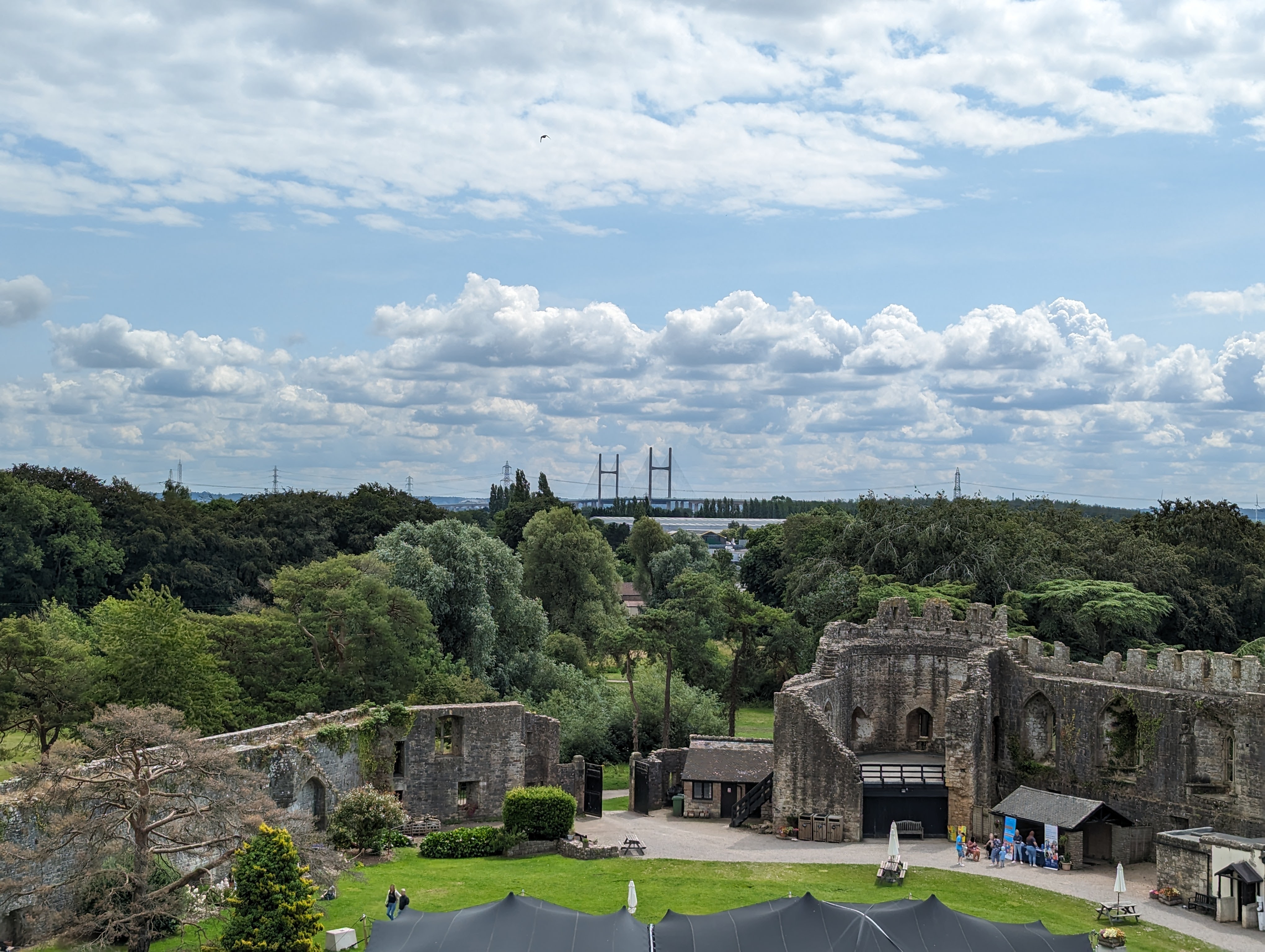
Extensive helical staircases would take us down to the basement, where a grate allowed us to peer into the darkness of the dungeons, and up to the top of the tower, where we enjoyed wonderful views over the Severn Estuary – very much a photo opportunity.
The view from the top of Caldicot Castle, with the Severn Bridge in the background
We enjoyed a snack and a drink from the castle’s tea room before we left. A truly wonderful place, a fantastic thing for the locals to have on their doorstep. The field next to the castle is used for concerts – Noel Gallagher’s High Flying Birds are performing there in August.
Day 5 – Friday 21st July
Our last full day in Wales. We had heard about a place called Dewstow Gardens & Grottoes, which was only about ten minutes away from the apartment by car, so we went there to take a look.
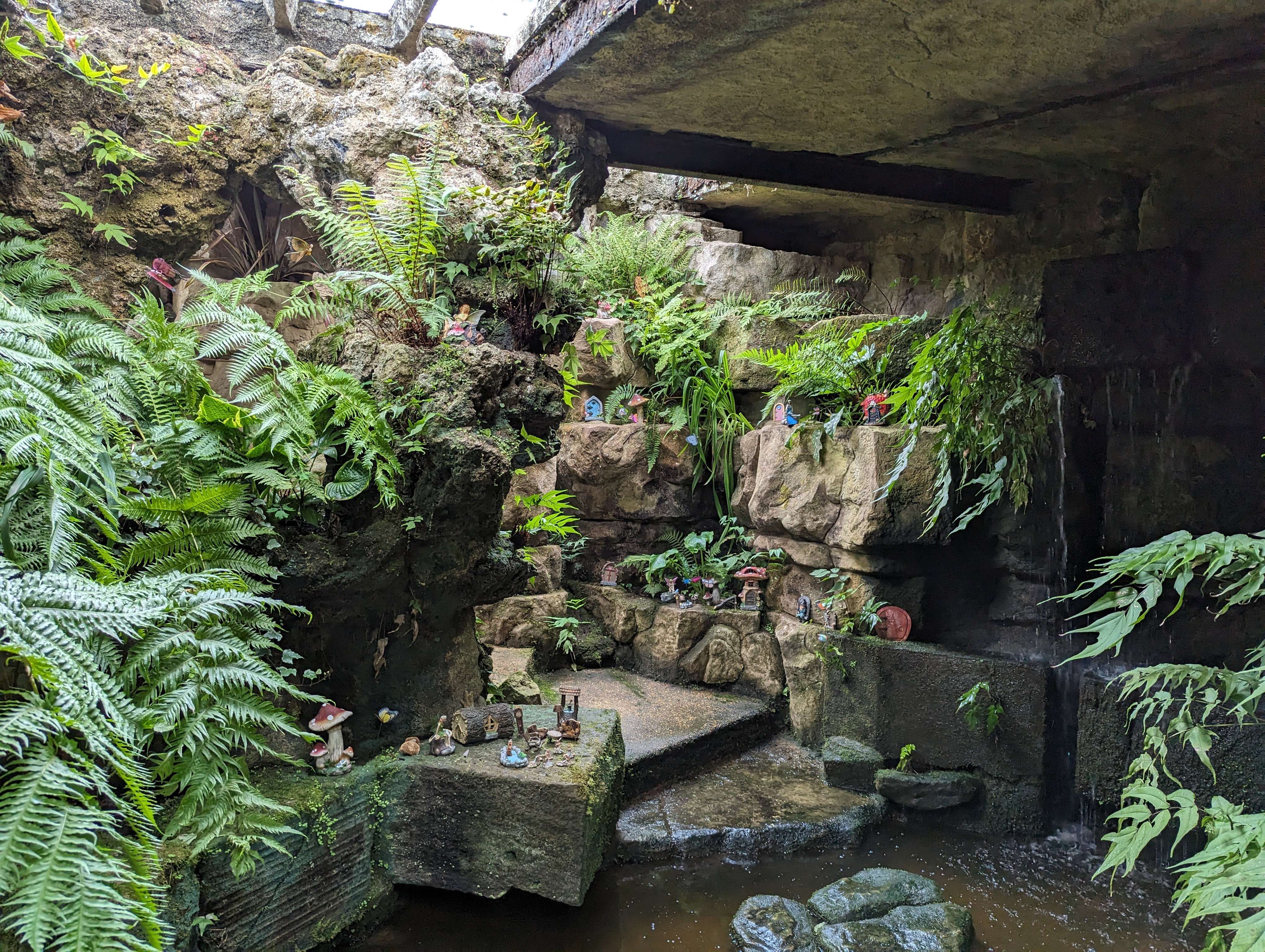
Honestly, if you are ever out that way you must go to Dewstow Gardens & Grottoes. The gardens at ground level are beautiful and incredibly well-maintained, with so many trees, plants and ponds to sit by and enjoy some peace and quiet. But it is when you go underground, into the network of tunnels that go through the stone, that your mind is truly blown. These grottoes are amazing spaces – they really are like stepping into another world.
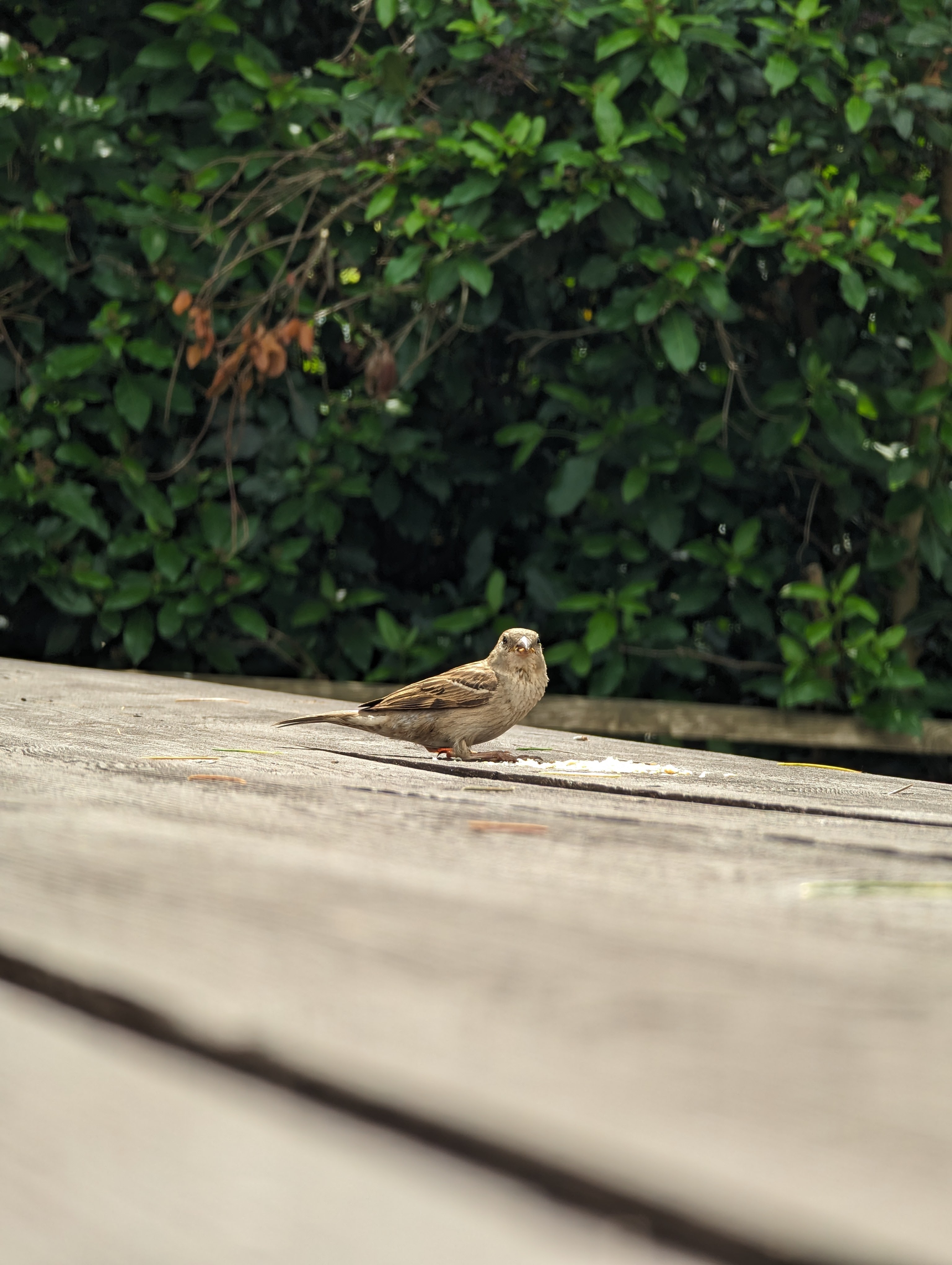
Even better, when I was enjoying a delicious sausage roll and slice of chocolate cake from the café, little birds like to sit on the tables and eat the crumbs that people have left behind. Look at this chap.
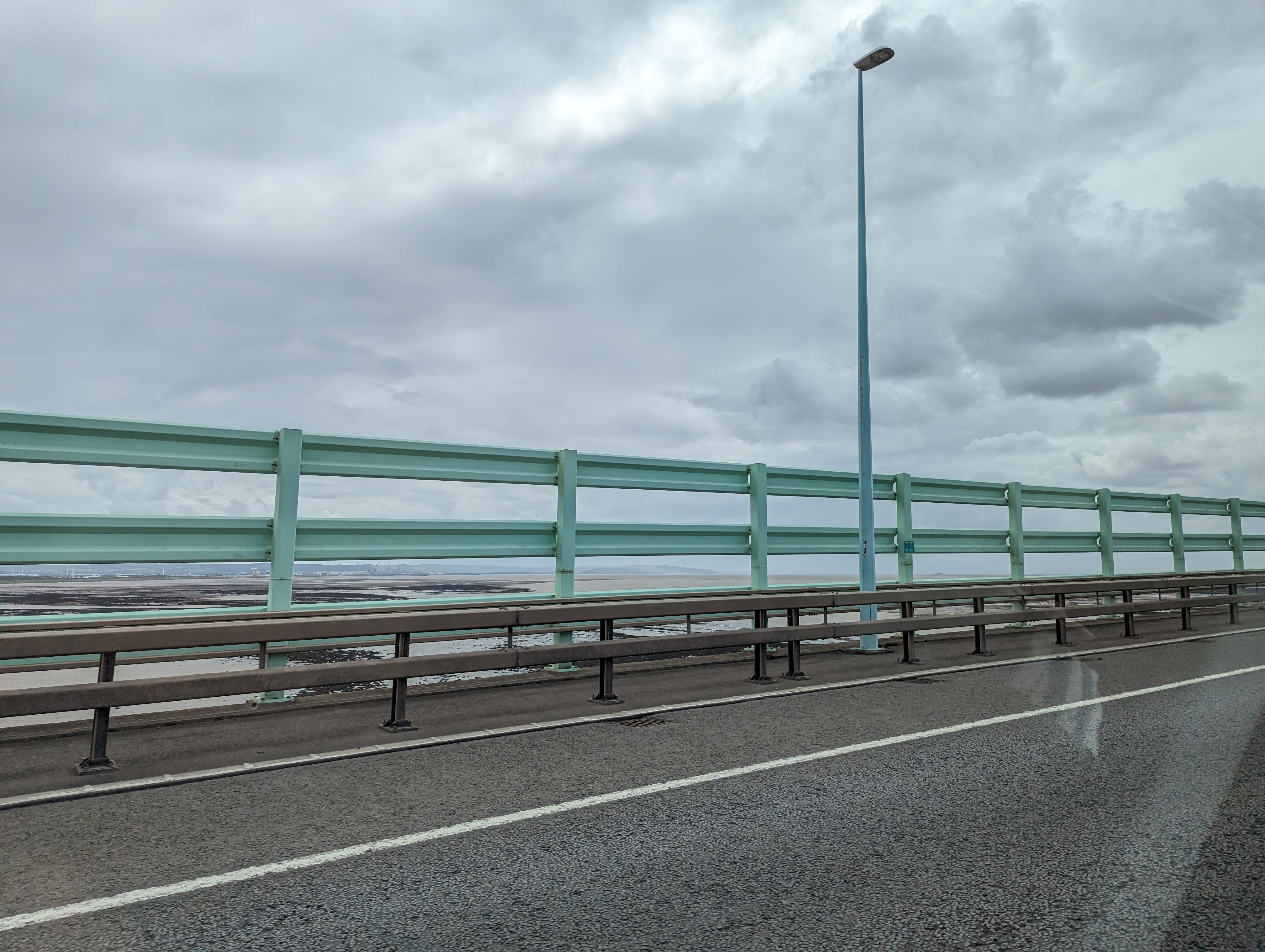
We didn’t really have a plan for what to do after we’d left Dewstow, and in an unexpected turn of events we ended up crossing back into England and stopping at Severn View Services. As the name suggests, this is where a short walk will give you the best possible view of the Severn Bridge.
Increasingly weary, next we found ourselves back in Chepstow, but with very little energy left in the tank we didn’t do anything other than visit a Wetherspoons for a meal. I had a pizza (and no, I’m not getting any thinner).
We were knackered, but content. We’d seen so many new places and done so much walking that we knew our holiday in Wales was one we would never forget.
Day 6 – Saturday 22nd July
Time to go home. With the forecast suggesting that a month’s worth of rain in one day would leave Wales looking something like Atlantis before long, we left as early as we could. I put my head down for a nap just after we’d crossed the bridge back into England, and when I woke up we were driving around the suburbs of Reading, which was a surprise as no part of our journey home should have involved the suburbs of Reading.
Apparently, they had said on the radio that there was traffic on the M25 at Slough. This was exactly the part of the M25 we needed to go on, so Dave had made the decision to try to avoid the M25. Well, to say this meant we went home the long way round is an understatement. We must be the only people ever to travel between Wales and Norfolk and stop for a wee at the Tesco in Amersham, Buckinghamshire. After we’d been there I swapped with mum and sat in the front seat to help guide us in the right direction. We took in Chesham, Hemel Hempstead and St Albans but eventually made it to the A14 near Cambridge and back to dear old Dereham.
If you’ve made it down this far, thank you very much for reading. Hopefully I’ve inspired you to go exploring. Whatever you do, make sure you visit Dewstow Gardens & Grottoes!
It was the first time I’d been out that way, and it was a nice change from heading to the Yorkshire/Derbyshire area, which I had been doing most summers since I was a child – including last year.
I kept a diary of the six day trip, so here’s what we (my mum, step-dad and I) got up to:
Day 1 – Sunday 16th July
Departure day. It wasn’t just us going on holiday – our budgie, Messy, was spending the week at Dave’s brother’s house, and he’d been taken there on the Saturday night. We had said we wanted to be on the road by 8am, so of course we left shortly after 9am.
I had taken a travel sickness tablet, and tried to get some sleep on the journey. I put my head down somewhere near Thetford and when I woke up we were just to the south of Birmingham! We stopped for a break at Hopwood Park Services and then completed a pretty smooth journey by crossing the Prince of Wales Bridge into Wales.
Crossing the Prince of Wales Bridge into Wales
We were staying in an Airbnb in Caldicot, a small town near Chepstow. This was the first time we’d used Airbnb and first impressions were good. Our accommodation was a self-contained apartment attached to the owners’ house.
That evening we walked to find the railway station and explore the town.
Day 2 – Monday 17th July
With the weather forecast good for our first full day in Wales, we decided to go to Cardiff on the train. But once we’d arrived at Cardiff Central Station, we decided to carry on to the coast at Barry Island. This was, of course, where a lot of the sitcom Gavin and Stacey was filmed, as well as a few scenes from my favourite film Submarine.
I have to say I wasn’t expecting Barry Island to be quite so beautiful. The beach is huge, and with the sun shining the water sparkled and you could see Weston-Super-Mare on the other side. We stopped at a café on the sea front before walking to the end of Friars Point, where the heavens opened and we got soaked.
Enjoying my summer holiday
Making our way back, we had lunch at a fish and chip shop next door to Marco’s Cafe, the real life place that Stacey works at in Gavin and Stacey. It’s clear that Barry Island is very proud of its association with the hugely successful BBC show – there are murals celebrating the fact all over the place, and the shops are not short of mugs emblazoned with Nessa’s catchphrase ‘oh, what’s occurring?’ or t-shirts with ‘sugar tits’ printed on them, the ‘affectionate’ nickname Dave Coaches used for Nessa.
A game of adventure golf and a drink sitting outside a pub followed before we headed to the station, but the day wasn’t over. I like ticking off any sporting arenas I see on my travels, and Cardiff has several. Not far from Cardiff Central I was able to see the Principality (formerly Millennium) Stadium, the home of the Welsh rugby union team, although we couldn’t get too close to it due to some work being done. I did take this photo though.
The cricket ground, named Sophia Gardens after the park that is close to it, is a bit of a walk from the Principality but we made the effort and were rewarded when we were told by a steward that we were welcome to go in and watch the end of a women’s match that was going on.
I can now add Sophia Gardens to the list of cricket grounds I’ve seen a match at: Lord’s, Trent Bridge, Headingley, Old Trafford and Edgbaston.
When the match was over, we were on our way back to the station when we realised that the next train back to Caldicot wasn’t until 7.50pm! So we had dinner at a Wetherspoons around the corner to kill the time. We were pleased we did, as it was in a fascinating old building – a theatre that was the venue for the first performance of the Welsh National Opera.
Reaching our apartment just before 9pm, we were all shattered. Our first full day would turn out to be our longest!
Day 2 – Tuesday 18th July
After the events of Monday, a quieter day was mooted for Tuesday. We walked into the town to see the market, which turned out to be about four stalls. The most noteworthy event that morning was a man tripping on a raised bit of paving and going down in instalments, hitting the ground chin first. Dave, a trained first aider, rushed to help. The response was actually quite heart warming – a chair was brought over from a nearby restaurant, a first aid kit was procured from a betting shop, and an off-duty nurse took over. As we were leaving, the police (or ‘heddlu’ as they are known in the utterly impenetrable Welsh language) were just arriving to see what was going on.
We got in the car and went to Chepstow, which is only 5 miles or so away. The only thing I really knew about Chepstow before arriving was that they did horse racing there, but it’s actually a really interesting town with plenty of history. Here’s a photo of Chepstow Bridge, where you can actually walk between Wales and England.
Chepstow Bridge from the Welsh side
I’ll be writing about the rest of my trip to Wales in the next few days – I hope you’ll come back for part 2!
For some reason, I failed to write about the second week of Euro 2020. Having made this great declaration of rounding up each week of the tournament, skipping one when it only lasts for four is poor form. Apologies. Let’s get back on track.
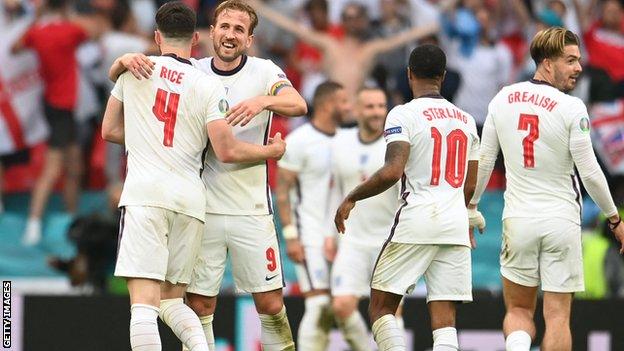
England beat Germany in a knockout match for the first time since 1966
Here’s what happened in the second week
Since my last post, Scotland had their little moment with a heroic 0-0 draw with England (sarcasm is the lowest form of wit) before losing to Croatia and exiting the tournament. Their first major tournament in 23 years was over in eight days, and they’d scored just one goal.
Hungary held world champions France to a draw before Germany brought their campaign to life with a 4-2 dismantling of Euro 2016 winners Portugal. On Sunday 20th June the final round of group games began with Switzerland sending Turkey – who some of the pundits had picked as their ‘dark horses’ – home winless, while Italy kept up their 100% record with a narrow victory over Wales. The Welsh didn’t mind, though, as they went through to the last 16 along with the Azzurri.
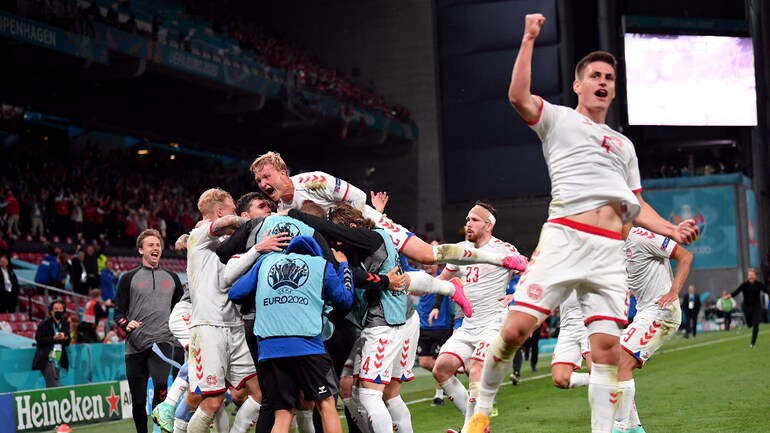
In Group B, a stirring performance from Denmark saw them thrash Russia 4-1 in Copenhagen, marking a delightful fightback from the trauma of Christian Eriksen’s cardiac arrest and sending them through. At one point it looked like Teemu Pukki and Finland might sneak through but their defeat to Belgium coupled with the Danish result brough their first major tournament to an end at the group stage. On the same day in Group C, unfancied Austria found a way into the second round by beating Ukraine, while plucky North Macedonia bowed out to the flying Netherlands.
Denmark were superb in beating Russia 4-1 to make it into the second round
England secured their passage through the group without conceding a goal by beating the Czech Republic at Wembley. Having finished top, they knew they would face the runners up of the feared Group F. The final round of games in that group were thrilling, topsy-turvy affairs – at various stages all four teams occupied second place. Eventually, a pair of 2-2 draws meant that it would be the old enemy Germany who would face England. In the other group, disappointing Poland were knocked out after a 3-2 defeat to Sweden, while Euro 2008 champions Spain reminded everyone what they were capable of with a 5-0 thumping of Slovakia.
With a 24 team tournament moving into a knockout round of 16 sides, only 8 actually took their leave after the group stage. As well as the top two from each group, the four best third placed sides also got through – Finland and Slovakia were the unfortunate ones to miss out.
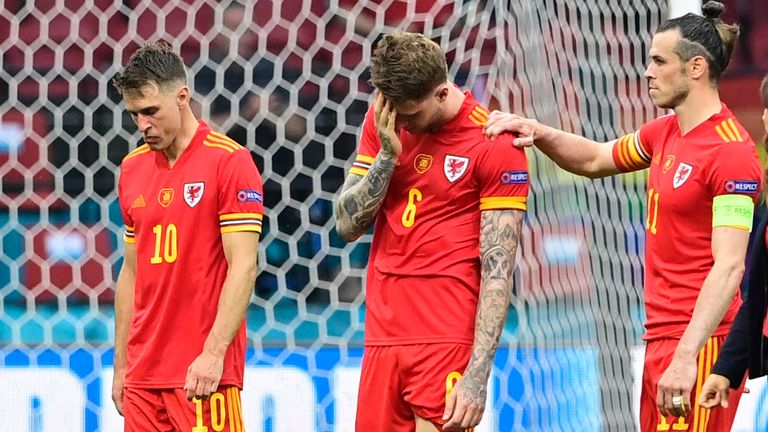
The Welsh are sent packing
Euro 2016 was the first time since the 1958 World Cup that Wales had appeared at a major tournament, and they memorably made it all the way to the semi-finals before being beaten by the eventual winners Portugal. Having got through the group stage the Welsh had hopes of emulating that achievement. Denmark, however, had other ideas and on a chastening evening in Amsterdam ran out 4-0 winners. The scoreline was a tad harsh (it was only 2-0 until the 88th minute, and Wales received a very dubious red card in stoppage time) but it was a sad end for a proud nation. Their captain and talisman Gareth Bale was rather rudely asked on the pitch immediately afterwards if he would be retiring from international football – the 31-year-old decided the question wasn’t worthy of an answer and simply walked away.
It took Italy extra time to finally overcome Austria. Former Stoke and West Ham striker Marko Arnautovic thought he had given the underdogs the lead, only for his headed goal to be disallowed by the VAR for offside. Eventually Italy’s quality found a way through and they scored twice in the extra time period, though they did concede their first goal of the tournament with six minutes to go. Austria couldn’t find an equaliser but left Euro 2020 with their heads held high.
It was a bad day for Gareth Bale and Wales as they were knocked out by Denmark
The Dutch despair and the champions bow out
The Netherlands were the favourites going into their last 16 tie with the Czech Republic. Having failed to qualify for both Euro 2016 and the 2018 World Cup, the Oranje had been a welcome addition to the tournament. However, in a cagey game, it was the red card shown to centre half Matthijs de Ligt in the second half that gave the Czechs the impetus. The referee, with the help of VAR, decided that de Ligt’s handball had denied a clear goalscoring opportunity. The Juventus player was sent off, the Czechs scored twice and the Dutch were out.
Also on their way out were defending champions Portugal, who were beaten by Belgium in a game far more entertaining than the 1-0 scoreline suggests. Half time was approaching when Thorgan Hazard – brother of Eden – curled in from outside the box. Despite their best efforts in the second half, the Portugese couldn’t find a way back, and you have to wonder if Cristiano Ronaldo – who will be 39 by the time of the next one in 2024 – has played his last match at a Euros.
Manic Monday
If there is a more exciting day of this tournament than Monday 28th June it would have to be really special. The first game saw 2018 World Cup finalists Croatia take on Spain, and it looked like the Spaniards had sealed their place in the quarter finals with a 77th minute goal from Manchester City’s Ferran Torres putting them 3-1 up. The Croatians weren’t about to give up, however, and a 92nd minute equaliser from Mario Pasalic took it into extra time. You might have thought the momentum would be with Croatia after that but, alas, Spain scored twice in the first period of extra time to finally win 5-3.
The second match of the day, between France and Switzerland in Bucharest, had a lot to live up to – and it did. Haris Seferovic gave the Swiss a shock lead fifteen minutes in, and they were still leading into the second half when they were awarded a penalty. Defender Ricardo Rodriguez took it, but the chance to give his side an astonishing 2-0 lead went begging as Hugo Lloris of Spurs saved his spot kick. Within four minutes of that failure to convert the penalty, France were in the lead. Karim Benzema – not a nice man – scored twice as the world champions started to show why they were most people’s favourites for the tournament. With fifteen minutes remaining, a fantastic strike from Manchester United midfielder Paul Pogba seemed to put the tie beyond doubt.
Switzerland pulled one back through Seferovic’s second headed goal of the game, and then in the 90th minute substitute Mario Gavranovic finished superbly to spark wild scenes of celebration. It was 3-3, and just like Croatia v Spain, the game was going into extra time. Unlike Croatia v Spain, neither side could find a goal in the additional 30 minutes and so the first penalty shootout of Euro 2020 was upon us. Switzerland scored all five of theirs. France scored their first four, but their superstar Kylian Mbappe had his saved by goalkeeper Yann Sommer to seal a remarkable victory for the Swiss. In the space of two days the defending European champions, the World Cup winners and the World Cup runners up had all been knocked out.
Yann Sommer saves Kylian Mbappe’s penalty to send France home
England finally beat Germany in a knockout match
The German football team is not what it once was. Having won the 2014 World Cup, they were eliminated at the semi-final stage of Euro 2016 by France and suffered an embarrassing group stage exit at the 2018 World Cup, losing to Mexico and South Korea. In the run up to this tournament they had been beaten at home by North Macedonia and thrashed 6-0 by Spain. But they are still Germany, and England hardly ever seem to beat Germany when it matters. The last time they had managed to do it in a knockout match was the 1966 World Cup final. England’s exits at Italia ’90, Euro ’96 and the 2010 World Cup had all come at the hands of the Germans. Despite possessing the best squad of players in years it just didn’t feel like it could possibly happen for England.
Well then. At a raucous Wembley containing 45,000 fans, the home side showed their opponents plenty of respect in the first half, being very cautious at the back and hardly venturing forward. On the stroke of half time, a tackle on Raheem Sterling saw the ball loop towards Harry Kane to the left of the German net. The England captain was presented with a golden opportunity to score his first goal of the tournament, but his attempt to take the ball past keeper Manuel Neuer gave defender Mats Hummels the time to put in a crucial tackle. With 75 minutes on the clock, thoughts were already drifting to the prospect of a penalty shootout. But the introduction of Jack Grealish as a substitute had made England more of a threat going forward, and the Aston Villa man laid the ball off for Luke Shaw to drill it across the box, where Sterling was waiting to tap in. Wembley has rarely been louder. England were in front and with less than a quarter of an hour to go.
Sterling very nearly went from hero to zero as a careless pass backwards allowed Chelsea’s Kai Havertz to put Thomas Muller through on goal. Muller has often been a thorn in the English side but on this occasion he rolled his shot just wide of Jordan Pickford’s right hand post. ‘That never happens!’ bellowed BBC commentator Guy Mowbray. Written in the stars? Maybe. Shortly afterwards, Grealish found himself in a crossing position and played the perfect ball onto the forehead of Kane, who expertly guided it into the ground. The ball bounced up, out of the reach of Neuer and into the net. After a few seconds where no one could believe what they were seeing, the celebrations reached another level as it dawned on us that, this time, it was happening. Germany had no time to make a comeback. England had beaten them in a knockout game for the first time in 55 years.
The fans inside Wembley marvel at England’s victory over Germany
England would play the winners of the game that kicked off later that evening between Sweden and Ukraine. Manchester City left back Oleksandr Zinchenko put Ukraine ahead with a thumping finish but Emil Forsberg equalised for Sweden before half time. There were no goals in the second half so extra time was needed – the fourth of the eight knockout matches to go to the additional half an hour. Sweden’s Marcus Danielson was sent off in the first period for a nasty tackle on striker Artem Besedin, a tackle which has since ruled the Ukrainian out for six months. Extra time was an awfully scrappy, stop-start affair which by the end of it saw Ukraine looking like the walking wounded. Just as penalties looked nailed on, Artem Dovbyk headed in an excellent Zinchenko cross to win it for Ukraine and break Swedish hearts.
The Italians look like the real deal
After a two day break, the quarter finals got underway with Switzerland taking on Spain in St Petersburg. Spain took an early lead when Jordi Alba’s half volley from a corner was deflected in by the unfortunate Swiss midfielder Denis Zakaria. The Spaniards created plenty of chances but couldn’t add to their advantage against a dogged Switzerland side. Liverpool’s Xherdan Shaqiri equalised in the 68th minute, and despite Remo Freuler being shown a straight red card for a bad tackle thirteen minutes from time, the Swiss held out to take the game all the way to penalties. Sergio Busquets hit the post with the first Spanish penalty, giving Switzerland hopes of repeating their epic victory over France four days earlier, but they missed three of their spot kicks to give Mikel Oyarzarbal the opportunity to put Spain into the semi-finals.
Later on, a pulsating first half saw Italy go in at the break 2-1 up against Belgium, ranked number one in the world. Nicolo Barella and Lorenzo Insigne scored excellent goals to give their side a two goal advantage, but a penalty in first half stoppage time from Romelu Lukaku kept the Belgians in it. To some surprise there were no goals in the second half but there was some superb football on display from both sides. Italy have been tight at the back, with elder statesmen Giorgio Chiellini (36) and Leonardo Bonucci (34) in the centre, and thrilling to watch going forward. Federico Chiesa seems to shoot every time he gets the merest glimpse of the goal, and this performance really set Italy out as the favourites to go on and win the tournament. As for Belgium, their much vaunted ‘golden generation’ are left trophyless once more, and with an ageing squad and manager Roberto Martinez leaving their chance to win something may have passed them by.
So there we have it – you are now up to date with Euro 2020. As I write this it’s Saturday afternoon and the other two quarter finals, Czech Republic v Denmark and England v Ukraine, are a few hours away. The next time I write one of these will (hopefully) be just before the final. It’s been a brilliant tournament. What has it got left in store for us?
We are now one week into Euro 2020 – and, yes, it is still called Euro 2020 despite being delayed a year by the pandemic. Probably because UEFA had spent millions on the branding for it. Anyway, with the intention of writing a weekly round up of what’s been going on at the summer festival of football, here we go.
Andrea Bocelli gets everyone in the mood on opening night
The tournament began on Friday night in Rome, where Italy played Turkey. The match was preceded by the opening ceremony, usually a dull and cringeworthy affair, but the tenor Andrea Bocelli superbly belted out ‘Nessun dorma’ while fireworks lit up the stadium around him and suddenly everyone was in the mood. Italy won 3-0, and backed it up with the same scoreline against Switzerland to mark their return to the major tournament stage having failed to qualify for the 2018 World Cup.
Andrea Bocelli got Euro 2020 off to a bang in Rome
Christian Eriksen puts everything into perspective
On Saturday, Denmark played Finland in Copenhagen. I was mainly watching that match to see how Norwich’s Finnish striker Teemu Pukki was getting on, but surely before half time I saw things I will never forget. Danish midfielder Christian Eriksen, their most famous player and one of Tottenham’s best players before he left for Inter Milan last year, collapsed with no one near him. You can always tell when something bad has happened to a player on a football pitch, as the others on the field will react with shock and wave their arms towards the dugouts, pleading for the medical staff to hurry up.
Thanks to some rather insensitive camera work by the host broadcaster (that the BBC later had to apologise for, despite it not being their fault), I saw more of Eriksen’s plight than I wanted to. At one point I could see his face, eyes open but expressionless, and then the medics doing CPR on him. I was reminded of the time Fabrice Muamba collapsed on the pitch at White Hart Lane, a game I was watching with my Saturday night tea in 2012. I had to turn the TV off as I found it too upsetting. I then couldn’t think straight until I’d heard that Eriksen was awake and stable in hospital.
I’m not sure how, but the players managed to come back onto the field and complete the game. Finland won 1-0. Eriksen remains in hospital and it’s hard to imagine him playing professional football again.
Denmark’s shocked players form a human shield around their stricken teammate Christian Eriksen
Good start for the home nations… unless you’re Scottish
Wales were the first of the home nations to play in the tournament, drawing 1-1 with Switzerland in Baku on Saturday afternoon. Had Euro 2020 taken place when it was originally scheduled, the Welsh would have been managed by Manchester United legend Ryan Giggs – but he has been charged with assaulting two women and Robert Page is filling in, temporarily for now. It will take a lot for Wales to match the fairytale run to the semi-finals of five years ago but they already have one foot in the knockout stages after beating Turkey 2-0 in their second game.
England got their campaign underway with a 1-0 win over Croatia at Wembley, who had beaten them in the World Cup semi-finals three years ago. There’s a fair amount of optimism around Gareth Southgate’s side but questions remain about their ability to handle the big games.
Raheem Sterling scored the only goal of the game as England beat Croatia
Scotland haven’t played at a major tournament since the 1998 World Cup and the excitement was palpable going into their opener against Czech Republic in Glasgow, but a 2-0 defeat – the second goal coming from the halfway line – brought them back down to earth. Their next game is on Friday night against England.
The Dutch entertain and Mbappe sends a warning
The most entertaining game of the first week was without a doubt the Netherlands beating Ukraine 3-2 in Amsterdam. The Dutch were 2-0 up and seemingly cruising, but a stunning strike by West Ham’s Andriy Yarmolenko sparked a Ukraine comback only for right back Denzel Dumfries to win it for the Netherlands late on. Similar to Italy, the Oranje have been absent from major tournaments for a while (in their case seven years) and are keen to make the most of being back on the big stage.
Group H is this tournament’s ‘group of death’, containing both the current world champions France and European champions Portugal alongside Germany and Hungary. France met Germany in the first heavyweight clash on Tuesday night. France won 1-0 thanks to a Mats Hummels own goal, but Kylian Mbappe had a goal disallowed for offside and was also denied an assist by VAR. The 22-year-old looks set to take on the title of ‘world’s best player’ once Lionel Messi and Cristiano Ronaldo retire and his performance was a warning to the opposition of what’s to come.
I have mentioned before that films aren’t really my thing. I’m not quite sure why that is. I struggle to suspend my disbelief for 90+ minutes and therefore find it difficult to feel involved in a film (but then I can do that no problem with a TV series), and while the big explosions and huge fight scenes might entertain a lot of people they tend to bore me. Michael Owen gets a lot of stick for feeling this way, but I’m totally with him.
As a result of this, I have seen a very short list of films so far. I was taken to the cinema as a child, mostly to see Disney animations as I recall, but you could name a huge number of ‘classics’ that I’ve never seen a single second of. I saw Blade Runner for the first time last year – purely because it was set in November 2019 and it was appropriately geeky in my eyes to watch it in November 2019. To be honest, I didn’t really see what the fuss was all about.
My favourite film is one that a lot of people probably haven’t heard of. It was released in 2011, following a premiere at the Toronto International Film Festival in September 2010. It’s called Submarine.
Submarine trailer
Submarine is not about submarines. The film is based on a novel by Joe Dunthorne, who wrote most of it while at the University of East Anglia doing a creative writing degree. I read the book after seeing the film and thoroughly enjoyed it – the big screen adaptation stayed remarkably true to the source material, and Dunthorne’s writing style was very readable.
The focus of Submarine is a 15-year-old boy, Oliver Tate, who is something of an outsider. No wonder I can relate to the character. You see, when I was at school there was usually one girl a year that I was completely besotted with. But I never told any of them – I never even tried to speak to them at all. I preferred to admire from afar. Oliver seems to take a similar approach, but plans his attempt to get together with the object of his desires, Jordana Bevan, with military precision.
Jordana Bevan (Yasmin Paige) and Oliver Tate (Craig Roberts) in Submarine
I don’t want to spoil it, I want you to go and watch it, so I won’t go too far into the story but it centres around Oliver and Jordana’s relationship, Oliver’s fears that his mother is having an affair, and Oliver’s reaction to a crisis in Jordana’s family. There are poignant moments but also some very funny ones (‘My mother is worried I have mental problems. I found a book about teenage paranoid delusions during a routine search of my parents’ bedroom.’)
The title is derived from a line in the book, a love letter Oliver sends Jordana, in which he states ‘you are the only person that I would allow to be shrunken down to a microscopic size and swim inside me in a tiny submersible machine’.
Richard Ayoade, who you may know as Moss from The IT Crowd, directed the film and did a fantastic job at rooting it in the book’s 1980s setting. I think it’s the feeling Ayoade creates that seals the deal for me in making this my favourite film.
Richard Ayoade directed the film
So, will you have heard of any of the cast? Well, Oliver is played by Craig Roberts, who first appeared in the kids’ TV show The Story of Tracey Beaker and also turned up in one of the later episodes of Skins. Noah Taylor, who plays Oliver’s father, has been in Game of Thrones and Peaky Blinders, his mother (Sally Hawkins) starred in The Shape of Water, and Jordana’s mother is played by Melanie Walters, best known for playing Stacey’s mum Gwen in Gavin & Stacey.
Submarine often pops up on streaming platforms, though at the time of writing is only available for rental or purchase. Click here for places to get it.
37 days after it began, the Cricket World Cup has reached the end of the group stage and just the two semi-finals and the final are left to be played.
Before it started, I wrote a guide to the tournament and explained why I was so excited about it. This feels like an ideal time to look back at the five weeks of action we’ve seen and ask: has it lived up to the hype?
Rain
The World Cup got going with hosts and favourites England comfortably beating South Africa at The Oval. On day two, everyone was excited about what appeared to be the return of fearsome West Indian fast bowling as Pakistan were bounced out for 105.
On the first Sunday of the tournament, Bangladesh scored 330 against South Africa and successfully defended it to give us the first eyebrow-raising result. So long seen as minnows in the game, Bangladesh are now a competitive outfit in international cricket and look to be getting better and better.
Having beaten Pakistan 4-0 in an ODI series just prior to the World Cup, England would have been expecting to make it two wins from two when the two sides met again at Trent Bridge. However, Pakistan won by 14 runs – despite centuries from Joe Root and Jos Buttler – to give the favourites a reality check.
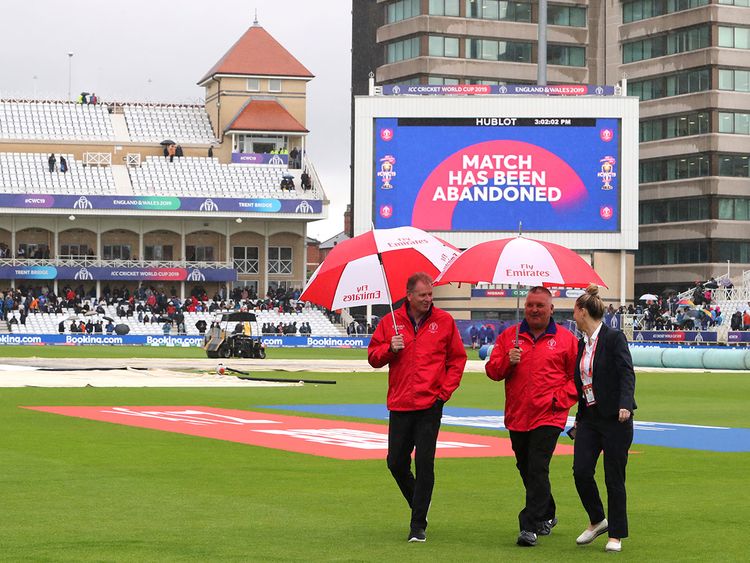
It was in Cardiff, the venue for Afghanistan versus Sri Lanka, where rain first reared its ugly head in the tournament. Having been blessed with the hottest and driest summer for forty years last year, things were very different in 2019 and an unusually wet couple of weeks saw four matches unable to render a result – three of them without a single ball being bowled. During this time, I spent a lot of time arguing with people on the internet who seemed to think that rain was somehow unique to the UK and that we shouldn’t be allowed to host future international tournaments. One of the matches lost to the weather was the fascinating prospect of India against New Zealand.
Rain caused havoc in the early stages of the World Cup
The first thriller
India began their campaign almost a week into it, apparently because they wanted their players to have extra time to rest after their efforts in the Indian Premier League (IPL). Their first match was a comfortable victory over South Africa – a third defeat for the Proteas, which left them teetering on the edge of elimination.
Up to this point, the World Cup had seen many strong individual performances but mostly one-sided games. Under the lights at The Oval, Bangladesh and New Zealand put an end to that. Chasing 245 to win, the Black Caps got over the line with just two wickets to spare. The following day, Australia recovered from 38-4 to set the West Indies 289 to win. Mitchell Starc’s 5-46 saw the holders win by 15 runs.
New Zealand won a close game against Bangladesh at The Oval
England racked up 386-6 against Bangladesh in Cardiff, winning by 106 runs to get back on track after their defeat by Pakistan. India beat Australia by 36 runs after the Australians took a muddled approach to chasing 353, but Aaron Finch’s side bounced back with a victory against Pakistan in Taunton.
England thrashed the West Indies in Southampton, bowling their opponents out for just 212 and chasing it down with more than 16 overs to spare. However, injuries suffered by Jason Roy and captain Eoin Morgan cast a shadow on the result.
India and Pakistan met at Old Trafford. A rivalry that goes way beyond sport, earlier this year there had been a threat that India would boycott the match as political tensions between the two countries escalated. 700,000 applications for tickets had reportedly been made for the game at a ground that holds around 25,000. India won handsomely.
Bangladesh chased 322 with ease to beat the West Indies, Shakib Al Hasan with an unbeaten century – the all rounder had a fine World Cup, amassing more than 500 runs.
England, and Eoin Morgan in particular, had a field day against Afghanistan in Manchester. The skipper hit a record 17 sixes on his way to 148, the hosts posting a total of 397-6 and setting up a 150 run victory. The next day, Edgbaston hosted its first match of the tournament and we were treated to an exciting finish as New Zealand chased 242 in the final over to beat South Africa. New Zealand had been 137-5, but an unbeaten 106 from their captain Kane Williamson and 60 from Colin De Grandhomme saw them home.
England captain Eoin Morgan smashed 17 sixes in his 148 against Afghanistan
Australia saw off Bangladesh in Trent Bridge’s final game, but Bangladesh got within 48 of the Aussie total of 381 to once again show that they are no pushovers.
Blown wide open
The weather had finally dried up and the cricket on show was entertaining, but it did seem like the likely semi-final line up of Australia, England, India and New Zealand was almost inevitable. Cue an English batting collapse.
England had been utterly transformed since the 2015 World Cup, playing aggressive cricket like no other. But against Sri Lanka at Headingley, they came unstuck. Restricting their opponents to a meagre 232-9, everyone was expecting England to sail to victory. They completely fell apart. Veteran Lasith Malinga took 4 wickets, the hosts were bowled out for 212, and suddenly the semi-final places were blown wide open.
Saturday 22nd June provided us with two thrillers. India were held to 224-8 by Afghanistan, but managed to save their blushes by bowling the Afghans out for 213. Afghanistan had fallen 12 short of pulling off the biggest shock in Cricket World Cup history. At Old Trafford, New Zealand set the West Indies 292 to win thanks to another Williamson hundred. It looked comfortable for the Black Caps at 164-7, but an extraordinary rearguard effort from Carlos Brathwaite got the West Indies within touching distance of victory. Needing 6 to win, Brathwaite tried to get it done in one hit but was caught on the boundary by Trent Boult. Brathwaite, who had made 101, sank to his knees and New Zealand had won by 5 runs.
Carlos Brathwaite came agonisingly close to pulling off a stunning victory for the West Indies against New Zealand
Lord’s joined the party on the Sunday and Pakistan took advantage of England’s defeat to Sri Lanka by overcoming South Africa. At the same venue a couple of days later, England were all out for 221 chasing 286 against the old enemy Australia and the prospect of England being knocked out of their own World Cup before the semis became very real. Pakistan dealt New Zealand their first defeat of the tournament the next day to rub salt into English wounds.
Semi-finals take shape
A week on from coming so close to beating India, Afghanistan came agonisingly short once again – this time against Pakistan. Needing 228 to win, Pakistan got there with just 2 balls and 3 wickets to spare. The result put Pakistan into 4th place, above England. Australia skittled New Zealand for 157 to complete an 86 run victory, making it clear that they are the team to beat.
England knew they had to beat India to stay in the race, and credit to them, they did just that. Batting first for a change, they powered their way to 337-7, the returning Jason Roy making 66. Jonny Bairstow made 111 and Ben Stokes finished the innings off with 79. In front of an Edgbaston crowd which was more than 80% India fans, a partnership between Rohit Sharma and Virat Kohli looked ominous but when Kohli was out for 66 the Indians never managed to get the chase back on track and ran out of overs with 32 runs still required. England had a confidence-boosting win, and had set up a huge game against New Zealand in Durham.
Pressure is not usually something that England teams deal with well. In any sport, English sides have a reputation for failing when it matters. So it was to their cricket team’s credit that, faced with having to beat India and New Zealand in succession to resurrect their World Cup campaign and make the semi-finals, they did just that. Winning the toss and batting first again, Jason Roy and Jonny Bairstow showed no nerves as they got off to a fast start. By the time Roy was out for 60, England had 123 on the board inside 19 overs and a platform had been set. They didn’t really capitalise on it, ending up with 305-8, but Bairstow did reach back-to-back hundreds.
New Zealand never really looked like chasing 306. Things were clearly going England’s way when Ross Taylor played the ball straight back from where it had come from, brushing the tip of Mark Wood’s finger on the way to hitting the stumps at the non-striker’s end, where New Zealand’s captain and most dangerous batsman was well short of his ground and therefore run out for 27. The Black Caps were all out for 186. England were through.
A century from Jonny Bairstow helped England qualify for the semi-finals
Another close one for Afghanistan, but another defeat as they finished their World Cup with a 23 run defeat by the West Indies in Leeds. All out for 288 chasing 312, the Afghans will only get better and better but leave the tournament with nine defeats from nine matches.
Pakistan were left bemoaning the use of Net Run Rate to decide league positions after their victory over Bangladesh at Lord’s wasn’t enough for them to take a semi-finals spot. They have a point, it seems odd that in a format in which everyone plays each other head-to-head results are not given greater importance than run rate. But there was nothing they could do about it, so New Zealand claimed the last place in the semis.
The final day of pool stage matches on Saturday 6th July was all about who would finish top of the table. India played in the early match and emphatically saw off Sri Lanka, both of their openers scoring centuries – Rohit Sharma with his fifth of the tournament – as they made light work of chasing 265.
The day/night match was between Australia and South Africa. The South African captain Faf du Plessis made a hundred as they posted a challenging 325-6 from their 50 overs. Despite a century from David Warner and 85 from wicketkeeper Alex Carey, the Aussies were all out on the penultimate ball of the innings ten runs short of their target. The Proteas had finished a disappointing World Cup on a high.
South Africa beat Australia in the last pool stage match
The semi-finals
After 45 matches, we now know the semi-final fixtures:
Tuesday 9th July: India v New Zealand, Old Trafford Thursday 11th July: Australia v England, Edgbaston
Of course, the winners of these two matches will play each other in the final at Lord’s next Sunday, 14th July. There is no third place play-off.
My awards
With the pool stage complete, here are my ‘bests’ of the tournament.
Best match
New Zealand v West Indies at Old Trafford was a great example of the best of ODI cricket. Superb individual performances, a good contest between bat and ball and one side almost pulling victory from the jaws of defeat. Watch the highlights below.
Best catch
This World Cup has been littered with fantastic catches. Martin Guptill plucked one out of the air for New Zealand against Australia. Sheldon Cottrell of the West Indies juggled the ball on the boundary to dismiss Steve Smith. But, for me, the award has to go to Ben Stokes, who took a catch which genuinely took my breath away way back in the first match of the tournament. I play village cricket, and catches like this are an example of how the professionals are superhuman compared to us. Watch the catch below.
Best innings
For the most part, the world’s best players came to the party. From the ‘big four’ – regarded as the best international batsmen in the world – of Virat Kohli, Joe Root, Kane Williamson and Steve Smith, all performed well. But it was the innings of New Zealand captain Williamson against South Africa at Edgbaston, guiding his team home from 137-5 chasing 242 with an unbeaten 106, that personified the notion of a captain’s innings. Watch highlights of the match below.
Most disappointing team
South Africa should have put on a much better show than they did. They looked to have one of the stronger squads, but never really got going. The great fast bowler Dale Steyn was sadly ruled out without bowling a ball, then factors such as muddled team selection and Hashim Amla’s old fashioned batting contributed to their downfall. They laboured to a win against Afghanistan to put their first victory on the board, and it was only when it was too late that they showed what might have been with a thrashing of Sri Lanka and a victory over Australia.
Worst part of the tournament
I thought about giving this award to the concept of someone playing a guitar made out of a cricket bat over the PA system at regular intervals during matches. It sounded horrendous. But the worst part of the World Cup for me has been the weather. Two particularly bad weeks in early June saw four matches called off and really put a halt to the party atmosphere. Thankfully, it has improved significantly since then.
Before the tournament began, I thought Australia, England and India would sail into the semi-finals leaving one place up for grabs. England made rather more hard work of it than I had anticipated, but they are there, and it was New Zealand who join them for what promises to be an exciting final week. It’s almost time to say goodbye to the 2019 Cricket World Cup – will its enduring image be the Aussies being crowned world champions for the sixth time?
For a mad keen cricket fan like me, 2019 is like a birthday and Christmas present rolled into one. The World Cup is being held in England and Wales, with England the favourites to win it, and in August the Ashes start with England and Australia renewing their famous rivalry.
I have friends who may not quite understand much about cricket and why I’m so excited about this year – so I’ve written this for you.
Hosts England are favourites to win the cricket World Cup
When does the World Cup start?
The World Cup is just one week away. It starts on Thursday 30th May when England play South Africa at The Oval in London. The final is on Sunday 14th July at Lord’s.
How does the World Cup work?
There are ten countries playing in the World Cup. That’s not many compared to other sports. Compare it to the last football World Cup – where 32 teams were involved – or the rugby World Cup later this year, which will feature 20 teams.
Those 10 teams are:
Afghanistan Australia Bangladesh England India New Zealand Pakistan South Africa Sri Lanka West Indies
The teams all play each other once, with the top four going through to the semi-finals. There, 1st place will play 4th place and 2nd will play 3rd. Then, of course, the winners of those matches will play in the final.
There will be one match a day (two on Saturdays) between the start of the tournament on 30th May and the conclusion of the group stage on 6th July.
Where are the matches being played?
Ten grounds will host matches in the World Cup, stretching as far north as County Durham and as far south as Hampshire. They are:
The Riverside (Durham) Headingley (Leeds) Old Trafford (Manchester) Trent Bridge (Nottingham) Edgbaston (Birmingham) Lord’s (London) The Oval (London) County Ground (Bristol) Sophia Gardens (Cardiff) County Ground (Taunton) Rose Bowl (Southampton)
The iconic Lord’s will host the cricket World Cup final on 14th July
How can I follow it?
Every single match of the World Cup is live on Sky Sports, so you’ll need to pay to watch it on TV. Now TV is the best way in my opinion – you can buy one of their devices and buy a Sky Sports month pass for £25. Two of those will see you through the World Cup.
Highlights of every match will be on Channel 4.
If you prefer listening to the radio, commentary will be available on the BBC’s famous Test Match Special on Radio 5 Live Sports Extra.
Why are you so excited about it?
This is the first time England have hosted the cricket World Cup since 1999. Back then, I was a nearly-7-year-old who didn’t know what cricket was. England are also the favourites for it, going into the tournament as the number one ranked One Day International (ODI) team in the world.
Australia won the last cricket World Cup in 2015
It’s going to a close run thing, too – out of the ten teams playing, I reckon seven have a genuine chance of winning it. I think Afghanistan, Bangladesh and Sri Lanka will struggle but the other seven will be fighting for the four places in the semi-finals. Even those three I’ve mentioned are capable of causing a few upsets.
I hope you’ve found this guide useful and you might indulge in a bit of cricket over the next eight weeks or so. I’ll be writing about the games you should watch as we go along.
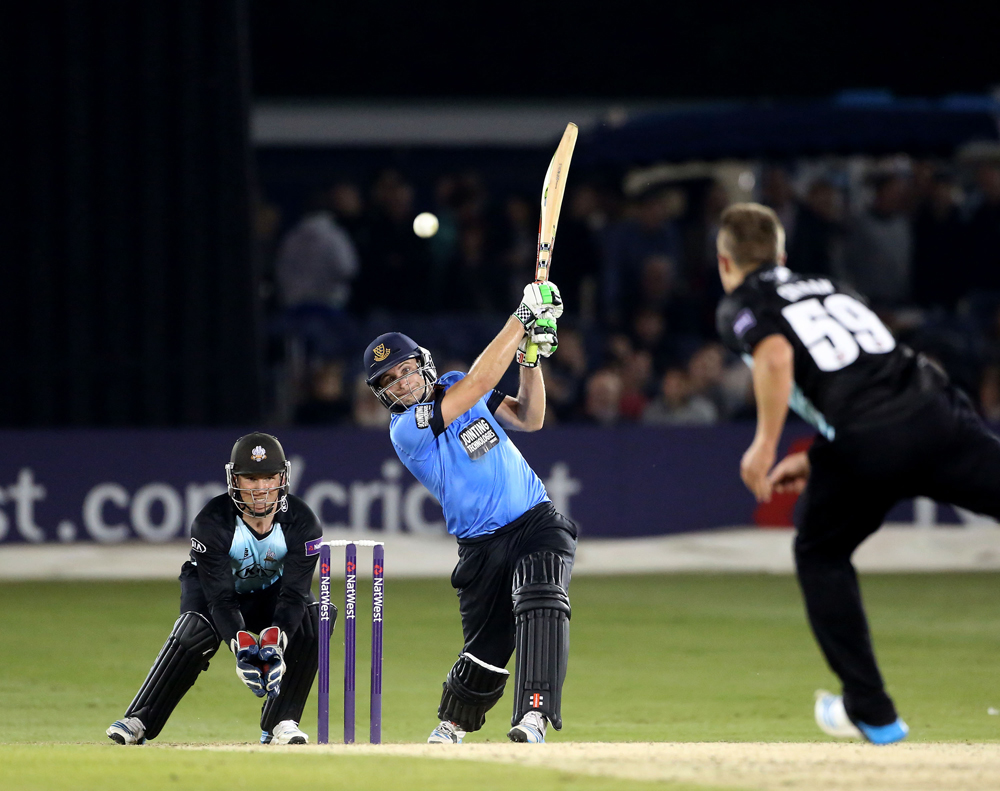
The new Twenty20 tournament would co-exist with the current T20 Blast
The England and Wales Cricket Board have announced a Twenty20 competition to begin in 2020 – their attempt at getting more people interested in cricket.
It has caused controversy, with some saying it will be the beginning of the end for county cricket and others saying it will keep the game alive in the UK.
While the domestic game currently has 18 major counties, the proposed tournament will contain eight teams with squads of 15 players each. The teams will most likely take on the names of the cities they are based in, doing away with Surrey and Yorkshire and perhaps introducing London and Leeds.
This eight team, city-based structure mirrors the hugely successful Big Bash in Australia and the Indian Premier League.
The plan is for 36 matches to be played over 38 days in the school summer holidays, and for 8 of those matches to be live on free-to-air TV.
The timing of the tournament could help to attract the best players in the world to it, as only England play regular international cricket at that time of year. Squads may miss England players but will be allowed 3 overseas stars.
Here are a few thoughts I have about this proposal.
County cricket is dying anyway
The County Championship, the oldest and purest cricket championship, has been attended by almost nobody for decades. Counties have a few die-hard members, and some of them will get a few spectators in at the height of the holiday season, but other than that matches are played in front of empty grounds, rendering the four-day competition next to pointless. The Twenty20 tournament is not threatening to end the Championship, but might make enough money to keep it alive. Each county has been promised £1.3 million as part of the proposal.
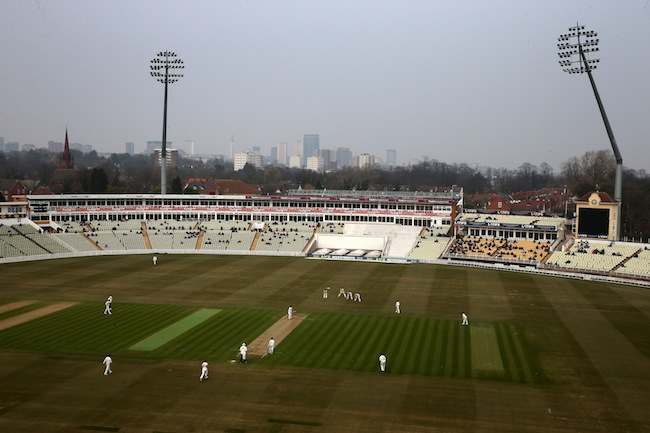
A County Championship match takes place in front of not many people at Edgbaston
Will enough matches be on free-to-air TV?
English cricket has not been live on free-to-air TV since 2005. Since the ECB made the game available only to people who could afford a Sky Sports subscription the number of schoolchildren getting into cricket has dropped dramatically. They know they made a mistake, and while they can’t do anything about it until the end of the current rights deal in 2019, they have ringfenced 8 of the 36 matches for FTA TV in the proposal. I wonder, is that enough? Will it be eight of the early league fixtures, making it difficult to follow, or will it include the semi-finals and the final? Only time will tell, but it seems you’re still going to need a pay TV subscription to have much of an idea of what’s going on.
Two Twenty20 tournaments could mean overkill
The ECB are not proposing to replace the current T20 Blast with this city-based tournament – they intend for them to co-exist. This year, the T20 Blast (which does feature all 18 counties) will take place over seven weeks. The new tournament would be planned to start almost immediately after the Blast – I have a feeling even a massive cricket fan like me could get fed up of watching Twenty20 after 12 solid weeks of it.
While there are questions to be answered, I think overall this is a positive step from the ECB and a genuine attempt to inject new life into cricket in this country. They’ve got three years to get it ready – the future of the sport could depend on them getting it right.












 LEE PAYNE